
Think the letter G always makes a sound? Think again! In many English words, the G is completely silent, leaving learners wondering why it’s even there. In this guide, you’ll discover the most common silent G words, simple pronunciation rules, plenty of real-life examples, and fun quizzes to help you pronounce these tricky words with confidence.
What Is a Silent G?
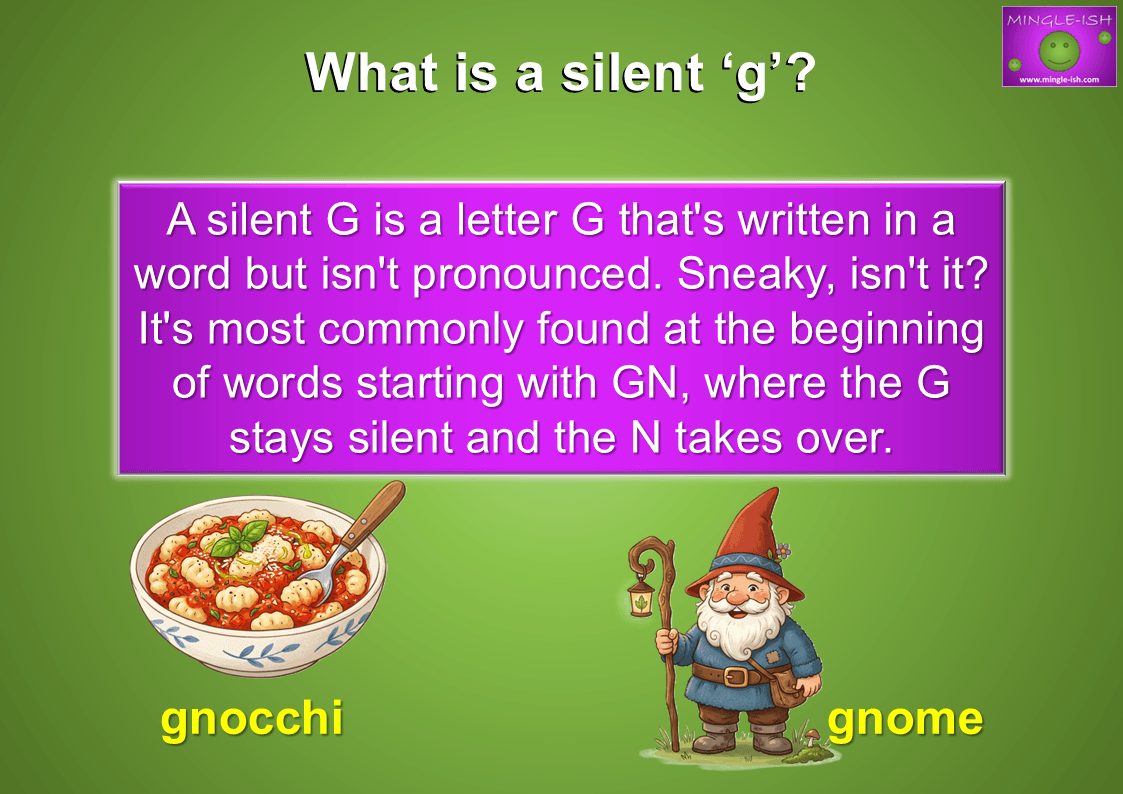
A silent G is a letter G that’s written in a word but isn’t pronounced. Sneaky, isn’t it? It’s most commonly found at the beginning of words starting with GN, where the G stays silent and the N takes over. There isn’t one rule that covers every word, but once you learn the common spelling patterns, silent G words become much easier to recognise and pronounce.
Silent G Pronunciation Rules
Silent G at the Beginning of Words
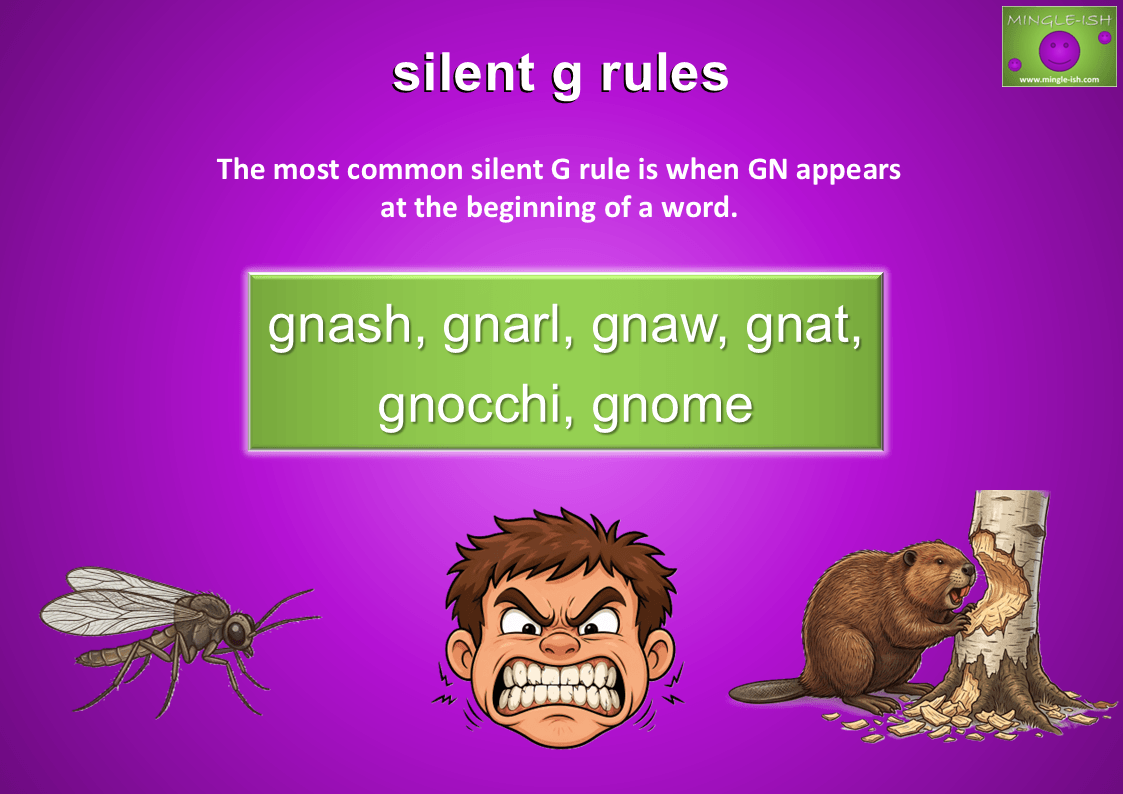
The most common silent G rule is easy to remember. When a word begins with GN, the G usually stays completely silent, leaving the N to do all the hard work.
Think of it as the G turning up to the word… and then saying absolutely nothing!
Common examples include:
- gnash
- gnarl
- gnaw
- gnat
- gnocchi
- gnome
Silent G at the End of Words (GN)
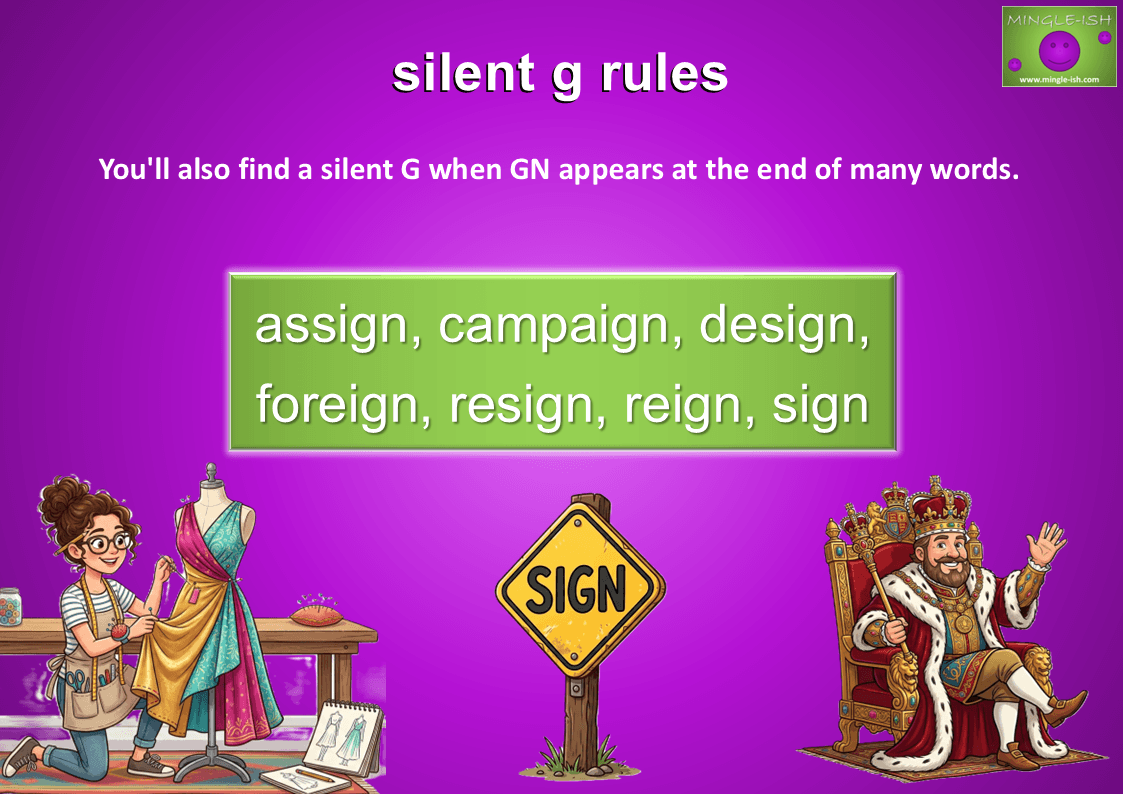
You’ll also find a silent G when GN appears at the end of many words. Just like at the beginning of words, the G isn’t pronounced, so you only hear the N sound.
Common examples include:
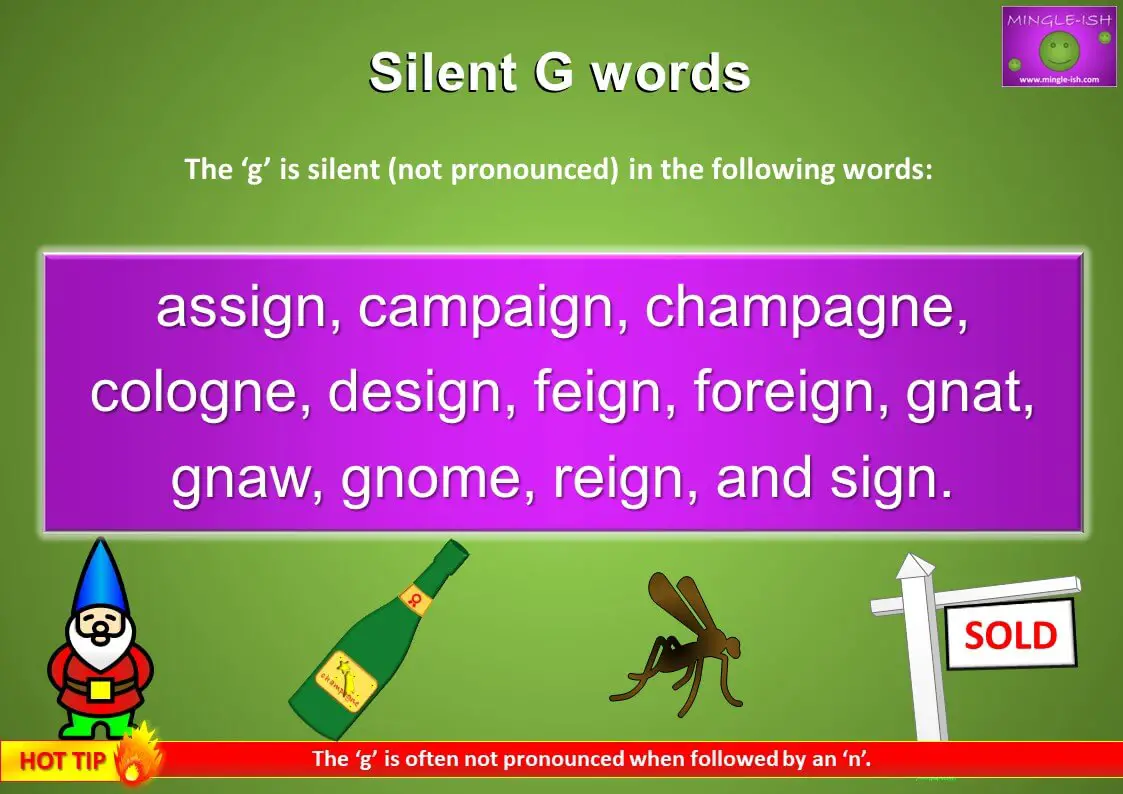
- assign
- campaign
- design
- foreign
- resign
- reign
- sign
Is There a Rule?
While there isn’t a perfect rule, there is a useful pattern you can remember.
Many English words ending in -gn come from Latin or French. As these words entered English, the spelling stayed the same, but the pronunciation changed over time. The result? The G became silent.
For example:
- sign comes from the Latin word signum.
- design comes from the French dessigner (and ultimately Latin).
- campaign comes from the French campagne.
- foreign comes from Old French forain.
The good news is that if you see -gn at the end of a common English word, there’s a good chance the G will be silent.
Watch out for related words
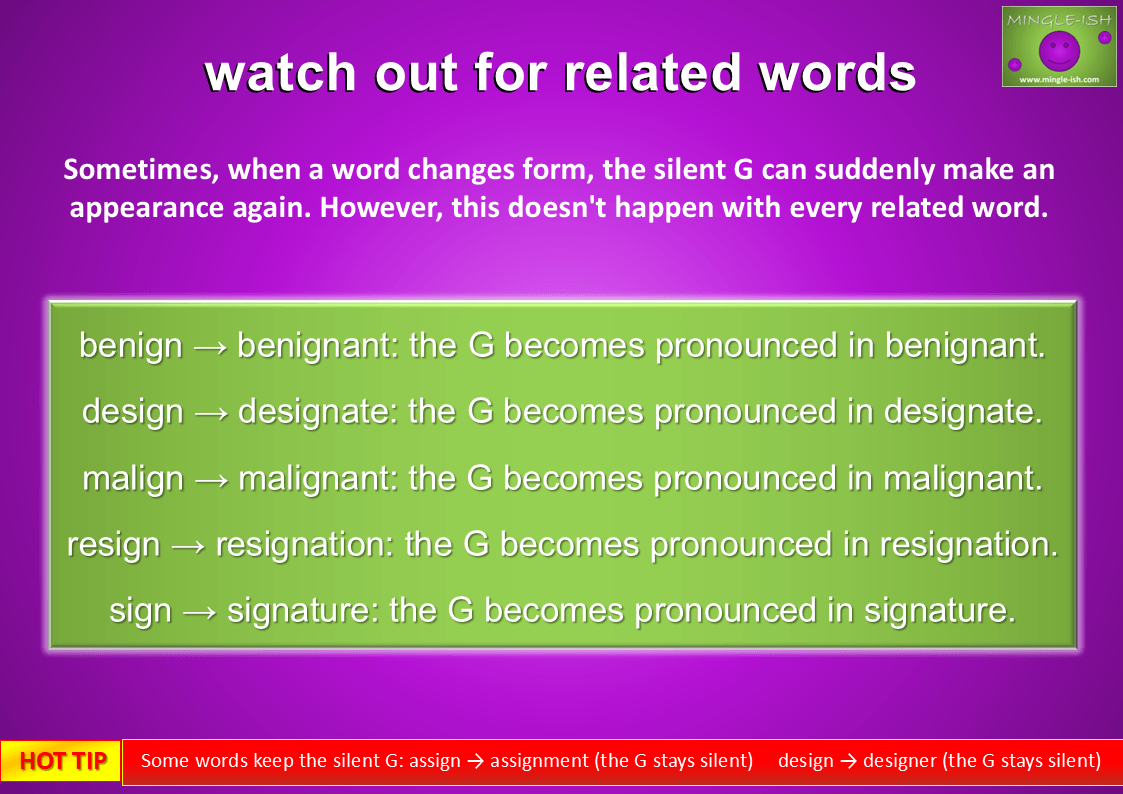
Here’s where English likes to keep us on our toes! Sometimes, when a word changes form, the silent G can suddenly make an appearance again. However, this doesn’t happen with every related word, so there isn’t a simple rule to follow.
For example, these word families bring the G sound back:
- benign → benignant: the G becomes pronounced in benignant.
- design → designate: the G becomes pronounced in designate.
- malign → malignant: the G becomes pronounced in malignant.
- resign → resignation: the G becomes pronounced in resignation.
- sign → signature: the G becomes pronounced in signature.
However, don’t assume that every word with a suffix will bring the G back. Some words keep the silent G sound:
- assign → assignment (the G stays silent)
- design → designer (the G stays silent)
So, when you see GN at the end of a word, the G is usually silent. But when you meet a related word, the pronunciation may change, so learning words as part of a family can help you remember when the G makes a comeback!
Silent G Before N in the Middle of Words
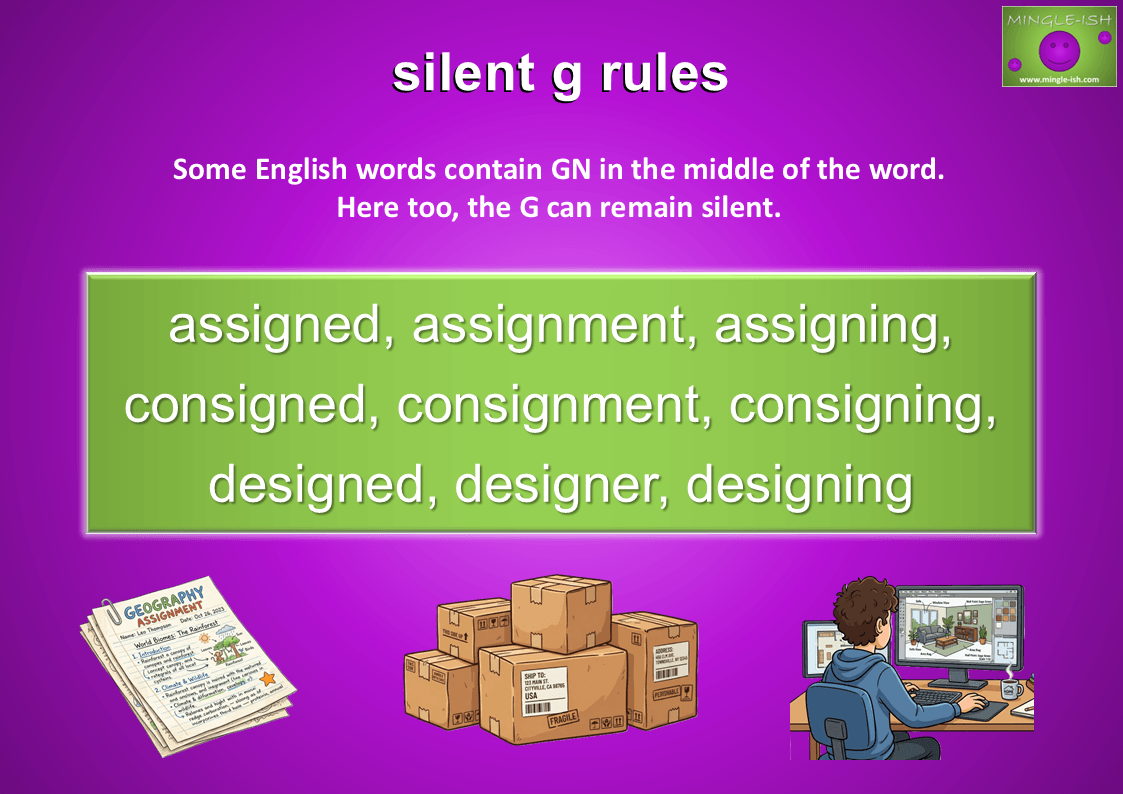
Some English words contain GN in the middle of the word. Here too, the G can remain silent.
Examples include:
- assigned
- assignment
- assigning
- consigned
- consignment
- consigning
- designed
- designer
- designing
Notice how these words are related to assign, consign, and design, so the silent G is retained even though extra letters have been added.
Common Silent G Words
Ready to meet some of English’s sneakiest words? The letter G may be hiding in the spelling, but it stays completely silent. Here are some common silent G words, along with their pronunciation and meaning.
| Word | Pronunciation | Meaning | Example Sentence |
|---|---|---|---|
| align | /əˈlaɪn/ | To put things into the correct position or line. | We need to align the pictures on the wall so they are straight. |
| assign | /əˈsaɪn/ | To give someone a task or responsibility. | My manager will assign me a new project next week. |
| benign | /bɪˈnaɪn/ | Gentle, harmless, or not dangerous. | The doctor said the lump was benign and nothing to worry about. |
| campaign | /kæmˈpeɪn/ | A planned series of activities to achieve a goal. | The charity launched a campaign to help homeless people. |
| champagne | /ʃæmˈpeɪn/ | A type of sparkling wine. | They opened a bottle of champagne to celebrate their anniversary. |
| consign | /kənˈsaɪn/ | To give something to someone for a particular purpose. | She decided to consign her old clothes to a local shop that sells second-hand items. |
| design | /dɪˈzaɪn/ | To plan or create something. | He helped design the new kitchen in their house. |
| foreign | /ˈfɒrən/ | From another country. | She enjoys learning about foreign cultures and traditions. |
| gnash | /næʃ/ | To grind or clench your teeth together. | He tends to gnash his teeth when he is stressed. |
| gnat | /næt/ | A tiny flying insect. | A gnat flew into my drink while I was sitting outside. |
| gnaw | /nɔː/ | To bite or chew something repeatedly. | The puppy likes to gnaw on its favourite toy. |
| gnocchi | /ˈnjɒki/ | Small Italian potato dumplings. | I made a bowl of gnocchi with tomato sauce for dinner. |
| gnome | /nəʊm/ | A mythical creature often shown wearing a pointy hat. | My neighbour has a garden gnome sitting beside the flowers. |
| malign | /məˈlaɪn/ | To say harmful or unfair things about someone. | It is unfair to malign someone without knowing the full story. |
| reassign | /ˌriːəˈsaɪn/ | To give someone a different task or role. | The company decided to reassign her to a different department. |
| reign | /reɪn/ | The period during which a king or queen rules. | Queen Elizabeth II’s reign lasted for more than 70 years. |
| resign | /rɪˈzaɪn/ | To officially leave a job or position. | He decided to resign from his job and look for a new career. |
| sign | /saɪn/ | A symbol, notice, or signal that gives information. | I saw a sign telling drivers to slow down. |
| sovereign | /ˈsɒvrɪn/ | A king, queen, or supreme ruler. | The sovereign opened the new hospital during an official visit. |
| unsigned | /ʌnˈsaɪnd/ | Not signed or without a signature. | The contract is still unsigned, so the deal is not complete yet. |
Common Pronunciation Mistakes
Silent G words can be a little sneaky! One of the biggest mistakes learners make is seeing the G and automatically pronouncing it. But in these words, the G is silent and should simply be ignored.
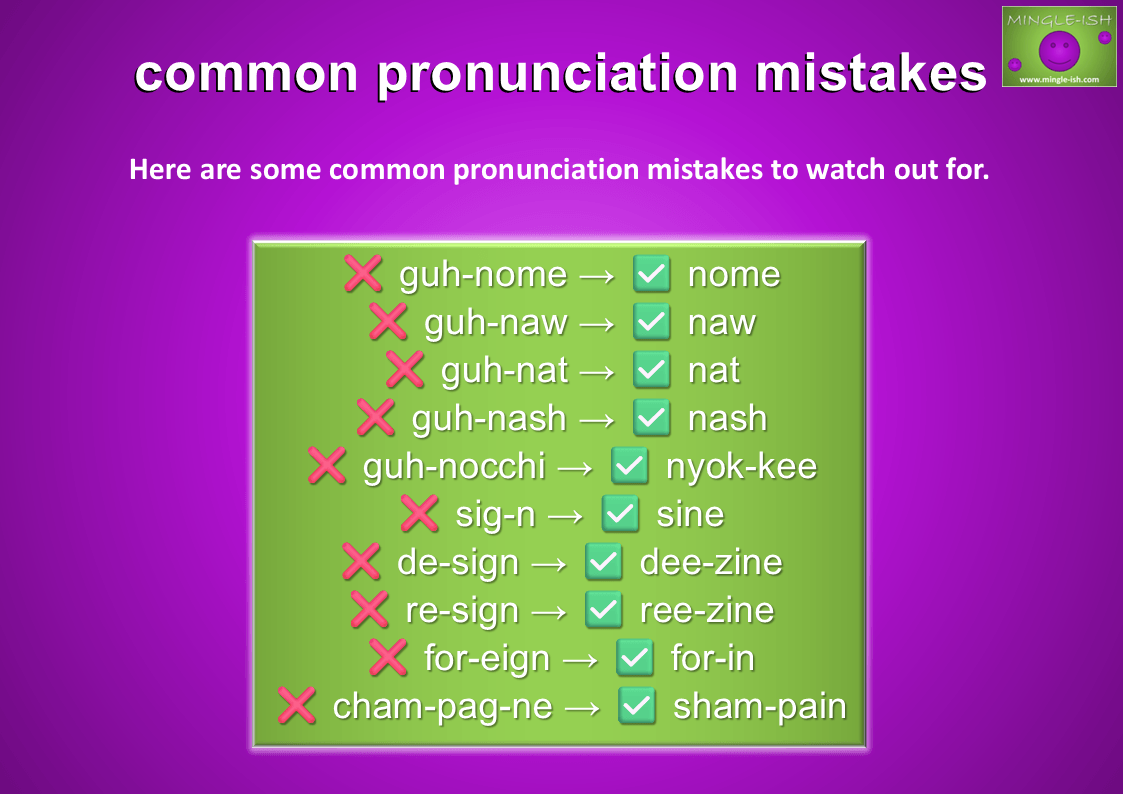
Here are some common pronunciation mistakes to watch out for:
- ❌ guh-nome → ✅ nome
- ❌ guh-naw → ✅ naw
- ❌ guh-nat → ✅ nat
- ❌ guh-nash → ✅ nash
- ❌ guh-nocchi → ✅ nyok-kee
- ❌ sig-n → ✅ sine
- ❌ de-sign → ✅ dee-zine
- ❌ re-sign → ✅ ree-zine
- ❌ for-eign → ✅ for-in
- ❌ cham-pag-ne → ✅ sham-pain
The trick is simple: don’t let the spelling trick you! When you see a silent G, ignore it and focus on the sounds that are actually spoken. Once you recognise the patterns, words like gnome, sign, and design become much easier to pronounce.
Why Is the G Silent?
Ever wondered why English puts a G in some words and then decides not to pronounce it? The answer goes back hundreds of years to the history of the language. Silent G words come from different origins. Some, like gnaw, come from Old English and Germanic languages, where the G was once pronounced. Others, such as sign and gnome, entered English through Latin, French, or Greek and followed different spelling and pronunciation patterns.
Over time, English pronunciation changed, and people naturally began dropping sounds to make words quicker and easier to say. In many cases, the spelling stayed the same even though the pronunciation changed, leaving us with words like gnaw, gnome, and sign. These words are like tiny language fossils, giving us clues about how English has evolved over the centuries. The G may be silent now, but it still has a story to tell!
Conclusion
Silent G words might seem confusing at first, but once you recognise the common patterns, they’re much easier to pronounce correctly. In many cases, the G is silent before N, at the end of certain words, or because the word has been borrowed from another language. Although there are a few exceptions, learning the rules and practising common examples will help you speak English more naturally and confidently. Keep listening, keep practising, and before long, silent G words will become second nature.
More English Pronunciation Lessons
Want to improve your English pronunciation even more? English has plenty of tricky sounds and spelling patterns, but once you understand the rules, things become much easier.
Explore more pronunciation lessons:
- Silent Letters – Learn more about letters that appear in spelling but disappear when we speak.
- Homophones – Discover words that sound the same but have different meanings and spellings.
- Difficult English Words – Practise some of the most commonly mispronounced words.
- Word Stress – Learn which syllables to emphasise for clearer pronunciation.
- Glottal Stop – Understand this common sound used by many native English speakers.
Prefer learning through videos? Visit my YouTube channel for more English lessons, pronunciation practice, and fun quizzes to help you learn.
Keep practising, and remember: English pronunciation can be tricky, but every pattern gets easier with practice.