
Welcome to our guide to the silent ‘gh’! Have you ever looked at a word such as night or though and wondered why those two letters are there if you don’t actually pronounce them? English spelling certainly likes to keep us on our toes!
In this lesson, we’re exploring words where ‘gh’ is silent, the patterns that can help you recognise them and a few exceptions to watch out for. So, let’s get started!
Introduction to silent letters in English
A silent letter is a letter in a word that is not pronounced when the word is spoken aloud. It remains in the spelling, even though you cannot hear it.
Silent letters can make English spelling and pronunciation a little confusing. They often reflect the history of a word, including changes in pronunciation over hundreds of years.
In this lesson, we’ll be specifically focusing on the silent letter combination ‘gh’.
What is a Silent GH?
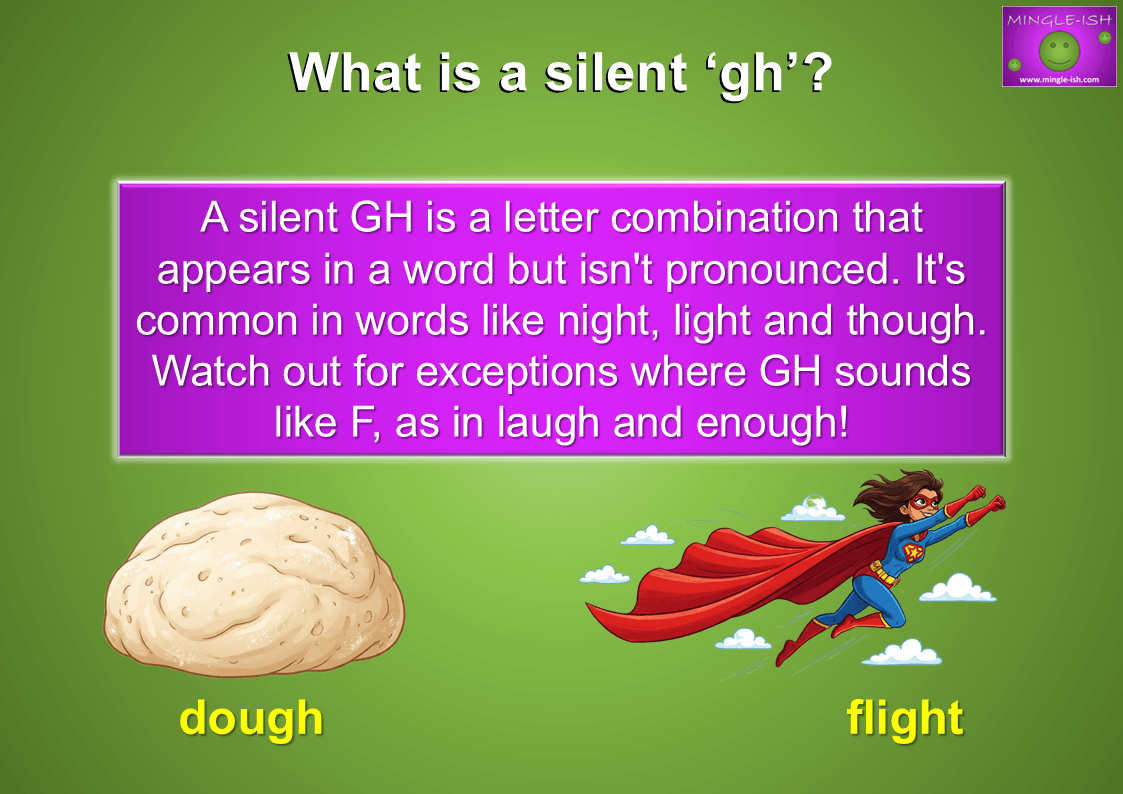
A silent GH is a letter combination that appears in a word but isn’t pronounced. Sneaky, isn’t it? It’s commonly found in words such as night, light and though, where both the G and the H remain silent. There isn’t one rule that covers every word, but once you learn the common spelling patterns, silent GH words become much easier to recognise and pronounce. Just watch out for exceptions, as GH can sometimes sound like an F, as in laugh and enough!
Common words with silent GH
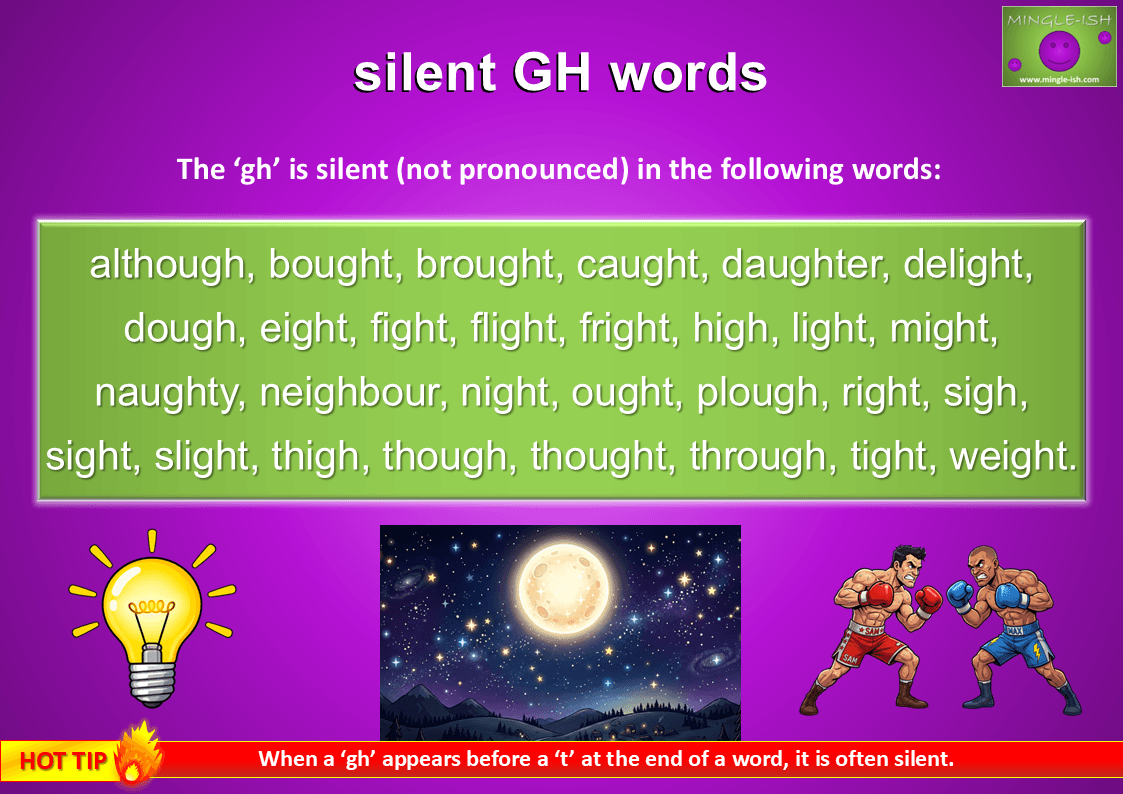
There are many English words containing ‘gh’ where neither letter is pronounced. You may already use some of these every day without realising that those two letters are silent!
Here are some common examples:
- although
- bought
- brought
- caught
- daughter
- delight
- dough
- eight
- fight
- flight
- fright
- high
- light
- might
- neighbour
- night
- naughty
- ought
- plough
- right
- sight
- sigh
- slight
- thigh
- tight
- thought
- though
- through
- weight
Did you spot any surprises? Let’s look at some of the patterns that can help you identify words with a silent ‘gh’.
Silent GH rules and patterns
There isn’t one simple rule that explains every word containing ‘gh’. However, there are some common spelling patterns that can help you recognise when these letters are silent.
When GH follows ‘i’
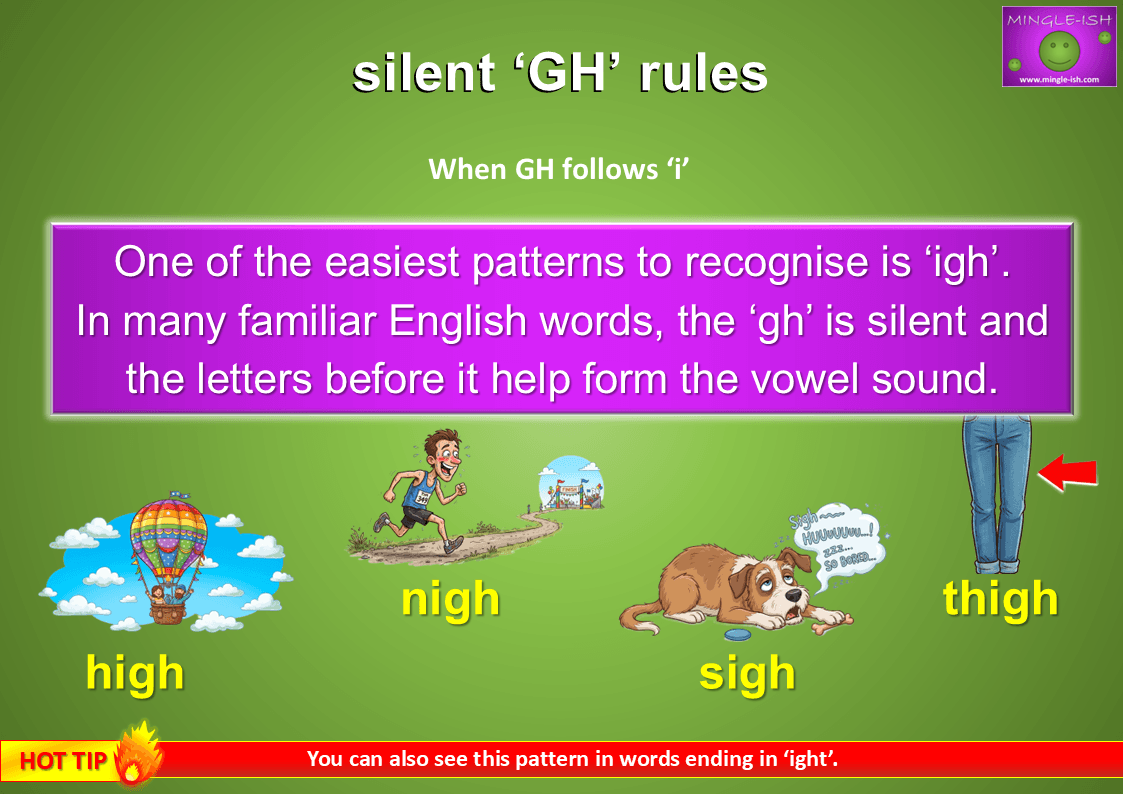
One of the easiest patterns to recognise is ‘igh’. In many familiar English words, the ‘gh’ is silent and the letters before it help form the vowel sound.
For example:
- high
- nigh
- sigh
- thigh
You can also see this pattern in words ending in ‘ight’.
When GH appears in words ending in ‘IGHT’
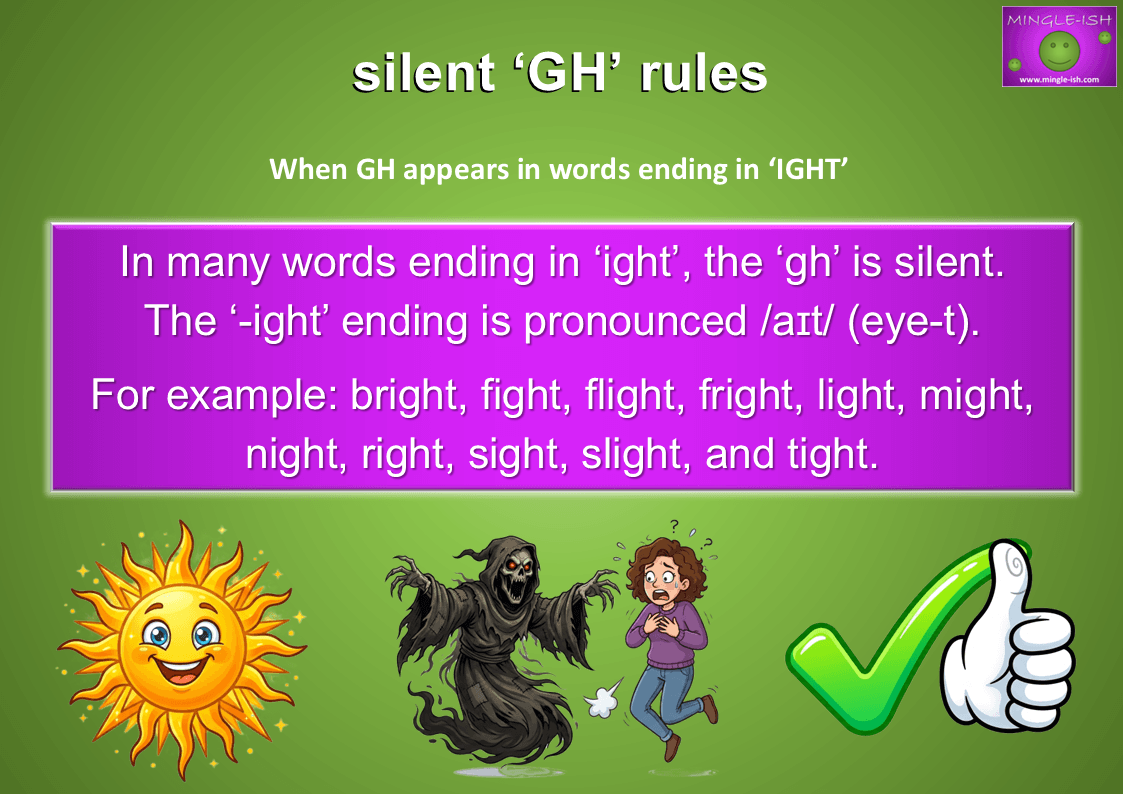
In many words ending in ‘ight’, the ‘gh’ is silent. The ‘-ight’ ending is pronounced /aɪt/ (eye-t).
For example:
- bright
- fight
- flight
- fright
- light
- might
- night
- right
- sight
- slight
- tight
Notice how the spelling stays the same, but the ‘gh’ doesn’t make a sound at all.
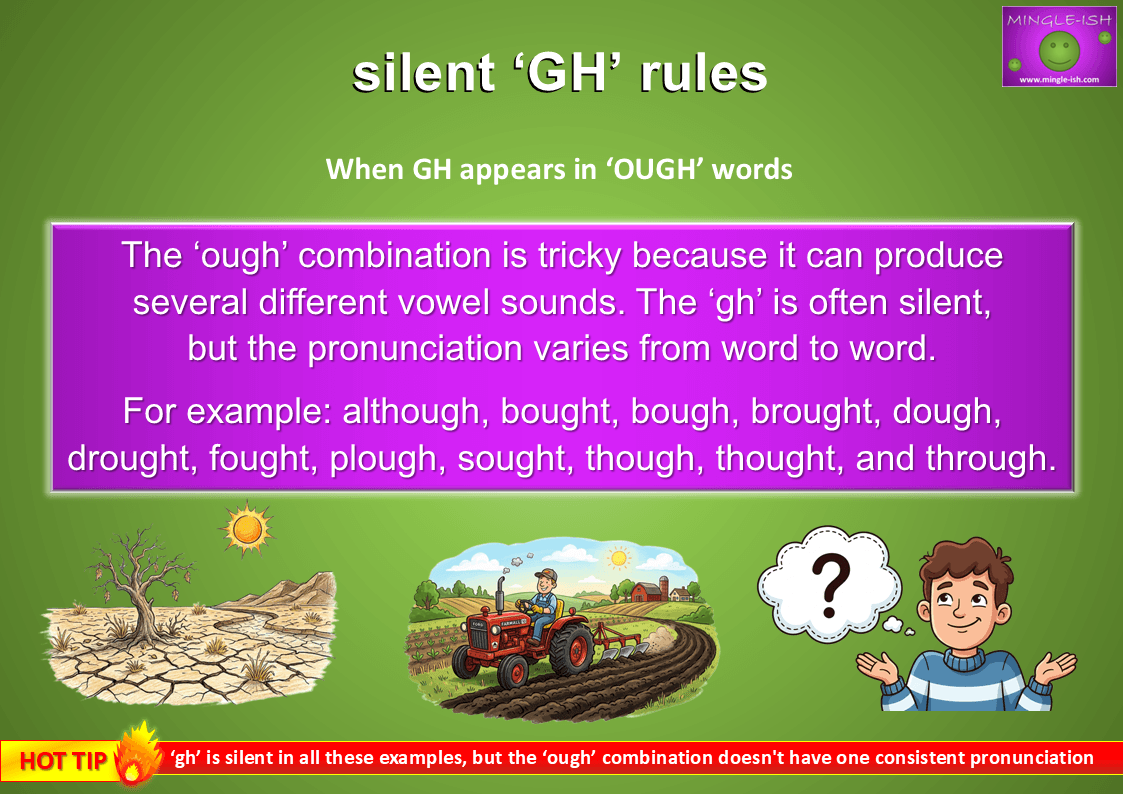
When GH appears in ‘OUGH’ words
The combination ‘ough’ is particularly tricky because it can produce several different vowel sounds in English. In many words, the ‘gh’ is silent, but the pronunciation of the whole word changes.
For example:
- although
- bought
- bough
- brought
- dough
- drought
- fought
- plough
- sought
- though
- thought
- through
The important thing to remember is that ‘gh’ is silent in all these examples, but the ‘ough’ combination doesn’t have one consistent pronunciation.
When GH appears in ‘AUGH’ words
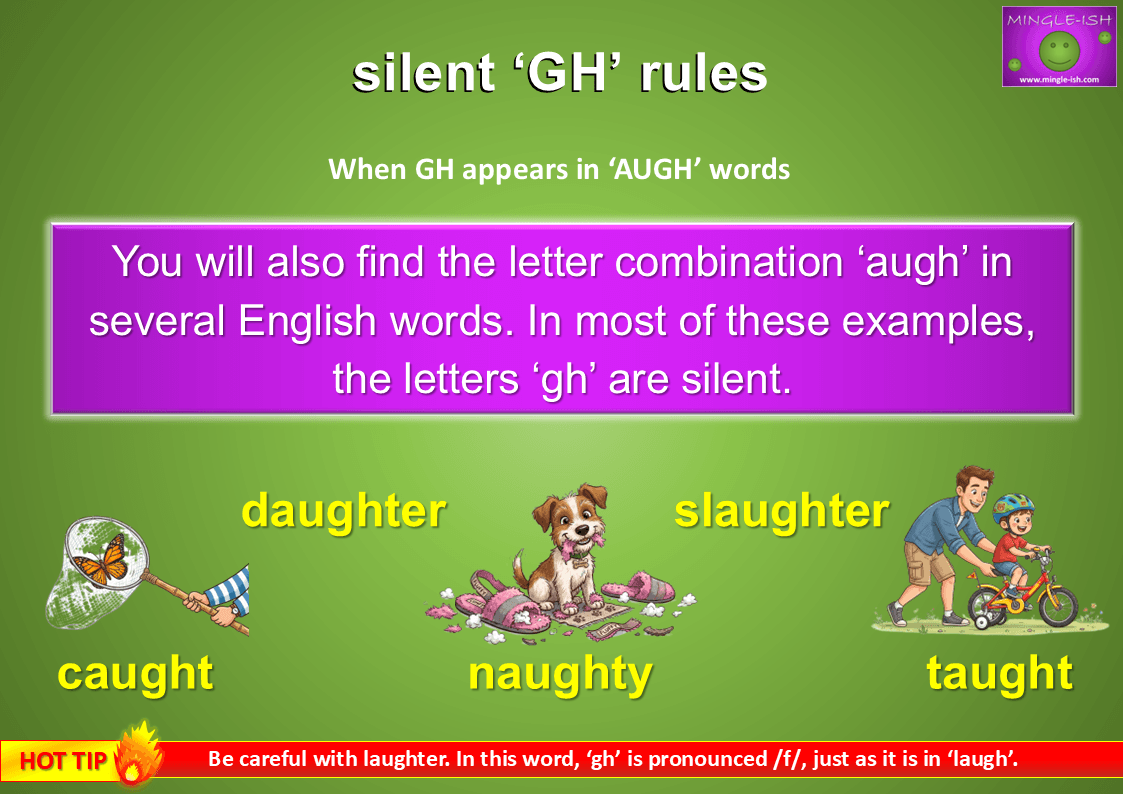
You will also find the letter combination ‘augh’ in several English words. In most of these examples, the letters ‘gh’ are silent.
For example:
- caught
- daughter
- naughty
- slaughter
- taught
However, be careful with laughter. In this word, ‘gh’ is pronounced /f/, just as it is in ‘laugh’.
When GH appears in ‘EIGH’ words
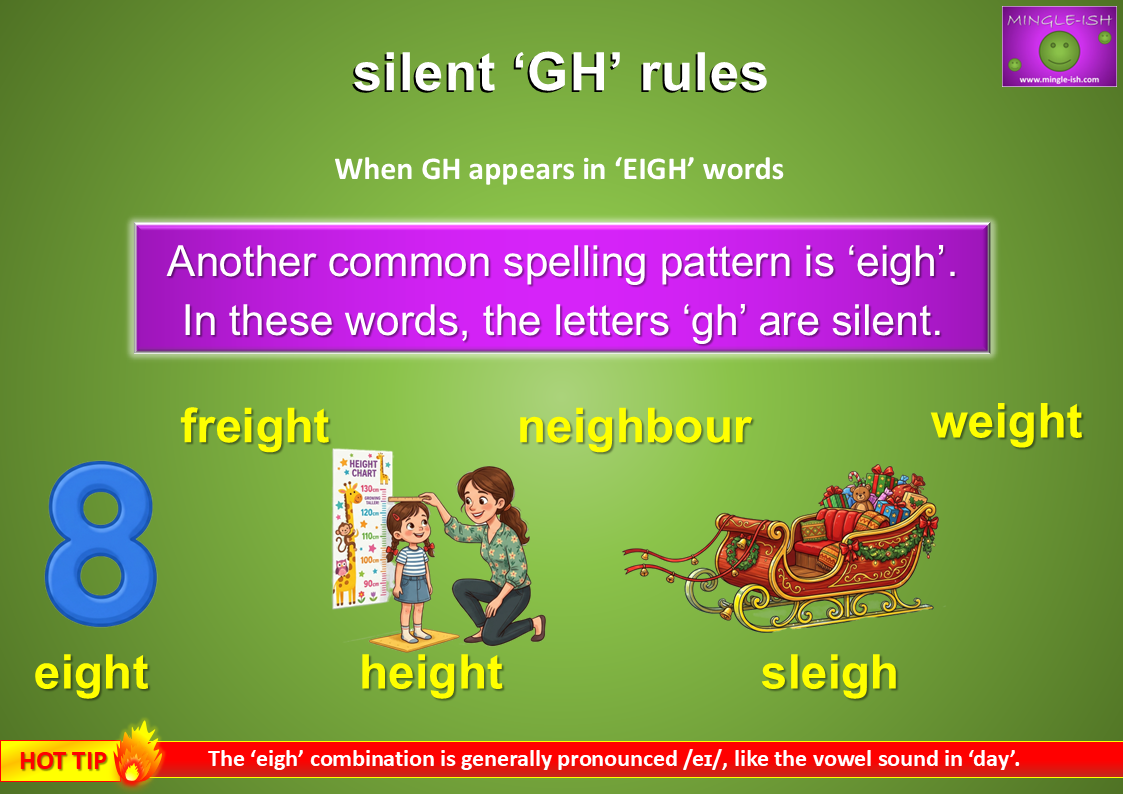
Another common spelling pattern is ‘eigh’. In these words, the letters ‘gh’ are silent.
For example:
- eight
- freight
- height
- neighbour
- sleigh
- weight
The ‘eigh’ combination is generally pronounced /eɪ/, like the vowel sound in ‘day’.
Exceptions to the silent GH rule
Now, before you decide that every ‘gh’ in English is silent, there are a few exceptions!
In some words, ‘gh’ makes an /f/ sound instead. This is why it’s important to learn how individual words are pronounced rather than assume ‘gh’ always follows the same pattern.
When GH sounds like F
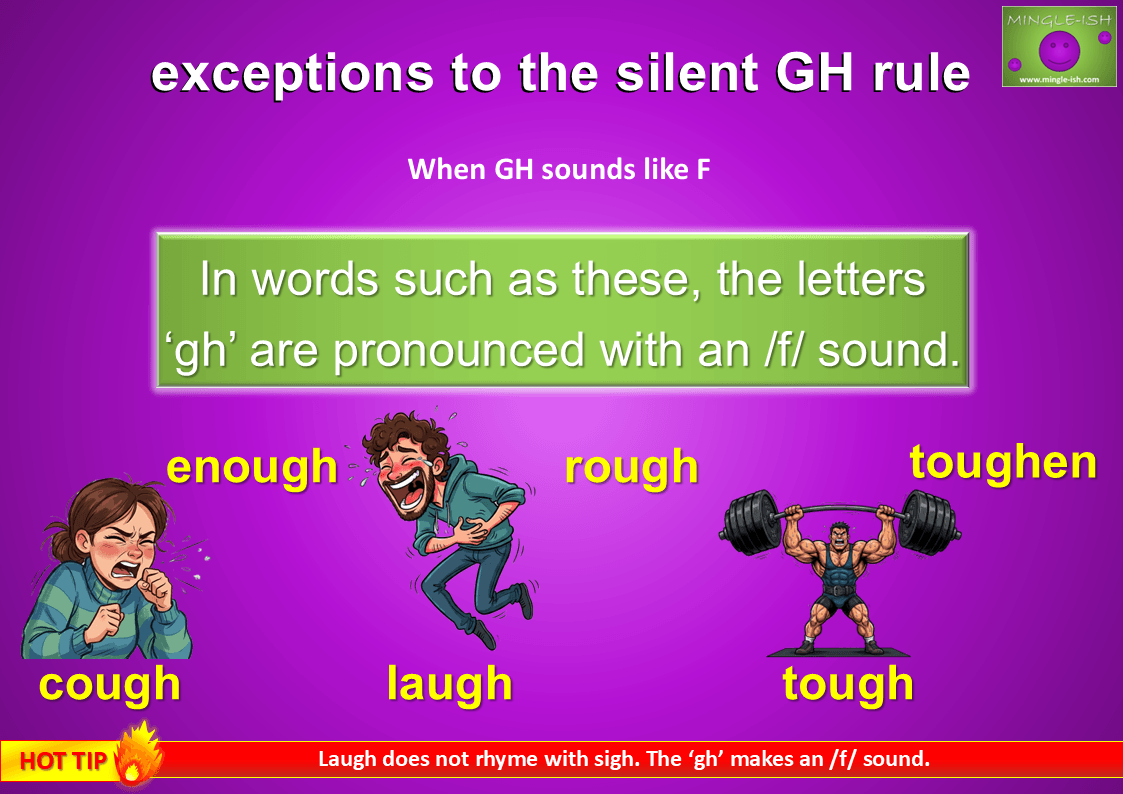
In words such as these, the letters ‘gh’ are pronounced with an /f/ sound.
- cough
- enough
- laugh
- rough
- tough
- toughen
For example, laugh does not rhyme with sigh. The ‘gh’ makes an /f/ sound.
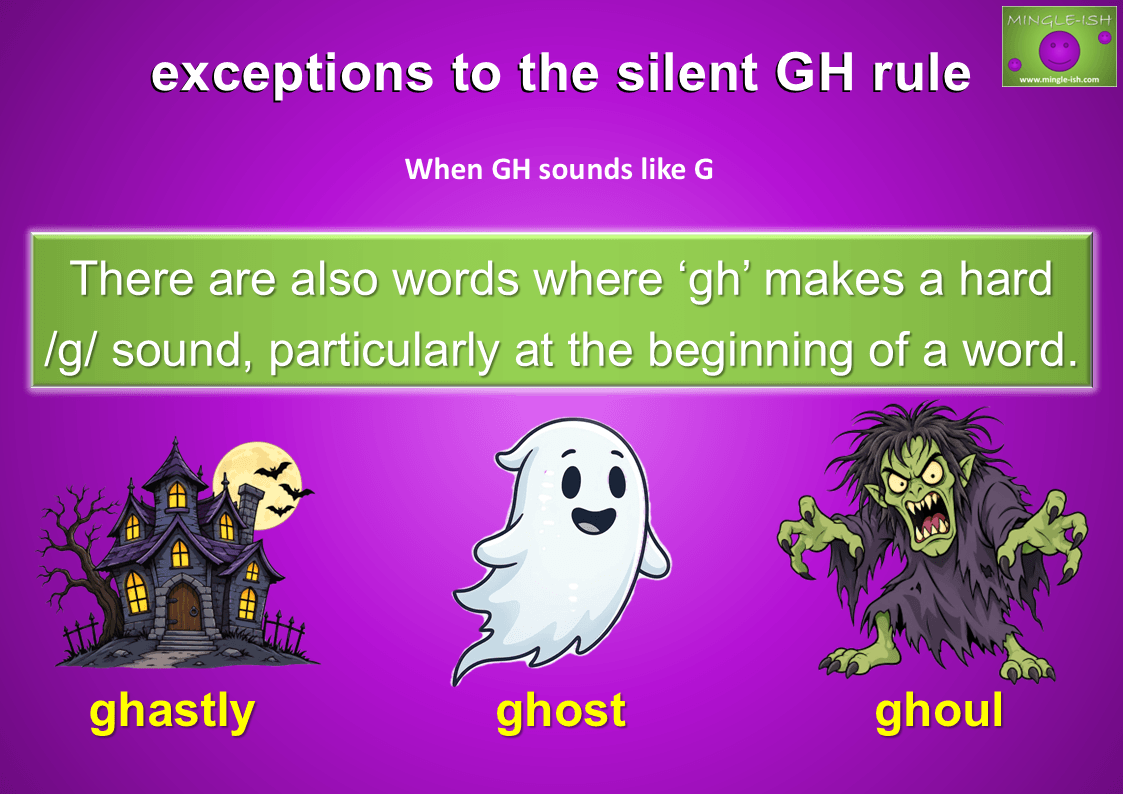
When GH sounds like G
There are also words where ‘gh’ makes a hard /g/ sound, particularly at the beginning of a word.
For example:
- ghastly
- ghost
- ghoul
So, although ‘gh’ is silent in many English words, it isn’t always silent. Keep an eye out for these exceptions!
Tips for remembering silent GH words
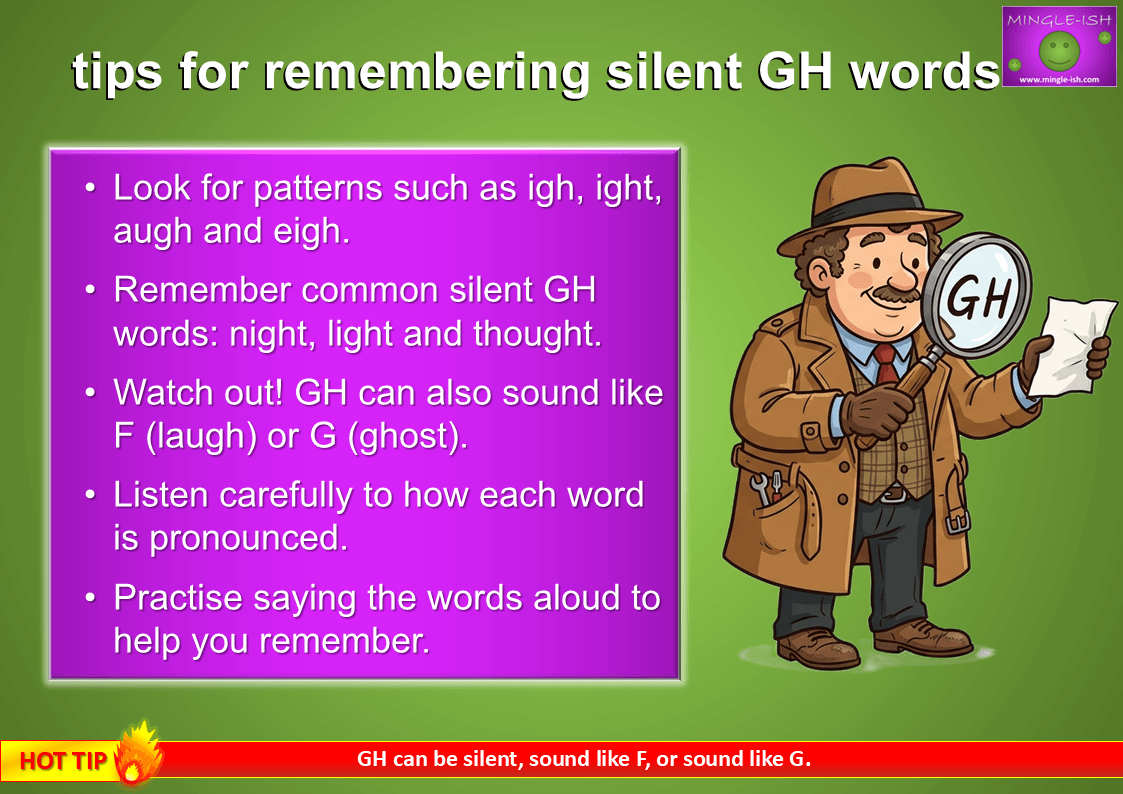
Here are a few tips to help you remember when GH is silent:
- Look out for familiar spelling patterns such as igh, ight, ough, augh and eigh. These can be useful clues, although there are exceptions.
- Remember that GH is silent in many common words, including night, light and thought.
- Watch out for exceptions, such as laugh and cough, where GH sounds like F, and ghost, where it sounds like a hard G.
- Listen to the pronunciation as well as looking at the spelling.
- Practise saying the words aloud. The more you hear and use them, the easier they become to remember.
Here’s a little reminder:
GH can be silent, sound like F, or sound like G.
English wouldn’t be English without a few surprises, would it?
Test your knowledge – Fun quizzes on silent GH words
COMING SOON.
In the meantime, head over to our YouTube channel for more quizzes
Conclusion
The silent ‘gh’ can be a little confusing, especially because the same letters can be pronounced in different ways depending on the word.
The good news is that once you become familiar with common patterns such as ‘igh’, ‘ight’, ‘ough’, ‘augh’ and ‘eigh’, recognising many silent GH words becomes much easier.
Remember, practise makes perfect! Keep listening, reading and saying these words aloud, and you’ll soon feel more confident with English pronunciation.
If you found this lesson helpful, why not explore some of the other silent letters in English? There are plenty more quirky spelling surprises waiting for you!
Happy learning!