
Conjunctions are the glue that holds sentences together. They connect words, phrases, and clauses, helping your writing flow naturally instead of sounding choppy. In this guide, you’ll learn the different types of conjunctions in English, the rules for using them, and plenty of examples to help you use them with confidence.
What are conjunctions?
Listen up, I’m going to tell you the meaning of a conjunction.
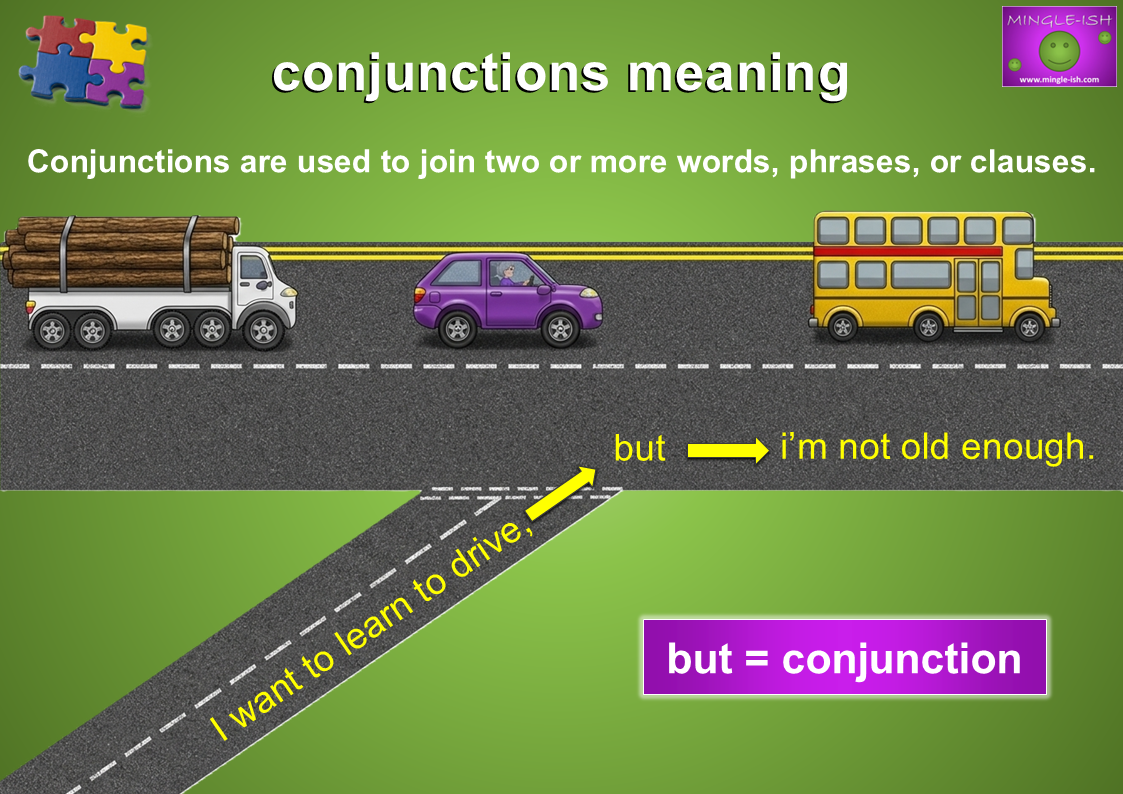
Think of a road junction. It’s where one road meets another and they join together so traffic can flow smoothly. A conjunction works in exactly the same way, but instead of roads, it connects parts of a sentence.
A conjunction is a word that joins two or more words, phrases, or clauses together. It helps sentences flow instead of sounding short, broken, or choppy.
The purpose of conjunctions is to improve sentence flow, link ideas smoothly, and make writing sound more natural.
Common examples include and, but, or, because, and so. These small words do a big job in English.
Why Conjunctions Are Important
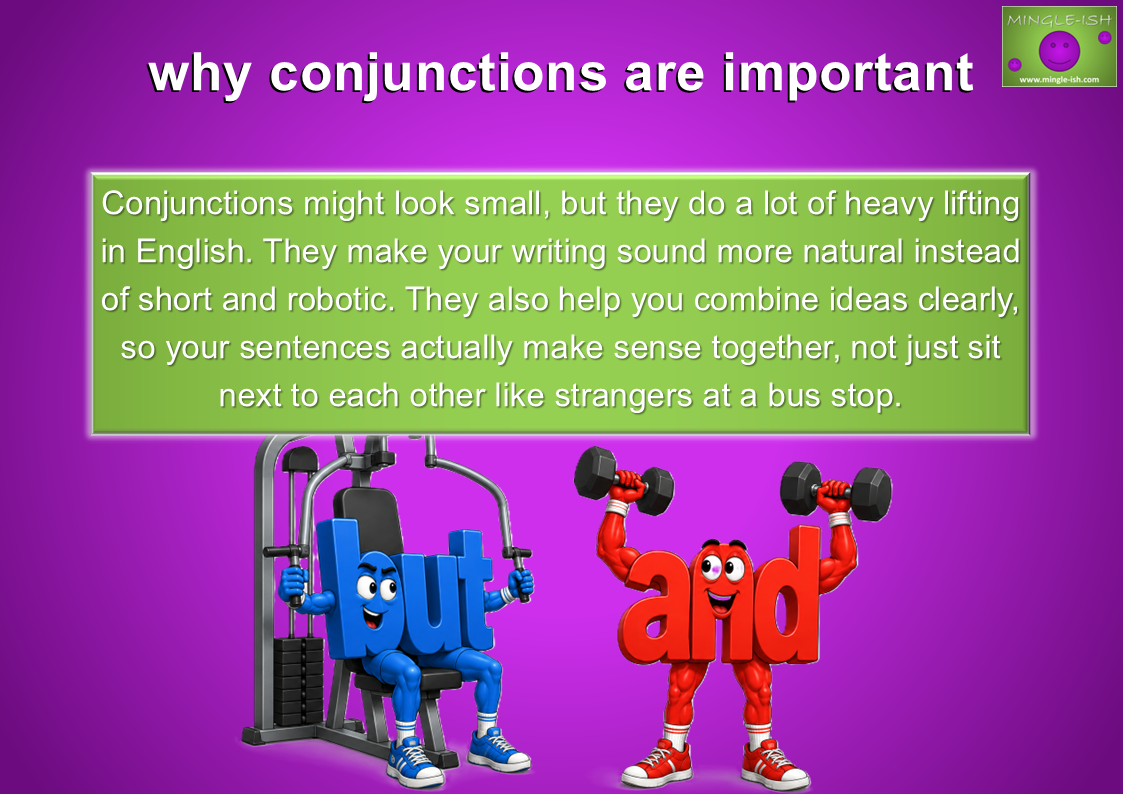
Conjunctions might look small, but they do a lot of heavy lifting in English.
They make your writing sound more natural instead of short and robotic. They also help you combine ideas clearly so your sentences actually make sense together, not just sit next to each other like strangers at a bus stop.
They improve fluency in both speaking and writing, which means your English sounds smoother and more confident.
And if you are learning English for exams, they are essential for IELTS, ESL, and EFL success. In short, no conjunctions, no flow.
Types of Conjunctions in English
Right, this is where conjunctions split into three main types. Think of it like three different ways of connecting ideas, all doing slightly different jobs in your sentence.
Coordinating Conjunctions
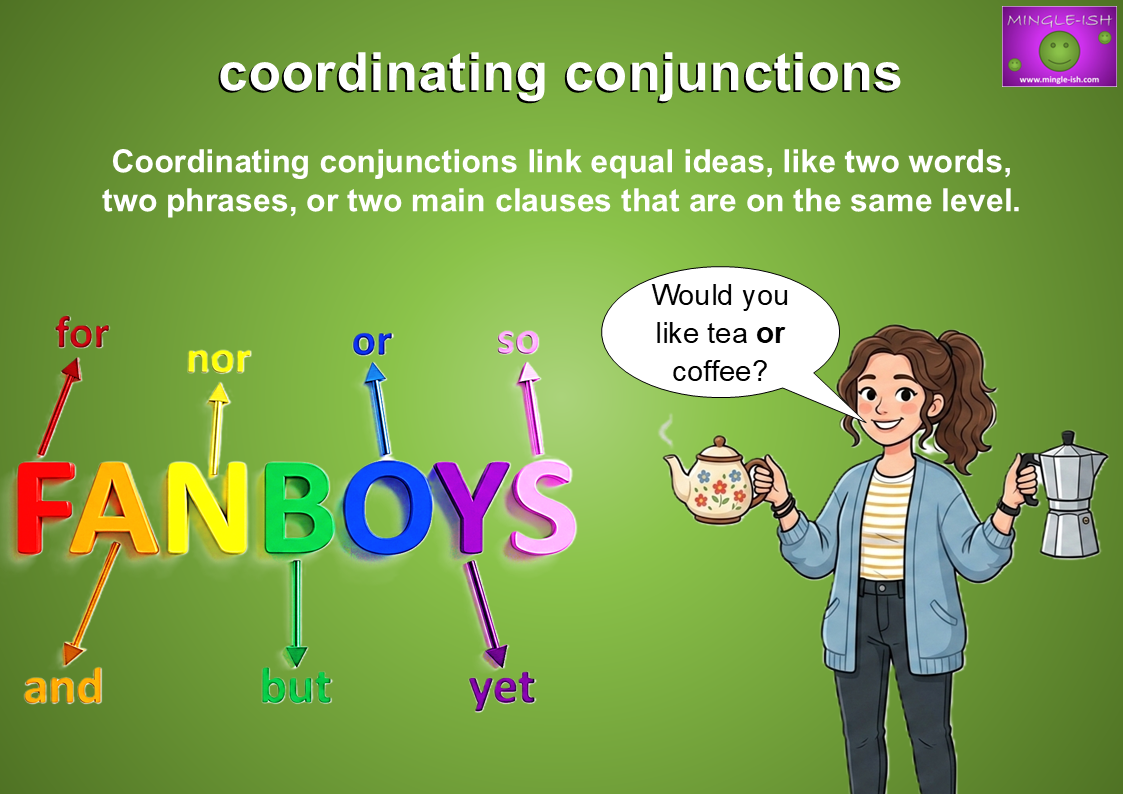
Coordinating conjunctions link equal ideas, like two words, two phrases, or two main clauses that are on the same level.
Subordinating Conjunctions
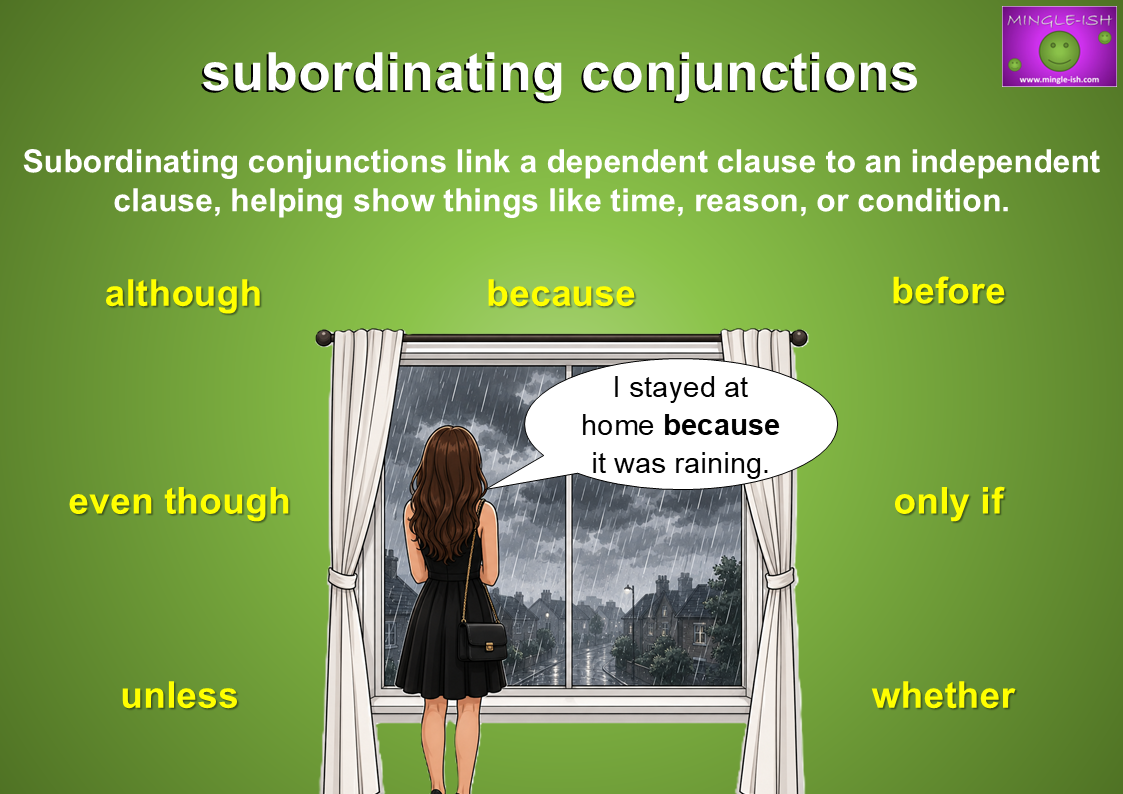
Subordinating conjunctions link a dependent clause to an independent clause, helping show things like time, reason, or condition.
Correlative Conjunctions
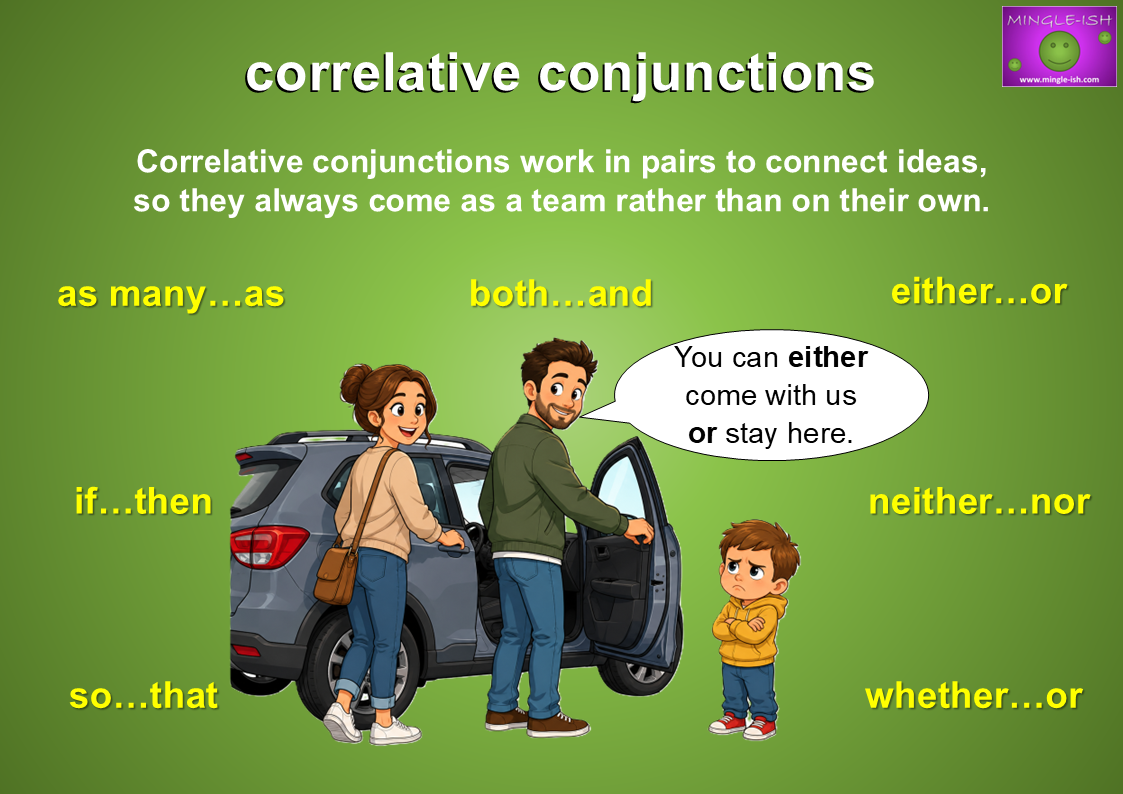
Correlative conjunctions work in pairs to connect ideas, so they always come as a team rather than on their own.
Coordinating Conjunctions (Overview)
Coordinating conjunctions are the simple connectors that keep sentences balanced and easy to read.
They are used to join equal parts of a sentence, like two ideas that sit on the same level.
Common examples include and, but, or, so, for, nor, and yet.
Subordinating Conjunctions (Overview)
Subordinating conjunctions are the ones that add a bit more depth to your sentences, linking ideas that are not equal but still belong together.
They are used to show cause, time, contrast, or condition, helping explain why something happens or when it happens.
Common examples include because, although, since, when, if, and while.
Correlative Conjunctions (Overview)
Correlative conjunctions are the ones that always work in pairs, like a matching set that needs both parts to make sense.
They are used to connect ideas evenly, often adding balance or emphasis to a sentence.
Common examples include either or, neither nor, both and, and not only but also.
Conjunction Examples in Sentences
Let’s break it down so you can actually see how each type works in real sentences.
Coordinating Conjunctions Examples
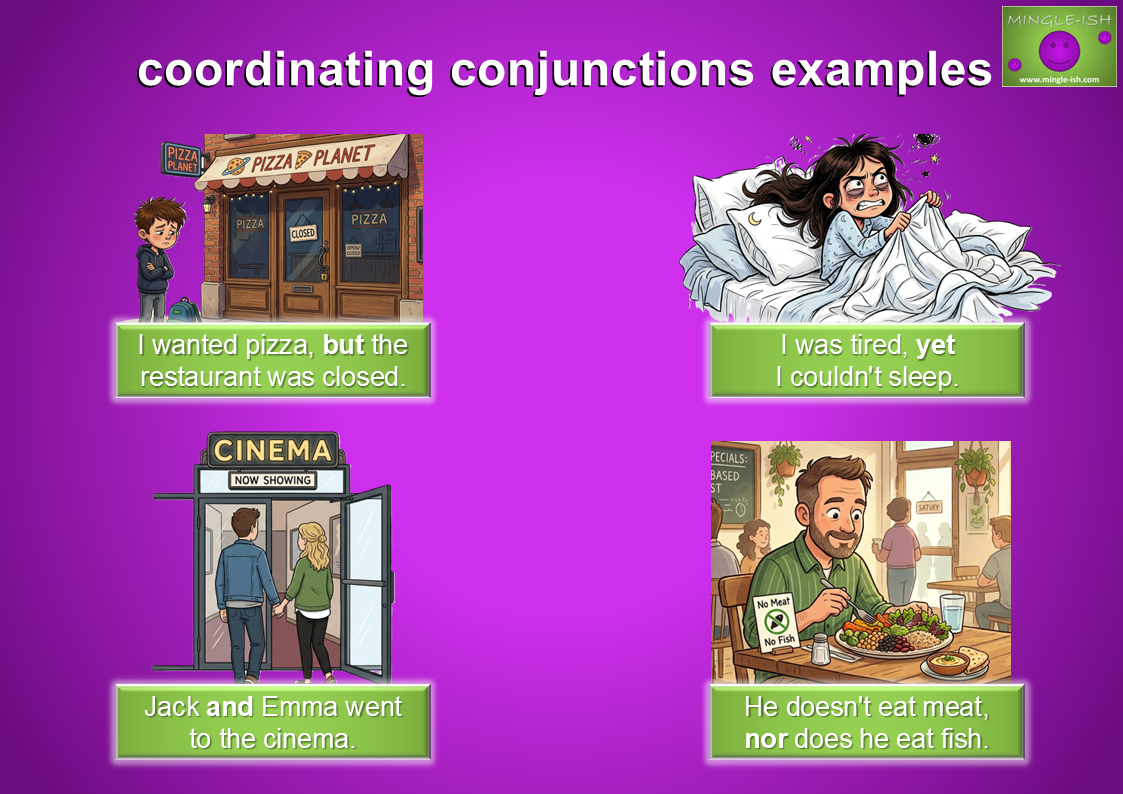
Coordinating conjunctions join words, phrases, and clauses that are of equal importance. Think of them as friendly little connectors that help your sentences flow instead of sounding like a list of random thoughts!
Here are some examples:
- I wanted pizza, but the restaurant was closed.
- Jack and Emma went to the cinema.
- Would you like tea or coffee?
- She didn’t study, so she found the test difficult.
- I was tired, yet I couldn’t sleep.
- He doesn’t eat meat, nor does he eat fish.
- Take your coat, for it might get cold later.
- You can stay here or come with us.
- The dog barked, but the cat ignored it.
- My brother plays football and my sister plays tennis.
The seven coordinating conjunctions are easy to remember with the acronym FANBOYS: for, and, nor, but, or, yet, so. They may be tiny words, but they do a mighty job of holding our sentences together!
Subordinating Conjunctions Examples
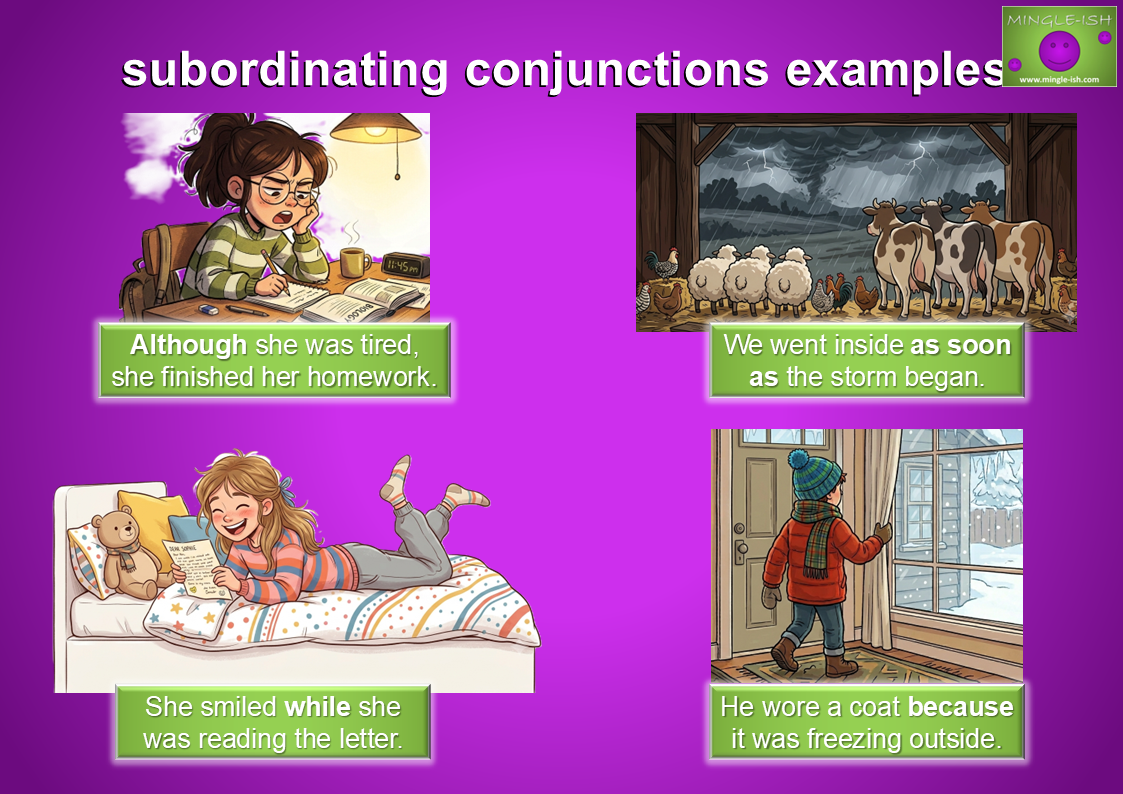
Subordinating conjunctions are the storytellers of English grammar. They connect a dependent clause to an independent clause and show relationships such as time, reason, condition, contrast, and purpose. In other words, they explain when, why, how, or under what conditions something happens.
Here are some examples:
- I stayed at home because it was raining.
- Although she was tired, she finished her homework.
- If you practise every day, your English will improve.
- We went inside as soon as the storm began.
- I will call you when I get home.
- Since you are here, you can help me carry these bags.
- He wore a coat because it was freezing outside.
- Unless you hurry, you will miss the bus.
- She smiled while she was reading the letter.
- We left early so that we could avoid the traffic.
- Even though the cake looked delicious, I was too full to eat it.
- Before you leave, remember to lock the door.
As you can see, subordinating conjunctions add extra information and help explain the relationship between ideas. Without them, our sentences would be much less interesting and a lot less connected!
Correlative Conjunctions Examples
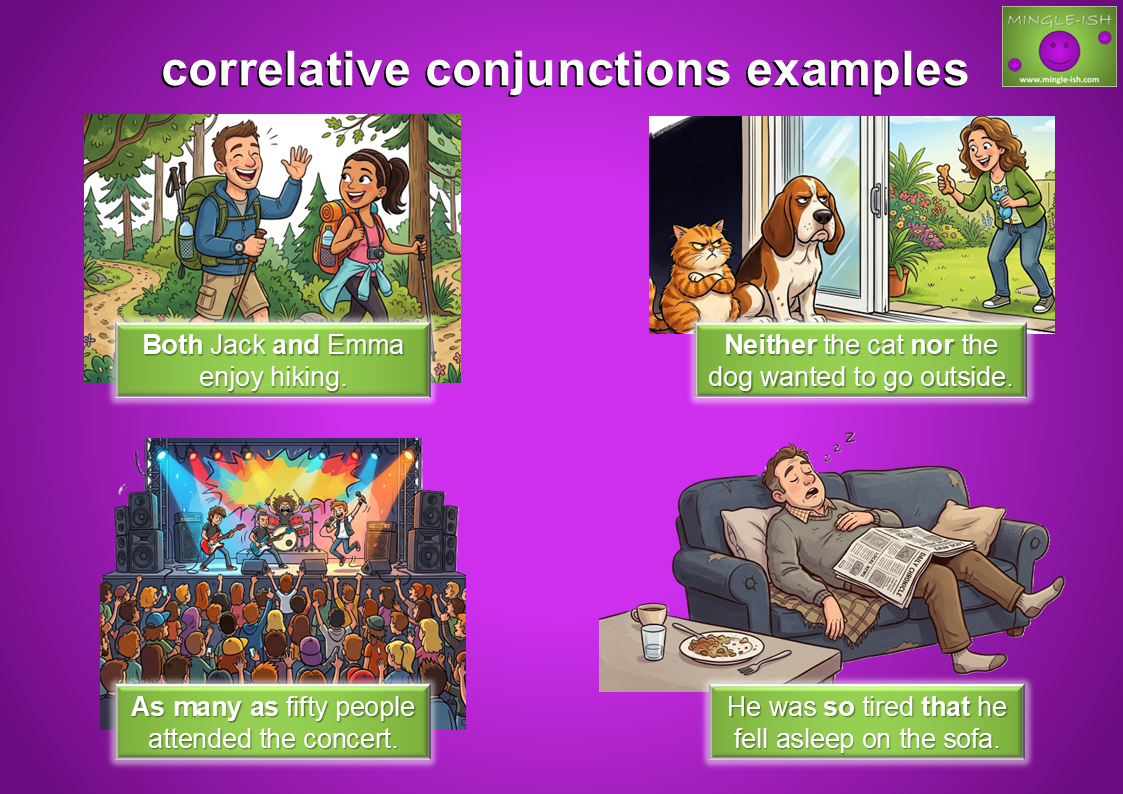
Correlative conjunctions are the dynamic duos of English grammar. They always work in pairs to connect equal words, phrases, or clauses. One half of the pair waits patiently for its partner, rather like socks in the washing machine… except these pairs usually stay together!
Here are some examples:
- Both Jack and Emma enjoy hiking.
- You can either watch a film or play a game.
- Neither the cat nor the dog wanted to go outside.
- She is not only clever but also very funny.
- Whether you agree or disagree, please be polite.
- I would rather stay at home than go shopping.
- The more you read, the more vocabulary you learn.
- The sooner we leave, the better.
- He was so tired that he fell asleep on the sofa.
- It was such a hot day that everyone wanted ice cream.
- Hardly had I sat down when the doorbell rang.
- As many as fifty people attended the concert.
As you can see, correlative conjunctions come as a team and help create balance in a sentence. If one part appears, the other usually isn’t far behind. They’re the grammar world’s famous double acts!
Common Mistakes with Conjunctions
Right, this is where things often go a bit wrong, and don’t worry, everyone does these at some point. Conjunctions are simple, but they can trip you up if you’re not paying attention.
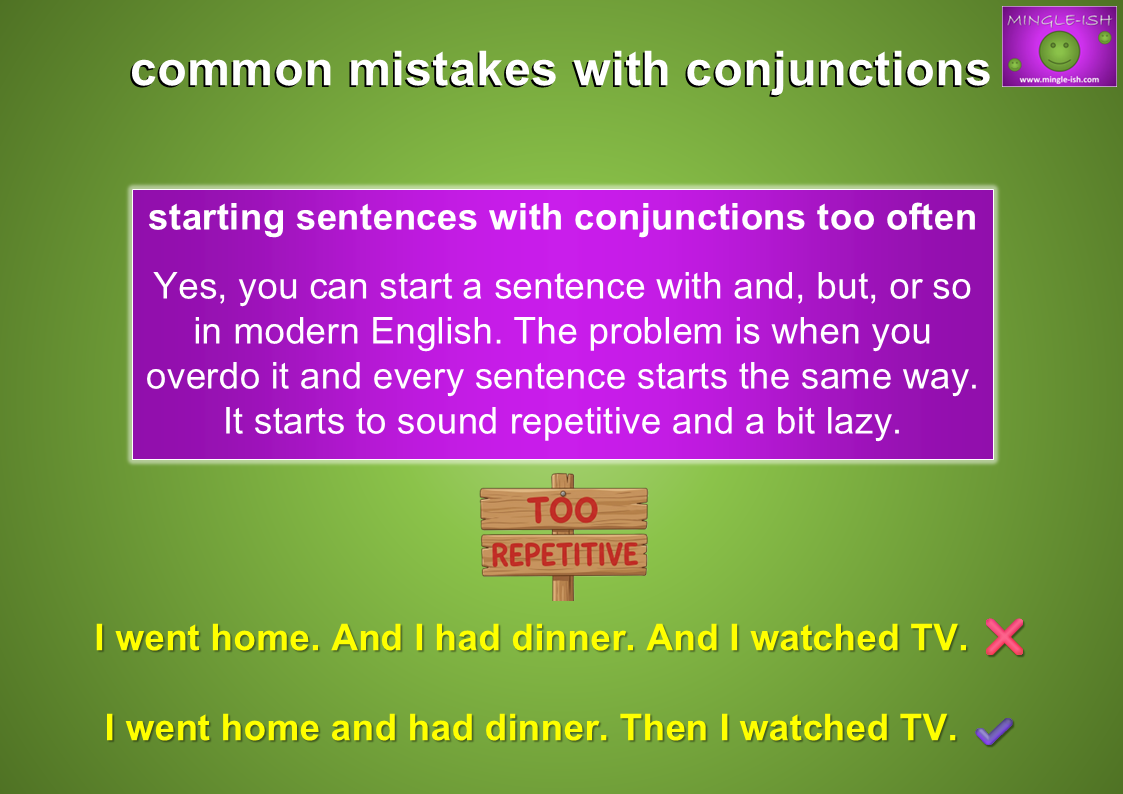
Starting sentences with conjunctions too often
Yes, you can start a sentence with and, but, or so in modern English. The problem is when you overdo it and every sentence starts the same way. It starts to sound repetitive and a bit lazy.
- I went home. And I had dinner. And I watched TV. ❌ (too repetitive)
- I went home and had dinner. Then I watched TV. ✔️
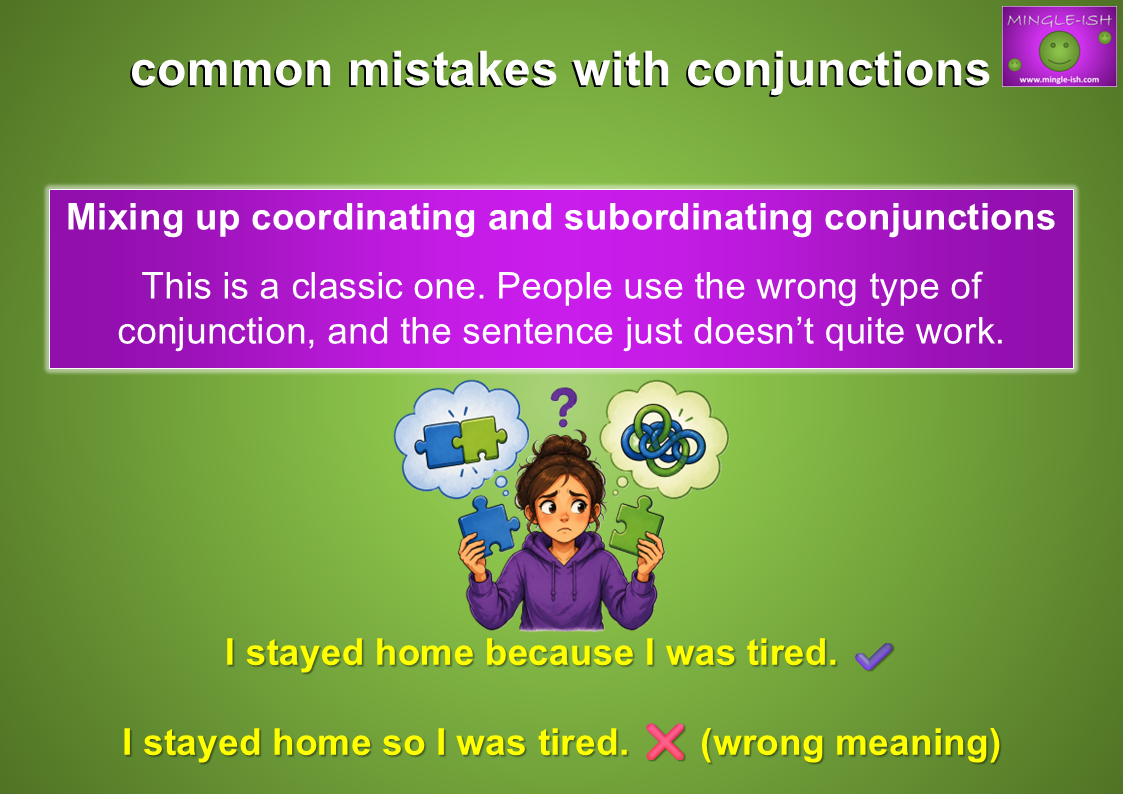
Mixing up coordinating and subordinating conjunctions
This is a classic one. People use the wrong type of conjunction, and the sentence just doesn’t quite work.
- I stayed home because I was tired. ✔️
- I stayed home so I was tired. ❌ (wrong meaning)
Another example:
- She was late because she missed the bus. ✔️
- She was late but she missed the bus. ❌
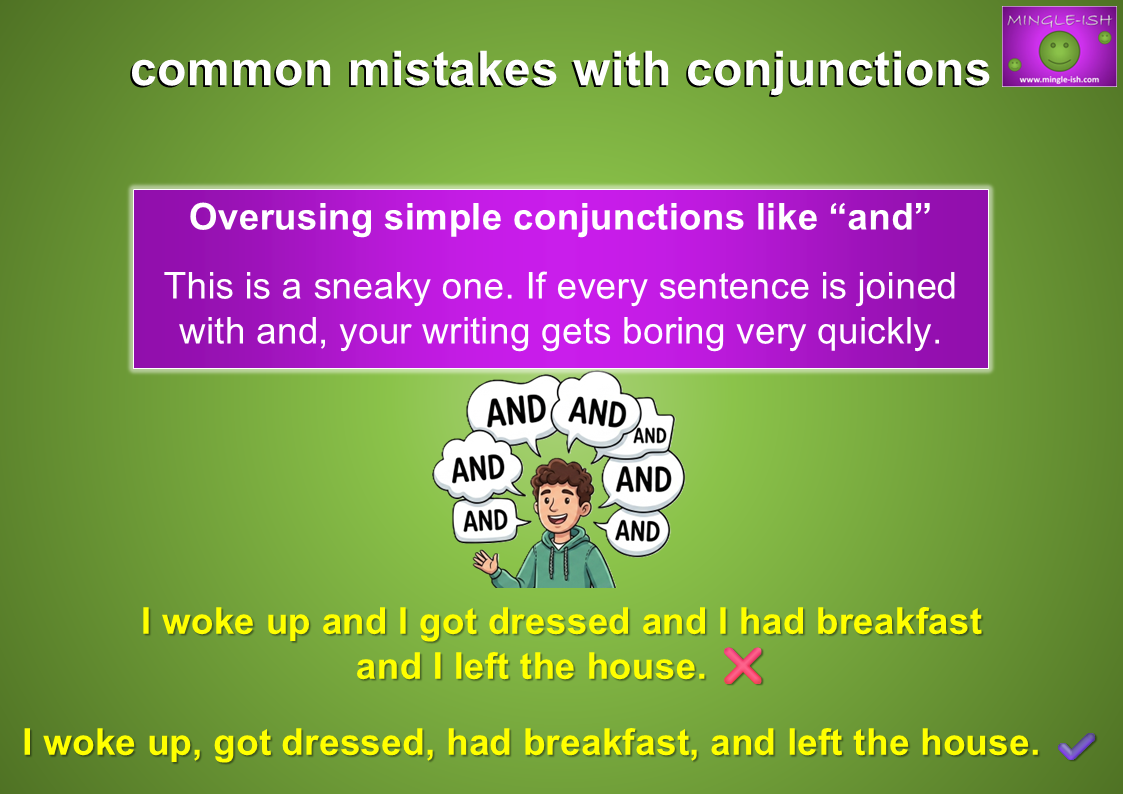
Overusing simple conjunctions like “and”
This is a sneaky one. If every sentence is joined with and, your writing gets boring very quickly.
- I woke up and I got dressed and I had breakfast and I left the house. ❌
- I woke up, got dressed, had breakfast, and left the house. ✔️
Using conjunctions without clear sentence structure
Sometimes learners add conjunctions, but the sentence doesn’t fully make sense on its own.
- Because I was tired. ❌ (incomplete sentence)
- I went to bed early because I was tired. ✔️
Test Your Knowledge: Conjunctions Quiz
Think you’ve got your and, but and because all under control? Put your conjunction skills to the test with these quick video quizzes! Choose your answers, see how well you do, and find out whether you’re a conjunction whizz or if there’s still a little room for improvement.
Enjoy this sort of challenge? Head over to our YouTube Grammar Quizzes playlist for more bite-sized quizzes to test your English grammar skills. There’s always another question waiting to catch you out!
Conjunctions FAQ
Can a Sentence Start with a Conjunction?
Yes. Despite what many people were taught at school, it is perfectly acceptable to start a sentence with a conjunction such as and, but, or so. The trick is not to overuse them, otherwise your writing can become repetitive.
What Is the Most Common Conjunction in English?
The most common conjunction in English is and. It is used to connect words, phrases, and clauses, making it one of the hardest-working words in the language.
What Is the Difference Between a Conjunction and a Preposition?
A conjunction joins words, phrases, or clauses together.
- I stayed at home because it was raining. ✔️
A preposition shows the relationship between a noun (or pronoun) and another part of the sentence.
- I stayed at home during the storm. ✔️
Although some words can look similar, conjunctions and prepositions do different jobs.
What Is the Difference Between Coordinating and Subordinating Conjunctions?
Coordinating conjunctions join equal ideas.
- She was tired but happy.
Subordinating conjunctions join unequal ideas by connecting a dependent clause to an independent clause.
- She went to bed early because she was tired.
How Can I Learn Conjunctions More Easily?
The best way to learn conjunctions is to read, write, and practise using them in real sentences. Instead of memorising long lists, focus on seeing how conjunctions connect ideas in everyday English.
Are Conjunctions Important for IELTS, ESL, and EFL Learners?
Absolutely. Conjunctions help improve sentence variety, coherence, and fluency. Using them correctly can make your speaking and writing sound more natural, which is especially important in IELTS and other English language exams.
What Happens If You Don’t Use Conjunctions?
Without conjunctions, writing can sound repetitive and disconnected.
- I woke up. I had breakfast. I went to work. ❌
With conjunctions:
- I woke up, had breakfast, and went to work. ✔️
The second example flows much more naturally.
What Are Correlative Conjunctions?
Correlative conjunctions are conjunctions that always work in pairs. Common examples include either…or, neither…nor, both…and, and not only…but also.
Think of them as a package deal. If one part shows up, the other part needs to be there too.
Further Study
If you’ve enjoyed learning about conjunctions, why stop there? English grammar is packed with fascinating topics that can help you become a more confident writer and speaker.
A great next step is to explore related grammar topics such as verbs, adjectives, adverbs, pronouns, prepositions, and sentence structure. These all work closely with conjunctions and will help you build clearer, more natural sentences.
And if reading isn’t enough and you fancy seeing grammar in action, head over to my YouTube channel. You’ll find plenty of English lessons, pronunciation guides, quizzes, and grammar challenges to really sink your teeth into.