
Have you ever heard someone say wa’er instead of water or bu’er instead of butter? If so, you’ve probably heard a glottal stop in action.
The glottal stop is a common feature of spoken English, especially in many British accents. It might sound unusual when you first notice it, but chances are you hear it every day without even realising it. In this guide, we’ll explain what a glottal stop is, how it works, and look at some common examples you’ll hear in everyday speech.
What Is a Glottal Stop?
Ever heard someone say “bu’er” instead of “butter” or “wa’er” instead of “water”?
That little missing “t” isn’t actually missing at all. It’s often replaced by something called a glottal stop.
Not many people notice it at first, but once you know what it is, you’ll start hearing it everywhere in informal speech.
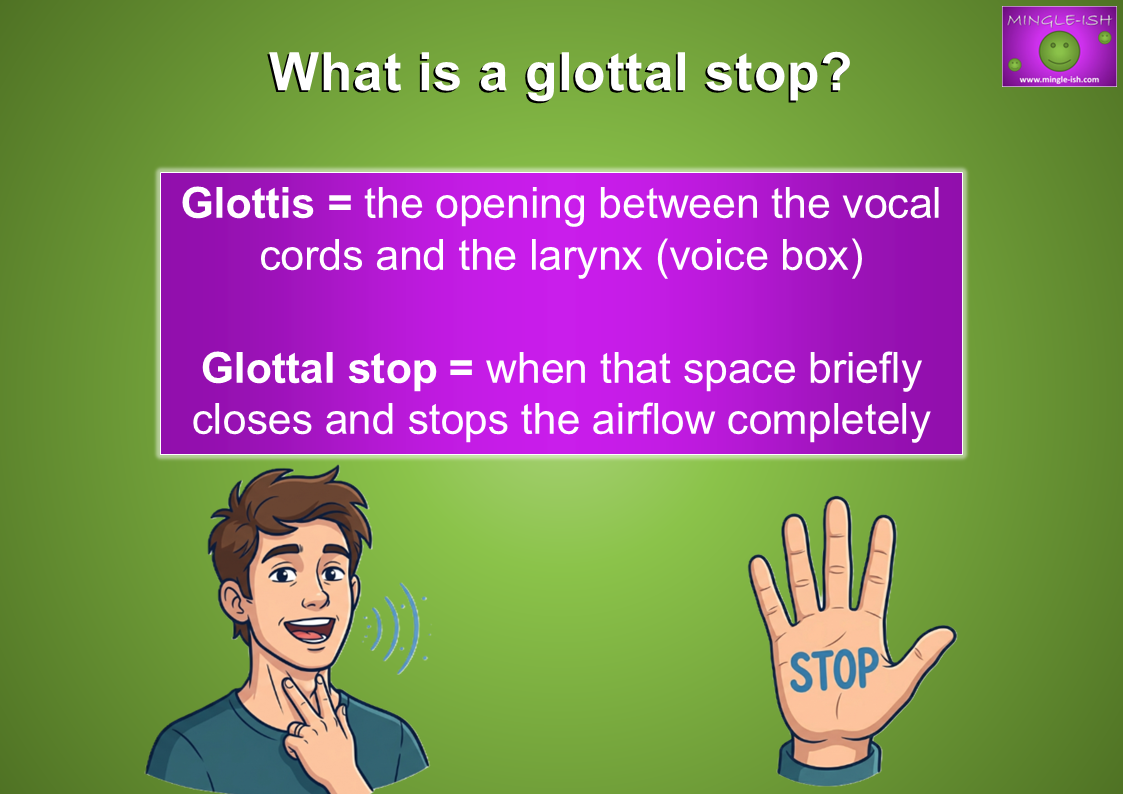
Glottis = the space between your vocal cords in the larynx.
Glottal stop = when that space briefly closes and stops the airflow completely.
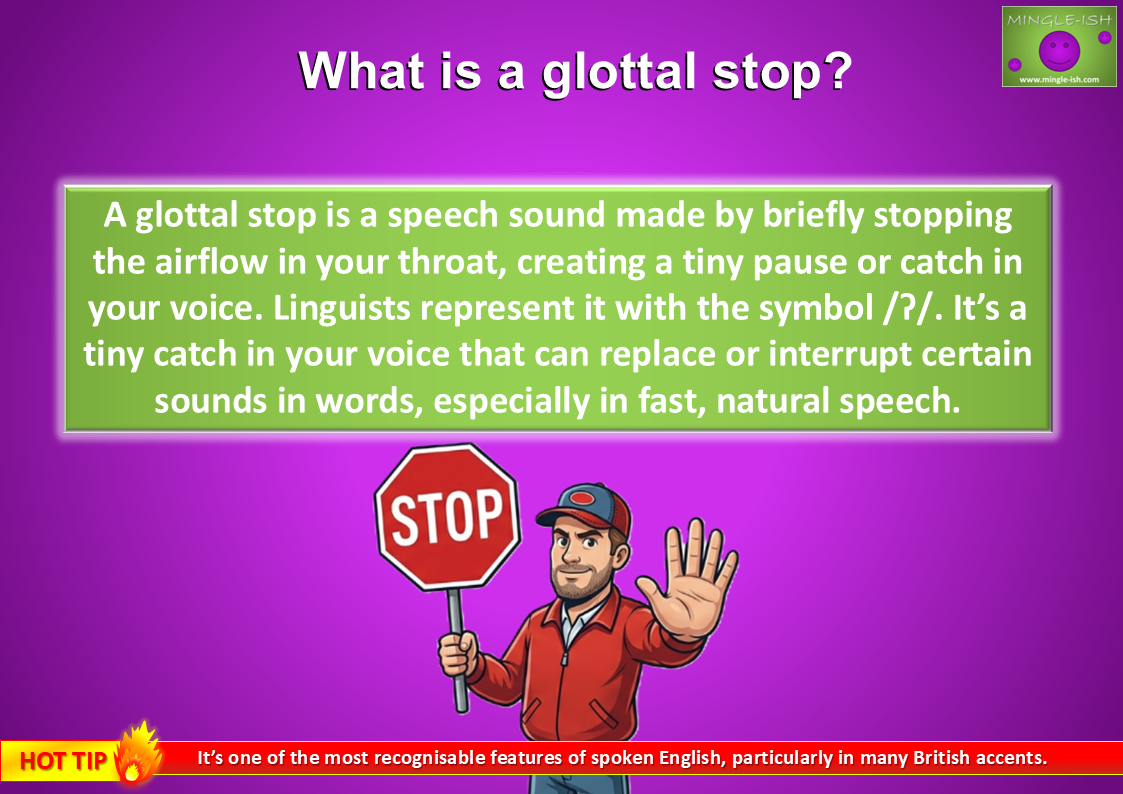
A glottal stop is a speech sound made by briefly stopping the airflow in your throat, creating a tiny pause or catch in your voice. Linguists represent it with the symbol /ʔ/, but don’t worry, you don’t need to remember that. Chances are, you’ve heard this sound thousands of times already.
In simple terms, it’s a tiny catch in your voice that can replace or interrupt certain sounds in words, especially in fast, natural speech.
It’s one of the most recognisable features of spoken English, particularly in many British accents. Some people use it constantly without even realising it, while others hear it and instantly think, “Wait… what just happened to the T?”
What Does a Glottal Stop Sound Like?
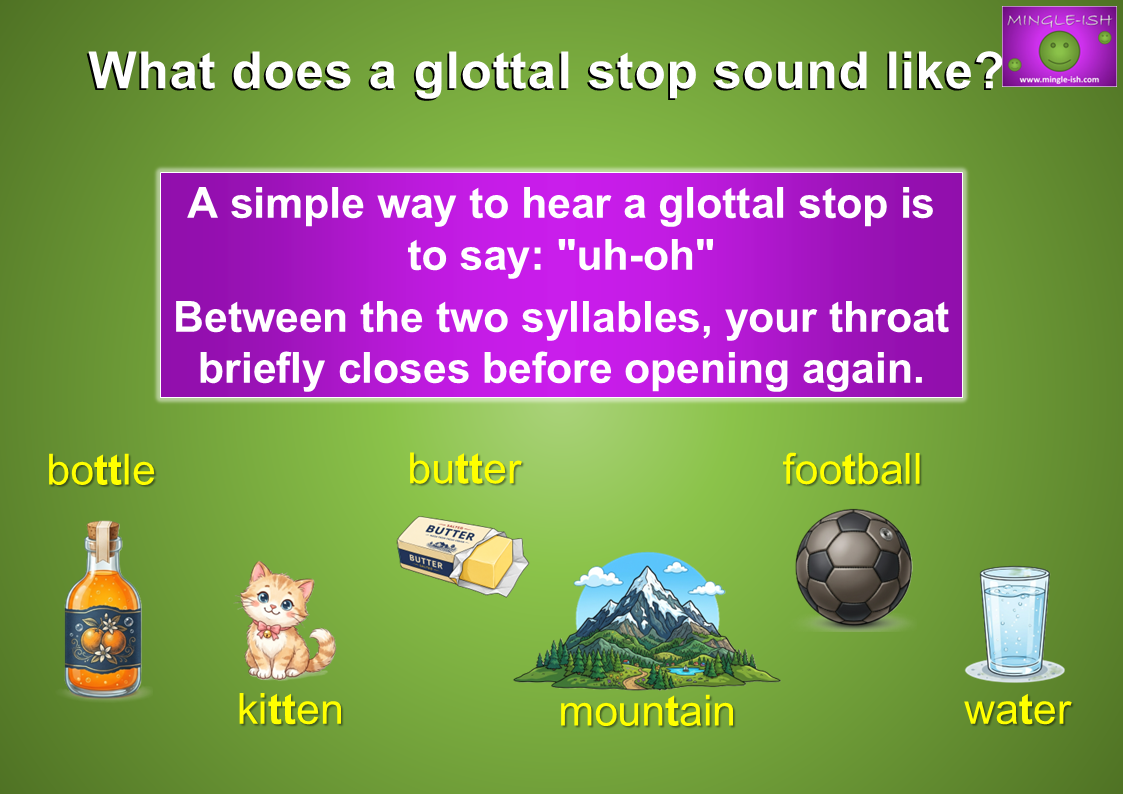
A simple way to hear a glottal stop is to say:
“uh-oh”
Between the two syllables, your throat briefly closes before opening again.
That short interruption is a glottal stop.
You can also hear glottal stops in words such as:
- butter
- water
- bottle
- mountain
- kitten
- football
Depending on the speaker’s accent, the “t” sound may disappear and be replaced by a glottal stop.
Common Examples of Glottal Stops in English
You probably hear glottal stops every day without even noticing. They’re especially common in casual speech and many British accents, where the tongue briefly blocks the airflow instead of pronouncing a clear /t/ sound.
Here are some examples you might hear:
- better → be’er
- bottle → bo’le
- Brighton → Bri’on
- certain → cer’ain
- cotton → co’on
- curtain → cur’ain
- football → foo’ball
- forgotten → forgo’en
- important → impor’ant
- kitten → ki’en
- little → li’le
- mountain → moun’ain
- water → wa’er
- written → wri’en
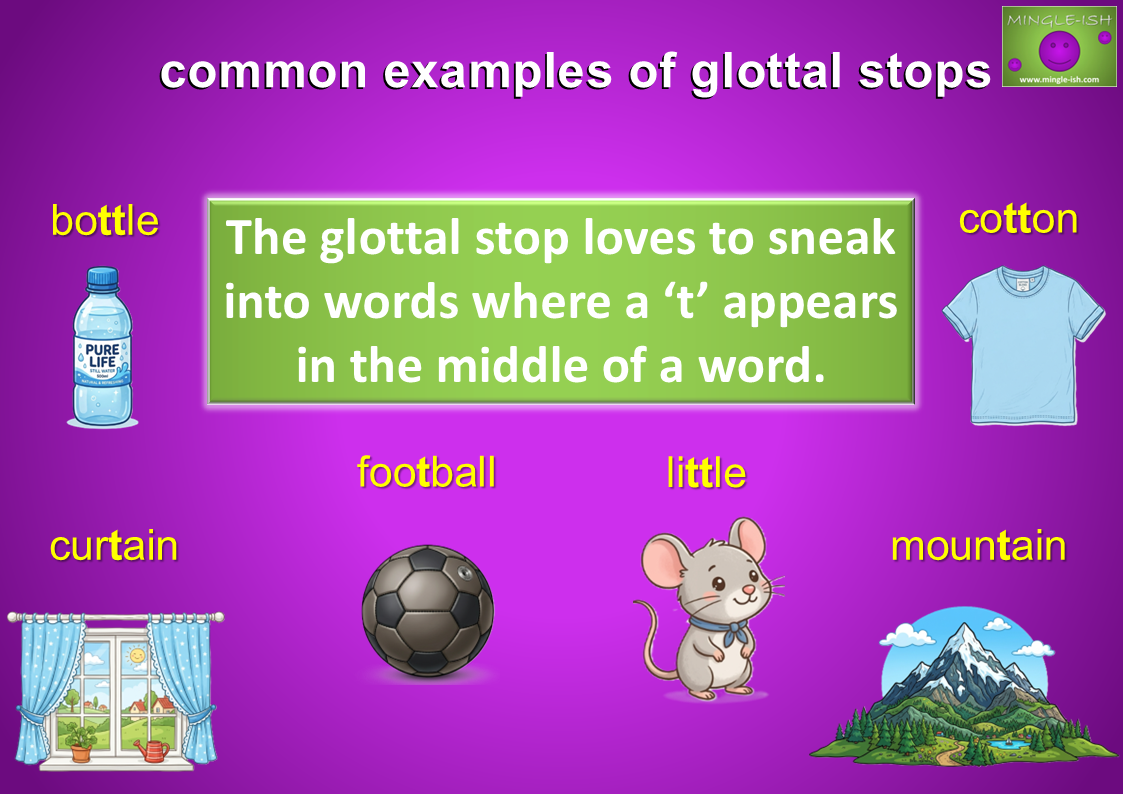
The glottal stop loves to sneak into words where a t appears in the middle of a word, especially when speaking quickly. It’s a bit like the letter t has decided to take the afternoon off.
Not everyone pronounces these words this way, and some accents use glottal stops much more than others. In fact, some speakers use them all the time, while others rarely use them at all. That’s one of the things that makes English pronunciation so wonderfully unpredictable.
If you’ve ever heard someone say “Can I ge’ a bo’le of wa’er?” you’ve already met the glottal stop in the wild.
Where Do Glottal Stops Appear in English?
Many learners think glottal stops only happen when a T sound disappears, but they’re a little sneakier than that. While replacing T is the most common use in English, glottal stops can pop up in a few different situations.
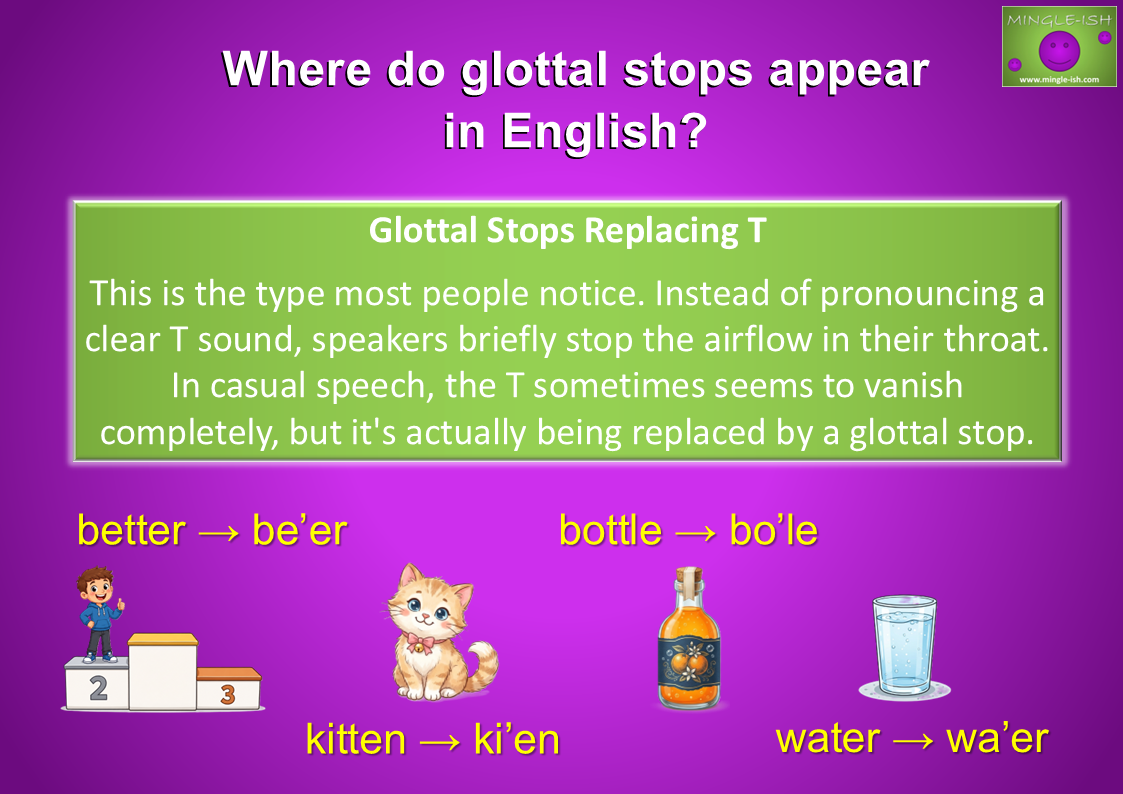
Glottal Stops Replacing T
This is the type most people notice. Instead of pronouncing a clear T sound, speakers briefly stop the airflow in their throat.
Examples include:
- Better → be’er
- Bottle → bo’le
- Kitten → ki’en
- Water → wa’er
In casual speech, the T sometimes seems to vanish completely, but it’s actually being replaced by a glottal stop.
Glottal Stops Before Another Consonant
Sometimes the T isn’t fully replaced. Instead, it’s pronounced as a glottal stop before another consonant sound.
Examples include:
- Atmosphere → a’mosphere
- Football → foo’ball
- Notebook → no’ebook
- Scotland → Sco’land
This is very common in everyday British English and often goes unnoticed by native speakers.

Glottal Stops Between Vowel Sounds
Glottal stops don’t always replace the letter T. Sometimes they appear between two vowel sounds, creating a tiny pause in the airflow. Think of it as a quick hiccup between vowels that stops them from crashing into each other.
Examples include:
- Co-operate → co’operate
- Go on → go’on
- Go over → go’over
- No idea → no’idea
- Re-enter → re’enter
- Uh-oh → uh’oh
These types of glottal stops are less common and less predictable than those that replace T. Whether you hear them often depends on the speaker’s accent and speaking style.

Why Do People Use Glottal Stops?
The answer is simple: speaking quickly is easier.
When we talk naturally, our mouths often take shortcuts.
Replacing certain sounds with a glottal stop can make words easier and faster to pronounce.
This doesn’t mean someone is speaking incorrectly. It’s simply a natural feature of many accents and dialects.
Language is surprisingly lazy. Given the chance, it often looks for the quickest route from one sound to another.

How to Practise Hearing a Glottal Stop
The easiest way to spot a glottal stop is to listen for words containing the letter “t”.
Pay attention to how different speakers pronounce words such as:
- bottle
- butter
- football
- kitten
- water
Some speakers pronounce the “t” clearly.
Others replace it with a glottal stop.
Once you start listening for it, you’ll notice it everywhere.
It’s a bit like spotting a yellow car. At first you don’t notice any. Then suddenly they’re all over the place.
Final Thoughts
The glottal stop might sound unusual when you first learn about it, but it’s an everyday part of spoken English.
Whether you hear it in “water”, “butter”, or “football”, it’s simply another way that speakers naturally produce sounds.
Understanding glottal stops can help improve your listening skills, pronunciation awareness, and understanding of different English accents.
And once you’ve learned what a glottal stop is, you’ll probably start hearing it absolutely everywhere.
Further Study
Fancy learning more about English pronunciation? Why stop at glottal stops?
You can explore some of our other pronunciation guides, including difficult words to pronounce, silent letters, voiced and voiceless sounds, and vowel pronunciation. They’re packed with examples, tips, and plenty of words that make English learners scratch their heads.
If that’s not enough to keep you busy, head over to our YouTube channel, where you’ll find pronunciation lessons, quizzes, and quick challenges designed to test your English skills. Fair warning: once you start, you may find yourself saying random words out loud for the rest of the day!