Before we begin, I’ll let you in on a little secret…

If you break the words you’re trying to pronounce down into their syllables, it makes them a lot easier to say.

You can also improve your pronunciation by being aware of word stress and sentence stress. Knowing which parts of a word or sentence to emphasise can make a big difference to how natural your English sounds.

Of course, some English words are still determined to make life difficult!

Here you’ll find a collection of difficult words to pronounce in English, from ballet and colonel to queue and Worcestershire. Let’s see if we can make them a little less difficult.

Difficult Words to Pronounce: Examples and Pronunciation

Now for the tricky bit!

Here are some difficult English words to pronounce, with simple pronunciation guides, example sentences and notes to help you work out what’s going on.

Because sometimes English spelling looks perfectly innocent…

…and then you try to say the word out loud.

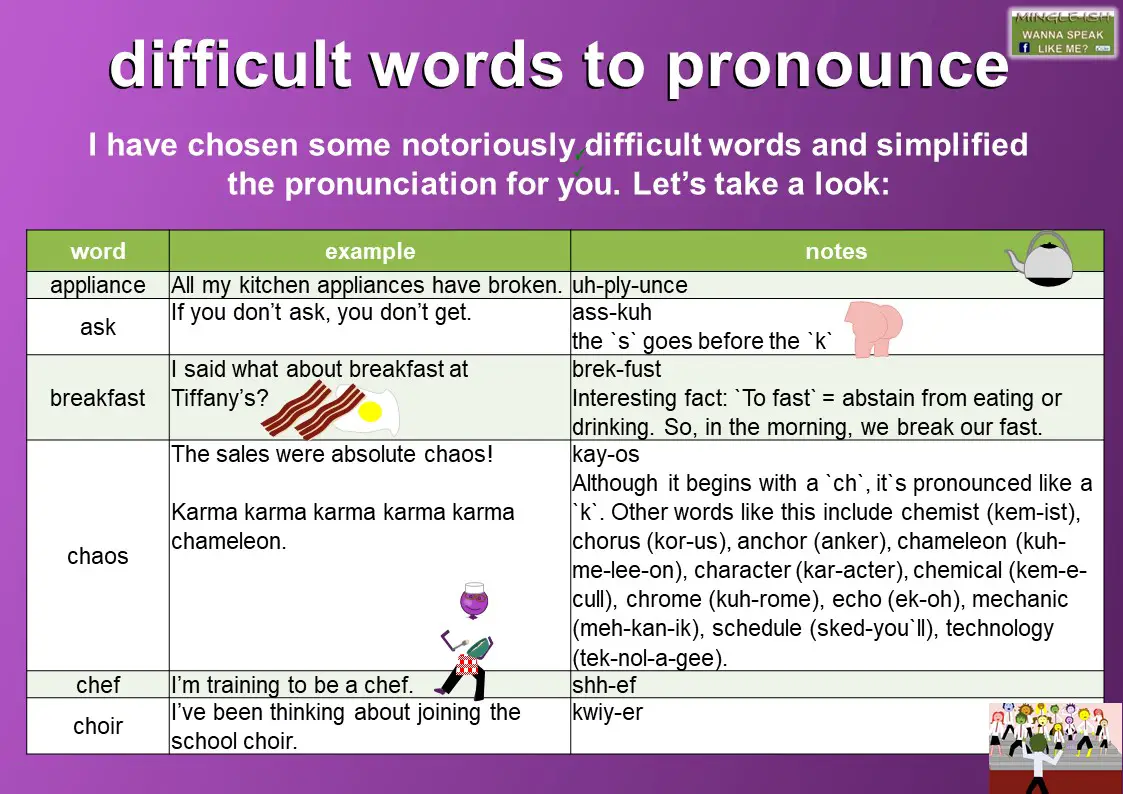
appliance

  • Example: All my kitchen appliances have broken.
  • Pronunciation: uh-PLY-unce
  • Notes: The stress is on the second syllable.

ask

  • Example: If you don’t ask, you don’t get.
  • Pronunciation: ahsk
  • Notes: The s comes before the k. Don’t add an extra vowel sound between them.

breakfast

  • Example: I said, what about breakfast at Tiffany’s?
  • Pronunciation: BREK-fust
  • Notes: To fast means to abstain from eating or drinking. So, in the morning, we break our fast.

chaos

  • Example: The sales were absolute chaos!
  • Pronunciation: KAY-os
  • Notes: Although it begins with ch, it’s pronounced like a k. Other words with this pronunciation include chemist, chorus, anchor, chameleon, character, chemical, chrome, echo, mechanic, schedule and technology.

chef

  • Example: I’m training to be a chef.
  • Pronunciation: shef
  • Notes: The ch is pronounced like sh.

choir

  • Example: I’ve been thinking about joining the school choir.
  • Pronunciation: KWY-er
  • Notes: The ch is pronounced like k, and the word has two syllables.
hard words to pronounce

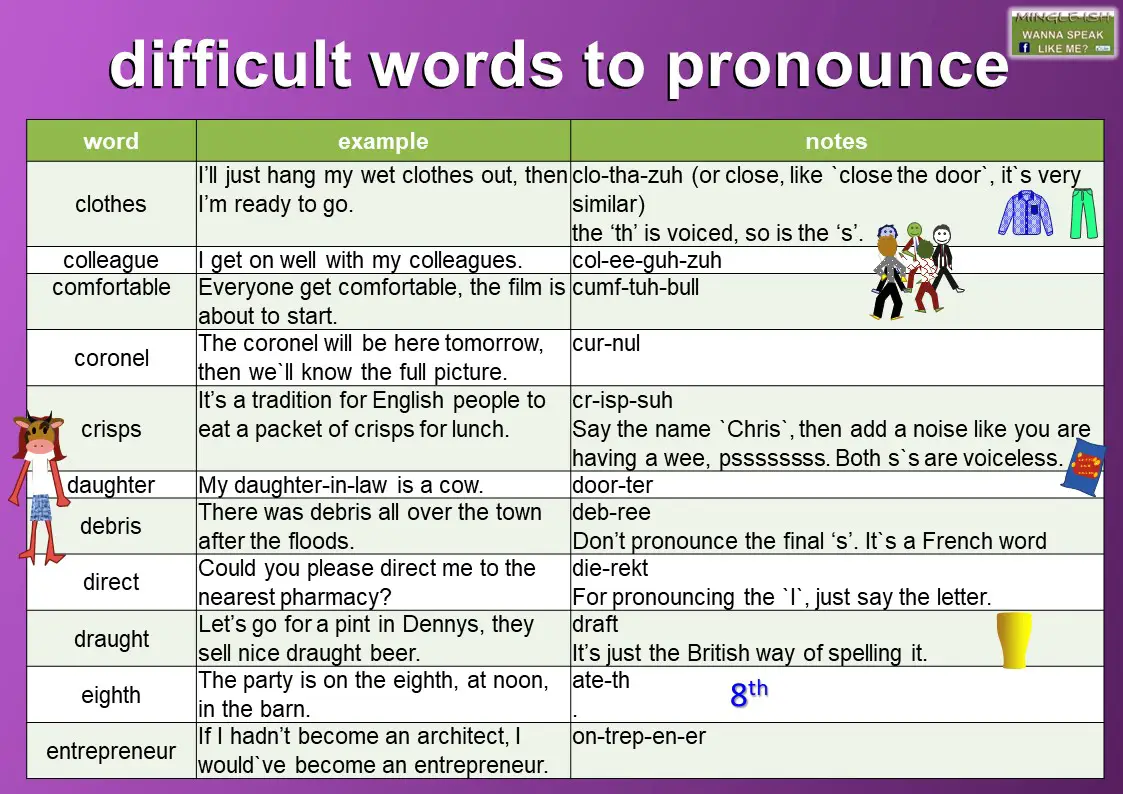
clothes

  • Example: I’ll just hang my wet clothes out, then I’m ready to go.
  • Pronunciation: klohthz
  • Notes: The th is voiced, and the final s is also voiced, making a z sound. It is very similar to the pronunciation of close in “close the door”.

colleague

  • Example: I get on well with my colleagues.
  • Pronunciation: KOL-eeg
  • Notes: The final ue is silent. In the plural, the final s is pronounced as a z sound.

comfortable

  • Example: Everyone, get comfortable. The film is about to start.
  • Pronunciation: KUMF-tuh-bul
  • Notes: There are normally three syllables. The or isn’t pronounced as a separate syllable.

colonel

  • Example: The colonel will be here tomorrow, then we’ll know the full picture.
  • Pronunciation: KUR-nul
  • Notes: This is one of those words where English spelling has gone completely rogue! Despite how it looks, colonel is pronounced as if it were spelled differently.

crisps

  • Example: It’s a tradition for English people to eat a packet of crisps for lunch.
  • Pronunciation: krisps
  • Notes: Start with the name Chris, then add an s sound. Both s sounds are voiceless.

daughter

  • Example: My daughter-in-law is a cow.
  • Pronunciation: DAW-tuh
  • Notes: The gh is silent.

debris

  • Example: There was debris all over the town after the floods.
  • Pronunciation: DEB-ree
  • Notes: Don’t pronounce the final s. The word comes from French.

direct

  • Example: Could you please direct me to the nearest pharmacy?
  • Pronunciation: dih-REKT / die-REKT
  • Notes: Both pronunciations are used in British English. The first syllable can have either a short i sound or the sound of the letter I.

draught

  • Example: Let’s go for a pint in Denny’s. They sell nice draught beer.
  • Pronunciation: draft
  • Notes: In British English, draught is pronounced the same as draft. It’s simply the British spelling.

eighth

  • Example: The party is on the eighth, at noon, in the barn.
  • Pronunciation: ayth
  • Notes: The gh is silent. The th is pronounced as an unvoiced sound, like the th in think.

entrepreneur

  • Example: If I hadn’t become an architect, I would’ve become an entrepreneur.
  • Pronunciation: on-truh-pruh-NUR
  • Notes: The stress is on the final syllable. It’s a word borrowed from French, which explains some of its slightly awkward spelling.
difficult vocabulary words

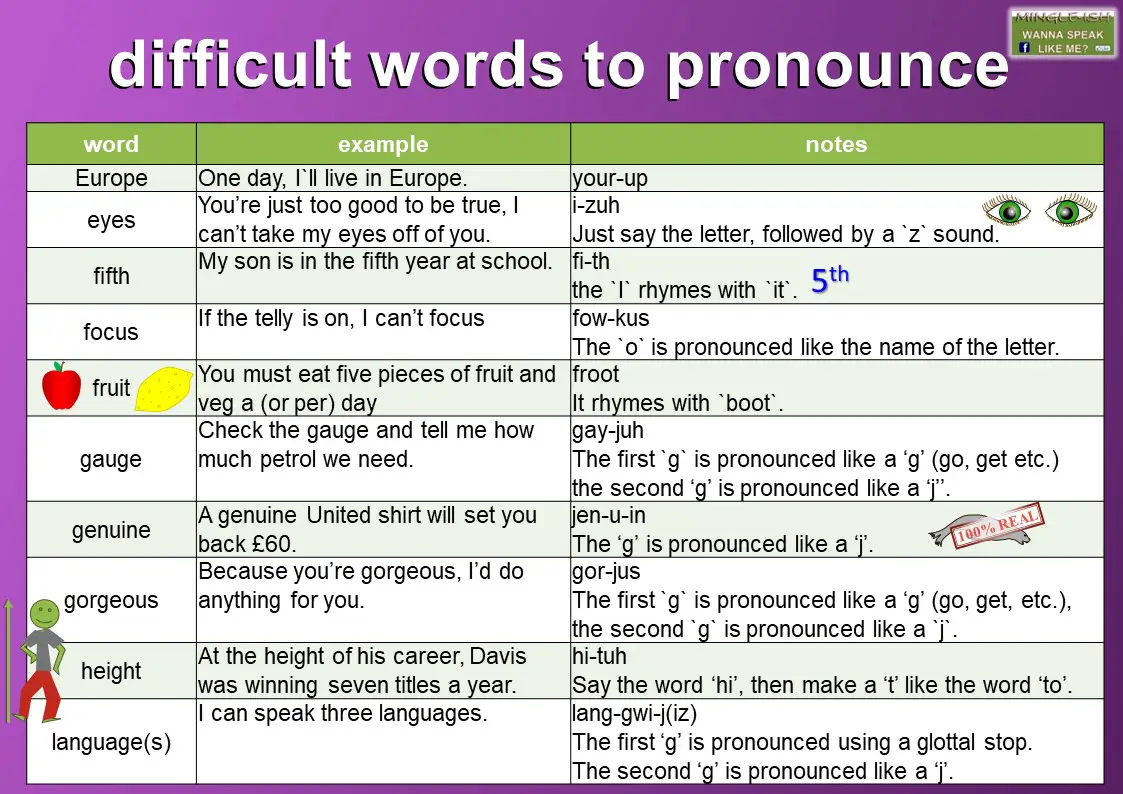
Europe

  • Example: One day, I’ll live in Europe.
  • Pronunciation: YUR-up
  • Notes: The first syllable sounds like your. The eu isn’t pronounced like the name of the letter E.

eyes

  • Example: You’re just too good to be true, I can’t take my eyes off you.
  • Pronunciation: eyez
  • Notes: Start with the sound of the letter I, followed by a z sound.

fifth

  • Example: My son is in the fifth year at school.
  • Pronunciation: fifth
  • Notes: The i rhymes with it. The th is an unvoiced sound, as in think. Take care not to add an extra vowel sound between the f and th.

focus

  • Example: If the telly is on, I can’t focus.
  • Pronunciation: FOH-kus
  • Notes: The first o is pronounced like the name of the letter O.

fruit

  • Example: You must eat five pieces of fruit and veg a day.
  • Pronunciation: froot
  • Notes: It rhymes with boot.

gauge

  • Example: Check the gauge and tell me how much petrol we need.
  • Pronunciation: gayj
  • Notes: The g is pronounced like a j sound. The u is silent, and the au produces the long ay sound.

genuine

  • Example: A genuine United shirt will set you back £60.
  • Pronunciation: JEN-yoo-in
  • Notes: The g is pronounced like a j. The word has three syllables.

gorgeous

  • Example: Because you’re gorgeous, I’d do anything for you.
  • Pronunciation: GOR-jus
  • Notes: The first g is pronounced like a normal g sound, as in go and get. The second g is pronounced like a j.

height

  • Example: At the height of his career, Davis was winning seven titles a year.
  • Pronunciation: hite
  • Notes: It rhymes with bite and light. The gh is silent.

language(s)

  • Example: I can speak three languages.
  • Pronunciation: LANG-gwij / LANG-gwij-iz
  • Notes: The g in language is pronounced like a g, while the g before e is pronounced like a j. In languages, the ending is pronounced as an extra syllable.
hard words to pronounce

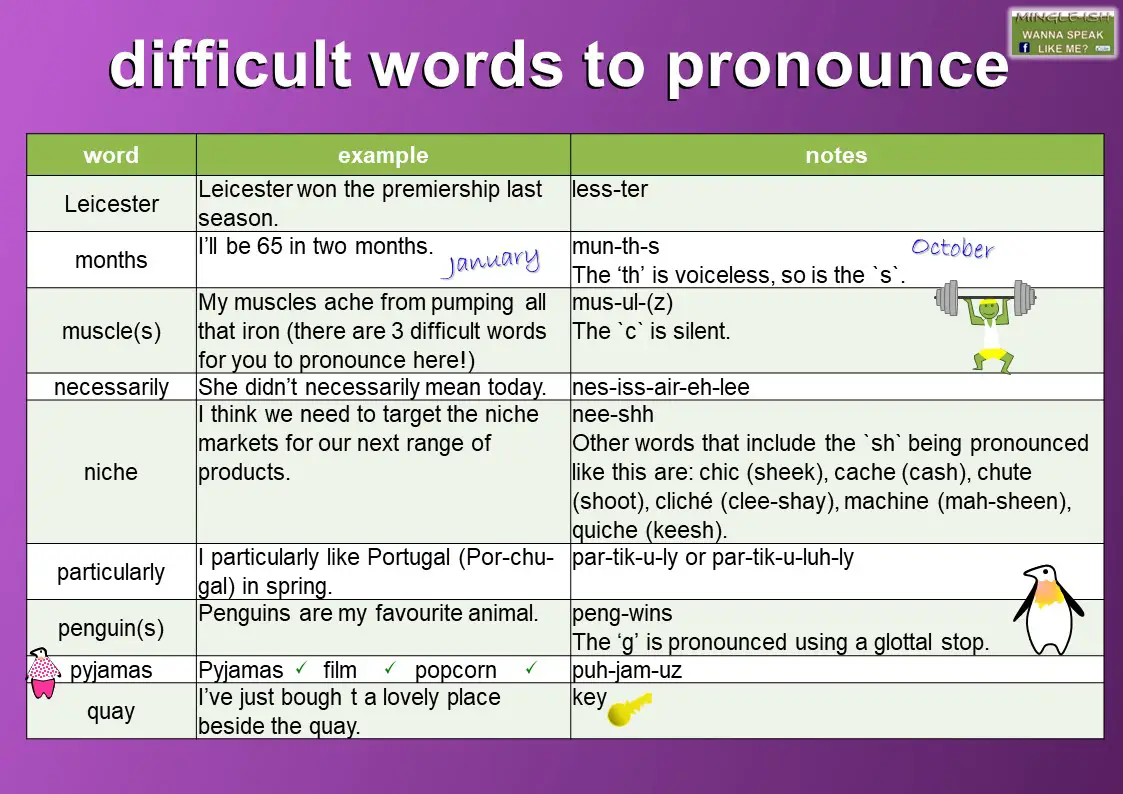
Leicester

  • Example: Leicester won the Premier League in 2016.
  • Pronunciation: LESS-ter
  • Notes: The c is silent, and the word has two syllables.

months

  • Example: I’ll be 65 in two months.
  • Pronunciation: munths
  • Notes: The th is unvoiced, as in think, and the final s is also unvoiced. The th and s sounds come together at the end, which can make this word particularly tricky.

muscle(s)

  • Example: My muscles ache from pumping all that iron. (There are three difficult words for you to pronounce here!)
  • Pronunciation: MUS-uhl / MUS-uhlz
  • Notes: The c is silent. In muscles, the final s is pronounced as a z sound.

necessarily

  • Example: She didn’t necessarily mean today.
  • Pronunciation: NESS-uh-ser-uh-lee
  • Notes: Don’t try to pronounce every letter exactly as it is written. The word has five syllables, with the stress on the first syllable.

niche

  • Example: I think we need to target the niche markets for our next range of products.
  • Pronunciation: neesh
  • Notes: The ch is pronounced like sh. Other words where ch is pronounced this way include chic, cache, chute, cliché, machine and quiche.

particularly

  • Example: I particularly like Portugal in spring.
  • Pronunciation: puh-TIK-yuh-luh-lee
  • Notes: The word has five syllables, with the main stress on the third syllable. The pronunciation can vary slightly in natural speech.

penguin(s)

  • Example: Penguins are my favourite animals.
  • Pronunciation: PENG-gwin / PENG-gwinz
  • Notes: The g is a normal g sound, not a glottal stop. The u combines with the i to produce the sound in win.

pyjamas

  • Example: Pyjamas, film, popcorn.
  • Pronunciation: puh-JAH-muhz
  • Notes: The j is pronounced like a j in jam, and the final s is pronounced as a z sound.

quay

  • Example: I’ve just bought a lovely place beside the quay.
  • Pronunciation: kee
  • Notes: The word is pronounced exactly like key. The spelling gives you absolutely no help whatsoever!
difficult vocabulary words

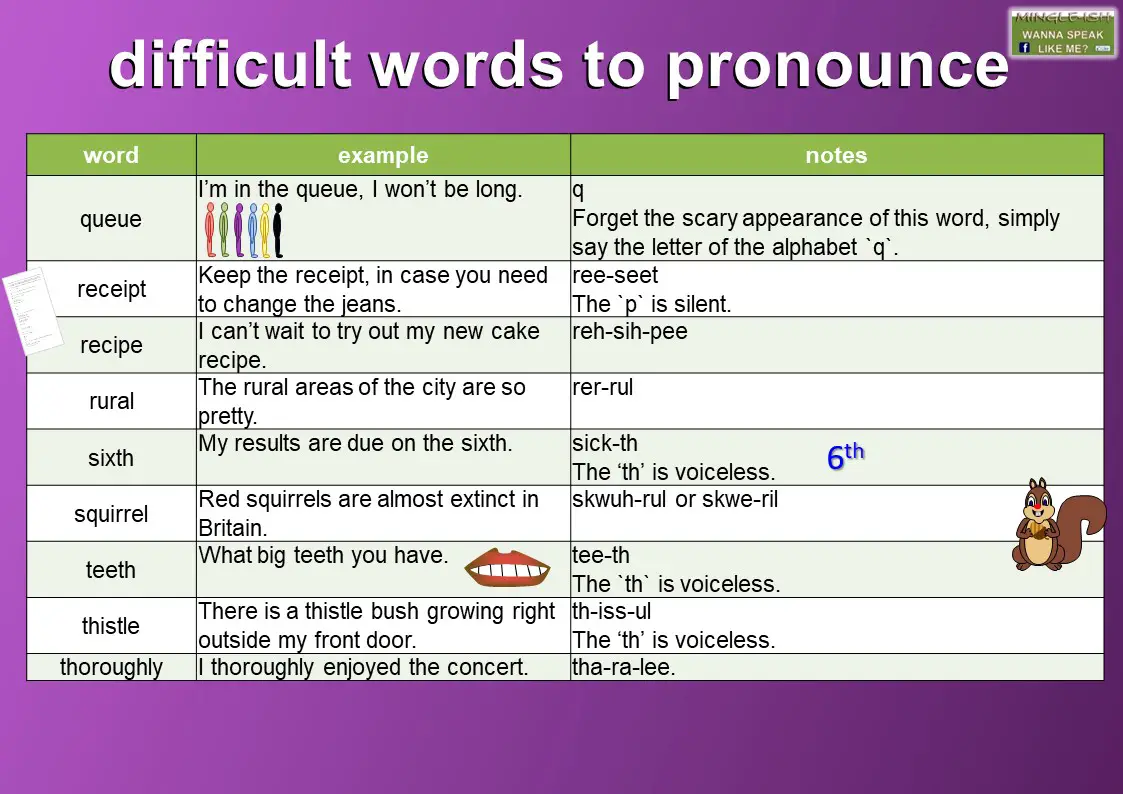
queue

  • Example: I’m in the queue, I won’t be long.
  • Pronunciation: kyoo
  • Notes: Forget the scary appearance of this word. Simply say the letter Q.

receipt

  • Example: Keep the receipt, in case you need to change the jeans.
  • Pronunciation: ri-SEET
  • Notes: The p is silent.

recipe

  • Example: I can’t wait to try out my new cake recipe.
  • Pronunciation: RES-uh-pee
  • Notes: The word has three syllables, with the stress on the first syllable. Don’t pronounce the c as an s sound.

rural

  • Example: The rural areas of the city are so pretty.
  • Pronunciation: ROOR-uhl
  • Notes: The two r sounds next to each other can make this word particularly tricky. Take your time and don’t try to say it too quickly.

sixth

  • Example: My results are due on the sixth.
  • Pronunciation: SIKSTH
  • Notes: The th is voiceless, as in think. The x represents a k sound followed by an s sound, so there are several consonant sounds together at the end.

squirrel

  • Example: Red squirrels are almost extinct in Britain.
  • Pronunciation: SKWIR-uhl
  • Notes: The combination of sounds in the middle of the word can make it tricky to pronounce. Take it slowly and concentrate on the skw sound.

teeth

  • Example: What big teeth you have.
  • Pronunciation: teeth
  • Notes: The th is voiceless, as in think.

thistle

  • Example: There is a thistle bush growing right outside my front door.
  • Pronunciation: THIS-uhl
  • Notes: The th is voiceless, as in think. The t is pronounced, so take care not to leave it out.

thoroughly

  • Example: I thoroughly enjoyed the concert.
  • Pronunciation: THUR-uh-lee
  • Notes: The word has four syllables, with the stress on the first syllable. The ough is pronounced like the ur sound in fur, and the final ly sounds like lee.
table of hard words to pronounce in English with pronunciation tips

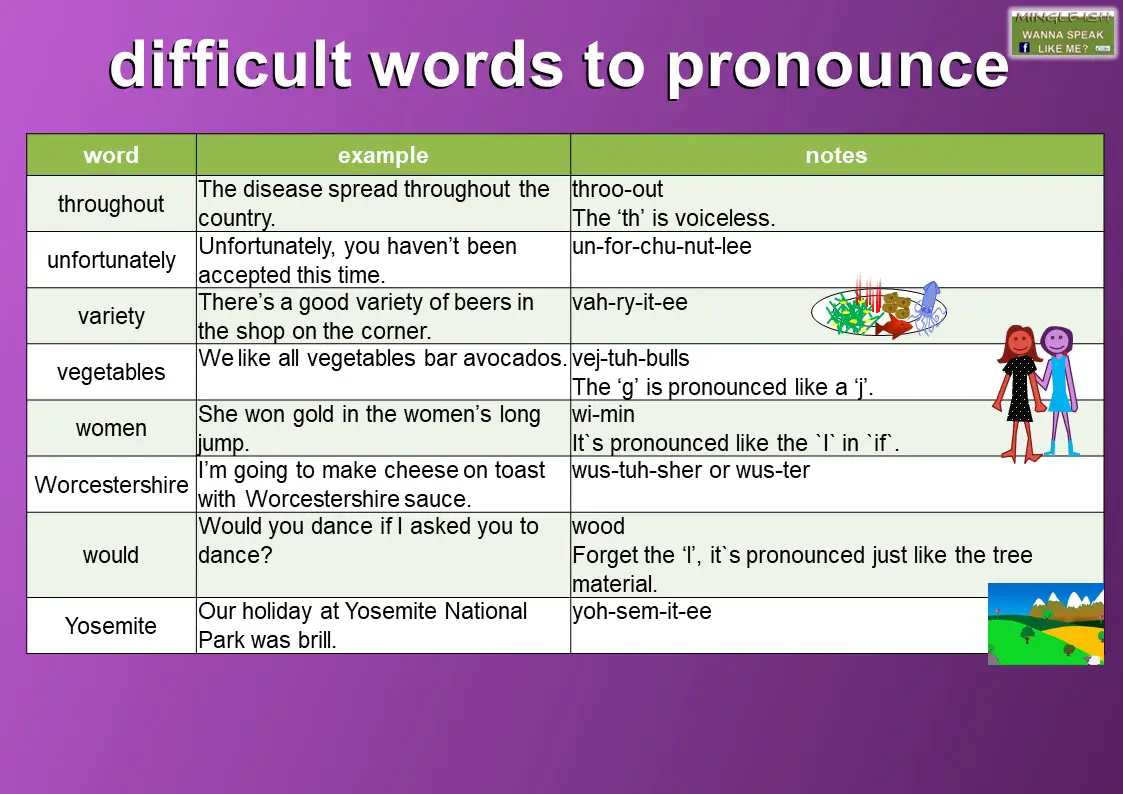
throughout

  • Example: The disease spread throughout the country.
  • Pronunciation: throo-OUT
  • Notes: The th is voiceless, as in think. The word has two syllables, with the stress on the second syllable.

unfortunately

  • Example: Unfortunately, you haven’t been accepted this time.
  • Pronunciation: un-FOR-chuh-nut-lee
  • Notes: The t in tunate is pronounced like a ch sound in natural British English. The word has five syllables, with the main stress on the second syllable.

variety

  • Example: There’s a good variety of beers in the shop on the corner.
  • Pronunciation: vuh-RY-uh-tee
  • Notes: The word has four syllables, with the main stress on the second syllable. The i in the third syllable is pronounced as a short uh sound.

vegetables

  • Example: We like all vegetables bar avocados.
  • Pronunciation: VEJ-tuh-bulz
  • Notes: The g is pronounced like a j. In natural British English, vegetables usually has three syllables rather than four.

women

  • Example: She won gold in the women’s long jump.
  • Pronunciation: WIM-in
  • Notes: The o is pronounced with the short i sound found in if. The word has two syllables.

Worcestershire

  • Example: I’m going to make cheese on toast with Worcestershire sauce.
  • Pronunciation: WUSS-tuh-sher
  • Notes: In British English, Worcestershire is commonly pronounced with three syllables. The spelling gives you very few clues about how to say it!

would

  • Example: Would you dance if I asked you to dance?
  • Pronunciation: wood
  • Notes: Forget the l – it’s silent. The word is pronounced like wood, the material that comes from trees.

Yosemite

  • Example: Our holiday at Yosemite National Park was brill.
  • Pronunciation: yoh-SEM-it-ee
  • Notes: The word has four syllables, with the main stress on the second syllable.
table of hard words to pronounce in English with pronunciation tip

Why Are Some English Words So Difficult to Pronounce?

English pronunciation can be confusing because English spelling and pronunciation don’t always match.

Sometimes a word contains silent letters. Sometimes the same combination of letters can produce completely different sounds. And sometimes a word has simply decided to ignore everything you thought you knew about pronunciation.

English has also borrowed words from many different languages, bringing some rather unusual spellings along with them.

So, if you’ve ever looked at a word and thought, “That can’t possibly be how you say it,” you’re certainly not alone.

English Words with Silent Letters

Silent letters are one of the biggest causes of pronunciation problems in English.

Why are the letters there if we’re not going to say them?

Good question.

Unfortunately, English has quite a collection of them.

Some examples include:

  • aisle
  • indict
  • knuckle
  • mortgage
  • plumber
  • pneumonia
  • psychology
  • receipt
  • salmon
  • subtle
  • yacht

The letters are written down perfectly clearly.

They just don’t make a sound.

English Words That Don’t Sound Like They Look

Some words are difficult because their pronunciation bears very little resemblance to their spelling.

Take:

colonel

queue

yacht

Worcestershire

If you’re learning English, words like these can be particularly frustrating.

And they’re not the only ones.

English spelling often gives you clues about pronunciation, but unfortunately, it doesn’t always give you the whole story.

Difficult Words with Tricky Spelling Patterns

Some English spelling patterns can be particularly confusing.

The famous -ough combination is a perfect example.

Compare:

  • though
  • thought
  • thorough
  • drought
  • draught
  • throughout

They all contain ough.

They don’t all sound the same.

Because apparently that would have been far too straightforward.

Long English Words That Are Difficult to Pronounce

Long words can look intimidating, but being long doesn’t necessarily make a word difficult to pronounce.

Breaking a word into syllables can make it much easier to tackle.

Some long words that can cause problems include:

  • conscientious
  • entrepreneur
  • hierarchy
  • juxtaposition
  • onomatopoeia
  • ubiquitous
  • unanimous

Rather than trying to say the whole word at once, break it into smaller sections and practise each part.

Then put it all back together.

Difficult Words Borrowed from Other Languages

English has borrowed words from languages all over the world.

Some have become such a normal part of English that we don’t even think about where they came from. Others have retained spellings that can make their pronunciation less obvious.

Examples include:

  • ballet
  • bourgeois
  • croissant
  • cuisine
  • genre
  • gnocchi
  • rendezvous
  • quinoa

These words are a good reminder that English pronunciation isn’t always predictable from spelling alone.

Commonly Mispronounced English Words

Some English words are particularly well known for being mispronounced.

Examples include:

  • espresso
  • et cetera
  • mischievous
  • nuclear
  • often
  • squirrel
  • vehicle

If you’ve been pronouncing one of these differently, don’t worry.

You’re certainly not the only one!

How to Pronounce Difficult English Words

When you come across a difficult English word, don’t just stare at the spelling and hope for the best.

Try these simple steps instead.

1. Break the Word into Syllables

Breaking a long word into smaller parts can make it much easier to pronounce.

2. Find the Word Stress

Listen for the syllable that receives the most emphasis.

Getting the stress right can make a big difference to how natural your pronunciation sounds.

3. Listen to the Word

Hearing a word pronounced correctly helps you connect the written word with its sounds.

4. Say It Slowly

Take your time and concentrate on the individual sounds.

5. Say It Naturally

Once you’re comfortable with the sounds, practise saying the whole word at normal speaking speed.

6. Use It in a Sentence

Using the word in context helps you become more comfortable with both its pronunciation and its meaning.

Pronunciation isn’t just about making the individual sounds correctly.

Stress is also extremely important.

In English, we don’t usually give every syllable or every word the same amount of emphasis.

Within a word, one syllable is usually stressed more strongly than the others. This is called word stress.

In a sentence, certain words are normally given more emphasis than others. This is called sentence stress.

Learning to recognise and use stress can make your English sound much more natural.

Enjoyed getting your tongue around some of those tricky English words?

Well, there’s plenty more where that came from!


More English Pronunciation Guides

Prefer learning by watching rather than reading?

Head over to the Mingle-ish YouTube channel, where you’ll find lots of English pronunciation videos, explanations and pronunciation practice.

So grab a cup of tea, warm up those vocal cords and get practising!

Further English Pronunciation Learning