
Here’s a list of the most common words where the ‘e’ is silent: bake, bike, bite, cake, come, date, drive, fine, give, hate, home, hope, live, love, made, make, name, note, plane, rate, ride, same, shape, take, time, type, use, wake, wave, write.
Have you ever met a word that looks like it should end with an obvious “ee” sound, only for English to quietly ignore the final letter? Welcome to the silent ‘e’. This tiny letter might not speak, but it is very busy behind the scenes. It changes sounds, shifts meanings, and regularly confuses learners. Let’s make sense of it.
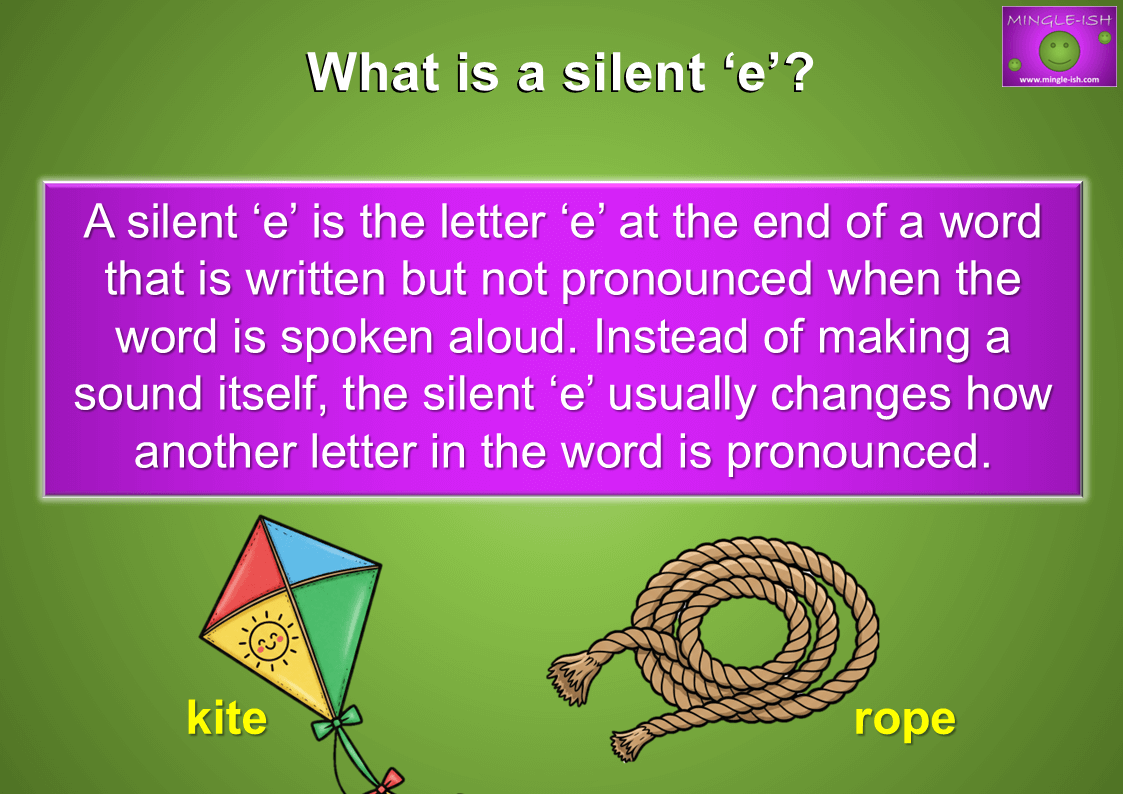
What is a Silent ‘E’?
It is the letter ‘e’ at the end of a word that is written but not pronounced when the word is spoken aloud. You will see it in many common English words, even though you never actually hear it. Instead of making a sound itself, the silent ‘e’ usually changes how another letter in the word is pronounced.
Why English Uses a Silent ‘E’
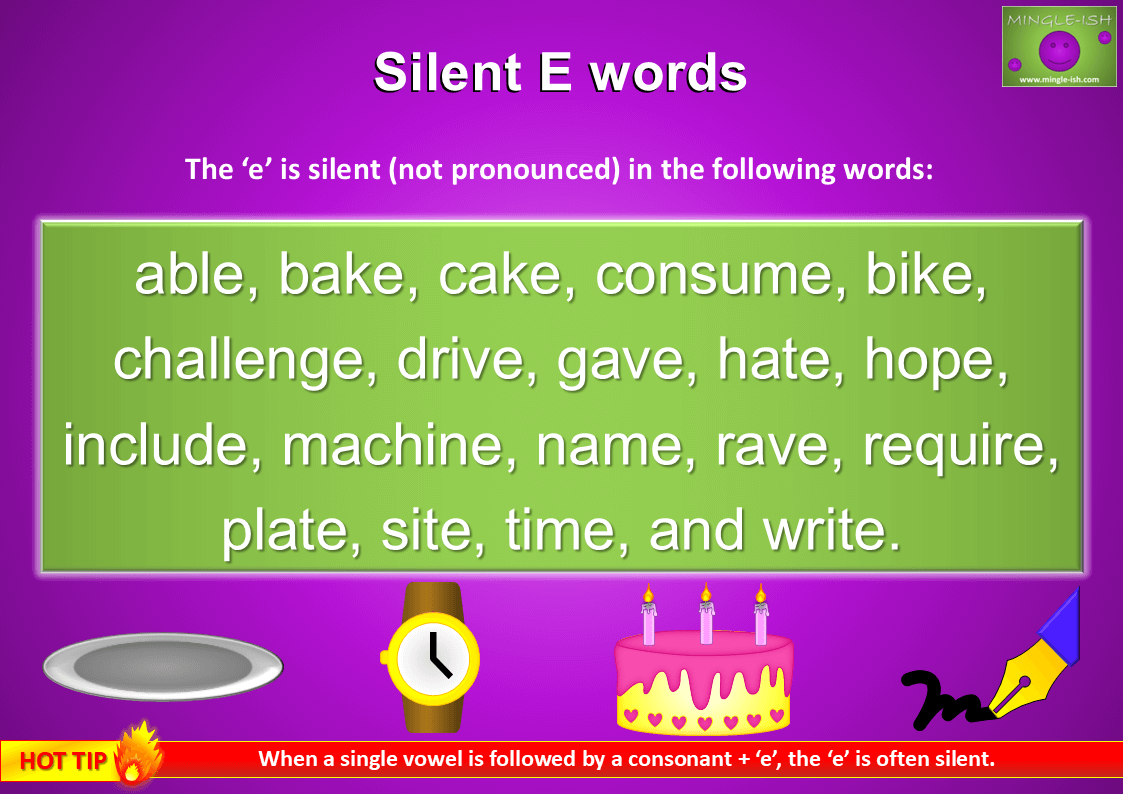
English did not add silent letters just to be awkward, although it can feel that way. The silent ‘e’ often exists to signal pronunciation, distinguish between similar words, or reflect older spelling patterns from the past. In many cases, it helps the reader know how a word should sound before it is spoken.
For example:
- The silent ‘e’ signals pronunciation: hope vs hop (the ‘e’ tells you the ‘o’ is long), rate vs rat (the ‘e’ makes the ‘a’ long).
- It distinguishes between similar words: rose (flower) vs roses (plural), plane (aircraft) vs plan (idea).
- It reflects older spelling patterns: name, time, like all kept the final ‘e’ from Middle English even though it’s not pronounced now.
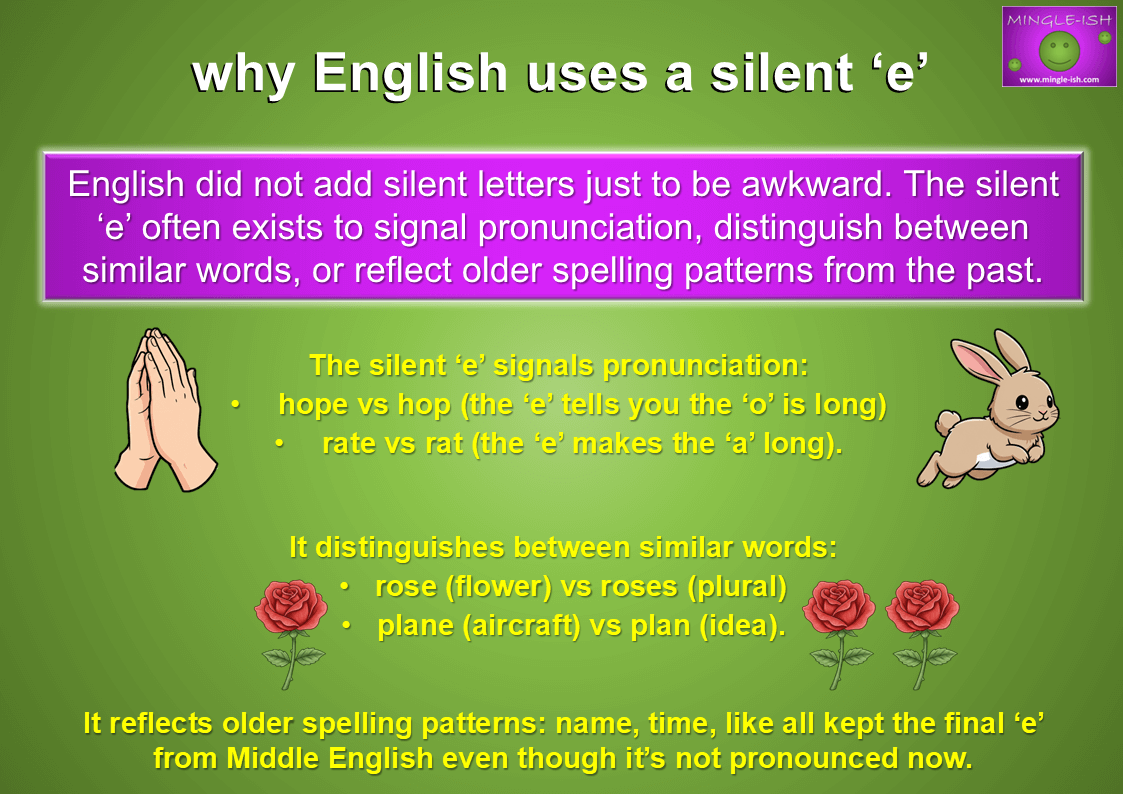
Common Words With a Silent ‘E’
You will see this silent letter everywhere in everyday English. It appears in short words, longer words, and very familiar vocabulary. Once you start noticing it, you will see it far more often than you expect, especially in reading and spelling.
When is the Letter ‘E’ Silent in English?
In English pronunciation, the letter ‘e’ is often silent, especially at the end of words. This silent ‘e’ is not random. It follows several clear spelling and pronunciation patterns that help readers understand how a word should sound, what it means, or where it comes from historically. Let’s take a look at the rules…
The magic ‘e’ rule (long vowel sounds)
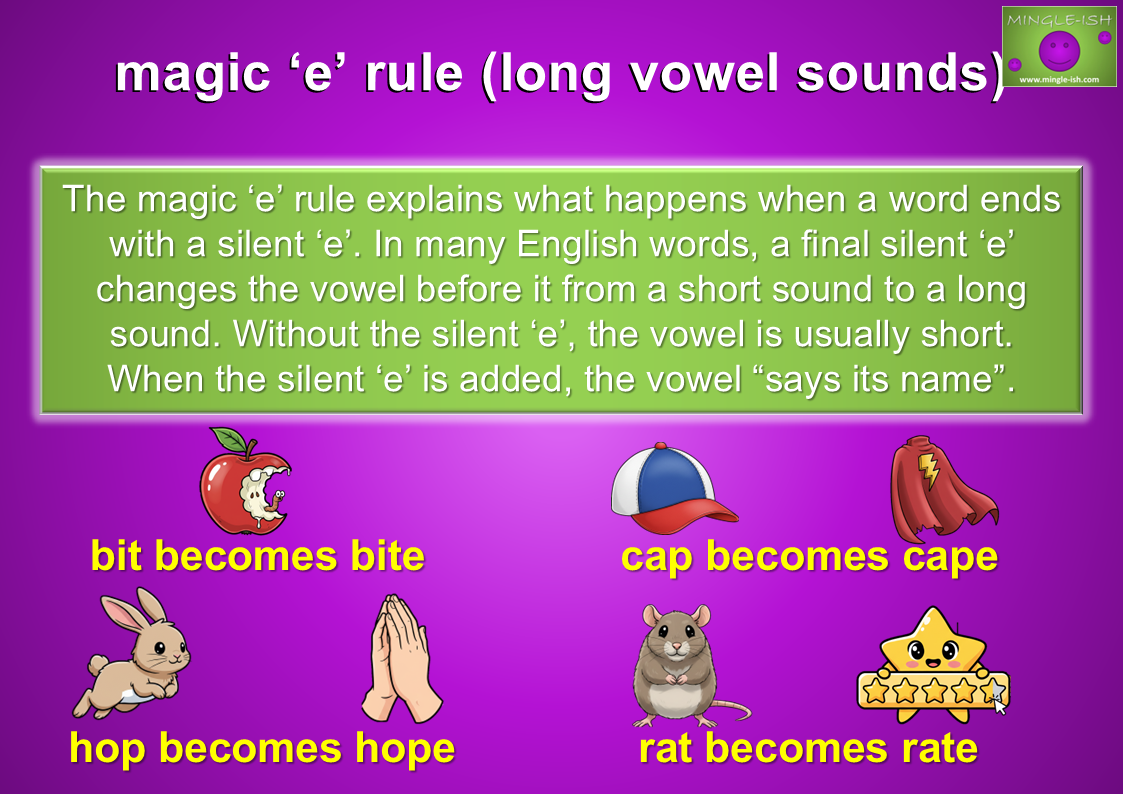
The magic ‘e’ rule explains what happens when a word ends with a silent ‘e’. In many English words, a final silent ‘e’ changes the vowel before it from a short sound to a long sound. This helps the reader understand how the word should be pronounced before it is spoken aloud.
Without the silent ‘e’, the vowel is usually short. When the silent ‘e’ is added, the vowel “says its name”, which is why this rule is sometimes called the magic ‘e’ rule.
This is one of the most important pronunciation rules in English spelling and reading.
For example:
- bit becomes bite
- cap becomes cape
- hop becomes hope
- rat becomes rate.
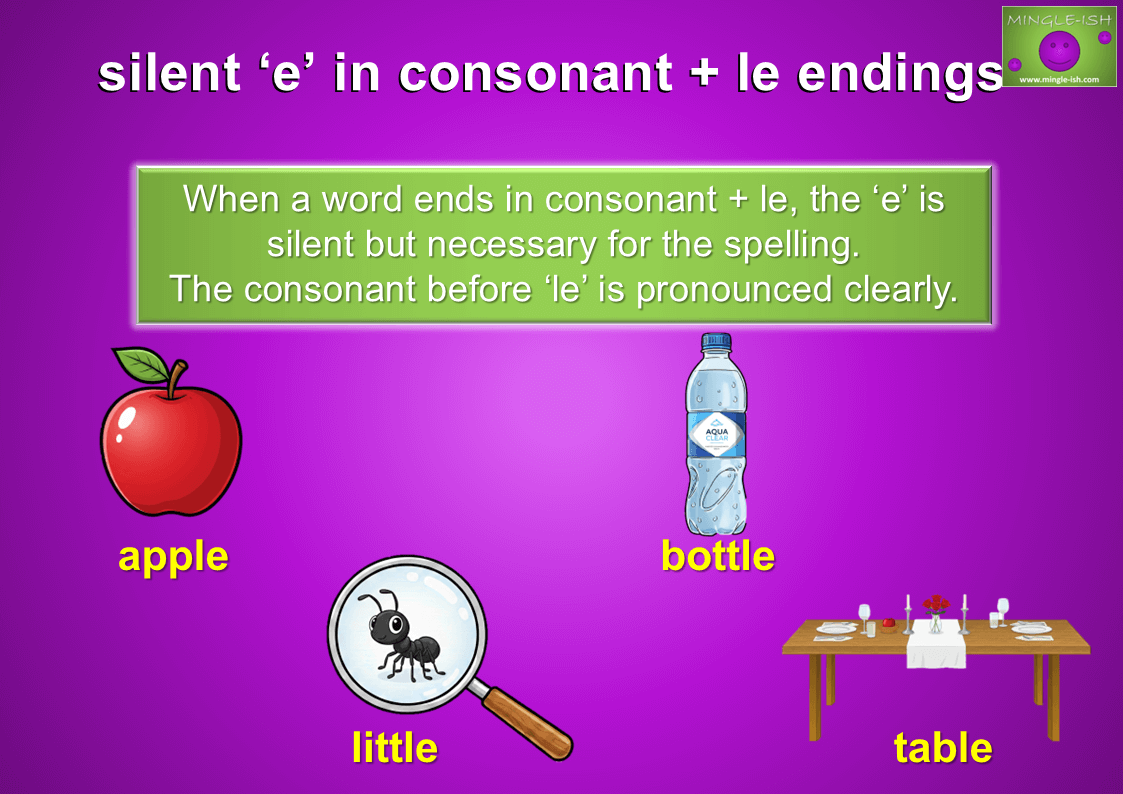
Silent ‘e’ in consonant + le endings
When a word ends in consonant + le, the ‘e’ is silent but necessary for the spelling. The consonant before ‘le’ is pronounced clearly.
For example:
- apple
- bottle
- little
- table
- simple
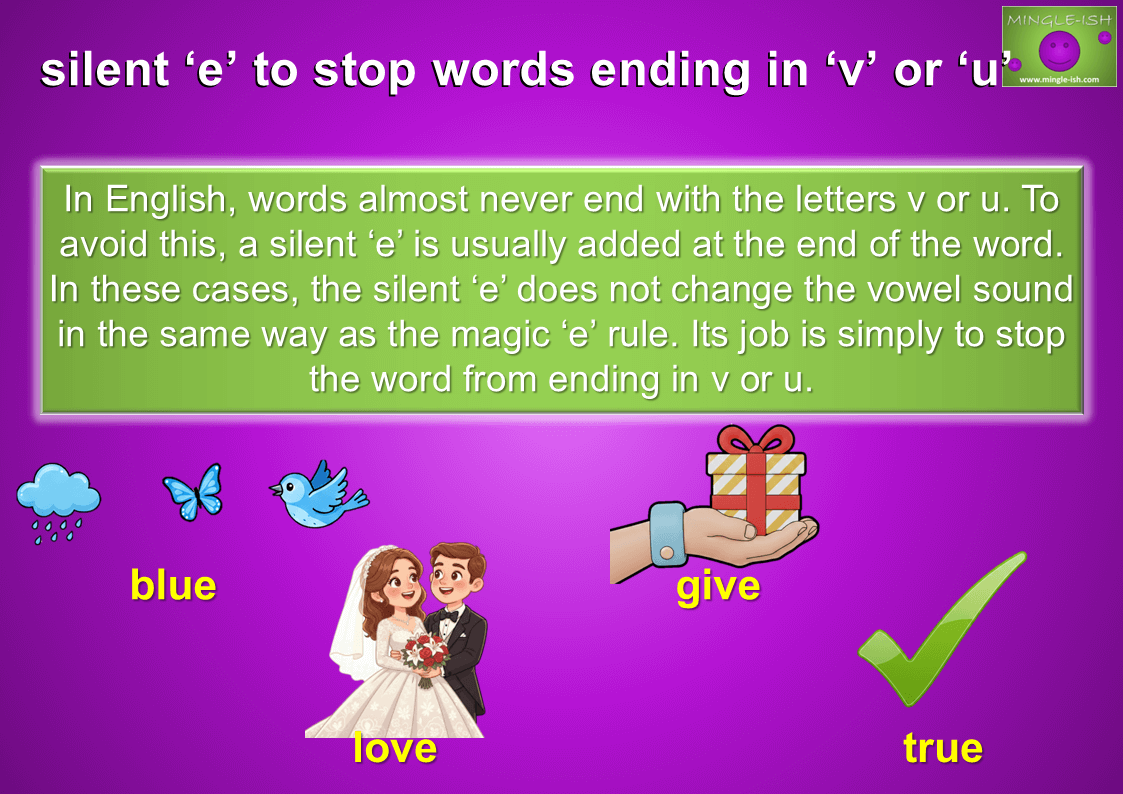
Silent ‘e’ to stop words ending in ‘v’ or ‘u’
In English, words almost never end with the letters v or u. To avoid this, a silent ‘e’ is usually added at the end of the word. This ‘e’ is not pronounced, but it allows the word to follow English spelling rules and look more natural to native readers.
In these cases, the silent ‘e’ does not change the vowel sound in the same way as the magic ‘e’ rule. Its job is simply to stop the word from ending in v or u.
For example:
- blue
- give
- have
- live
- love
- true.
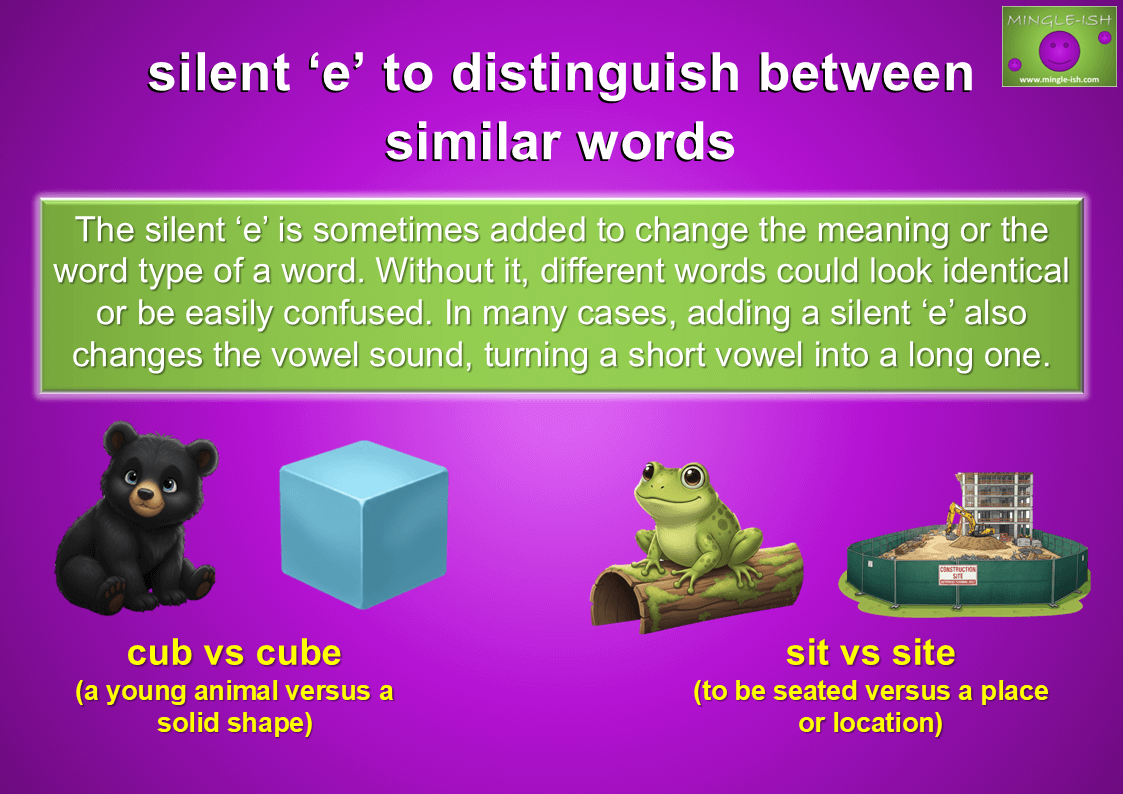
Silent ‘e’ to distinguish between similar words
The silent ‘e’ is sometimes added to change the meaning or the word type of a word. Even though the ‘e’ is not pronounced, it plays an important role in helping readers tell similar-looking words apart. Without it, different words could look identical or be easily confused.
In many cases, adding a silent ‘e’ also changes the vowel sound, turning a short vowel into a long one. This creates a clear difference in both spelling and meaning, making written English easier to understand.
For example:
- cub vs cube (a young animal versus a solid shape)
- hop vs hope (an action versus a feeling or wish)
- mad vs made (feeling angry or crazy versus something created)
- not vs note (a negative word versus a written or musical message)
- past vs paste (a time reference versus a substance)
- plan vs plane (an idea versus a type of transport)
- sit vs site (to be seated versus a place or location)
- us vs use (a pronoun versus a verb).
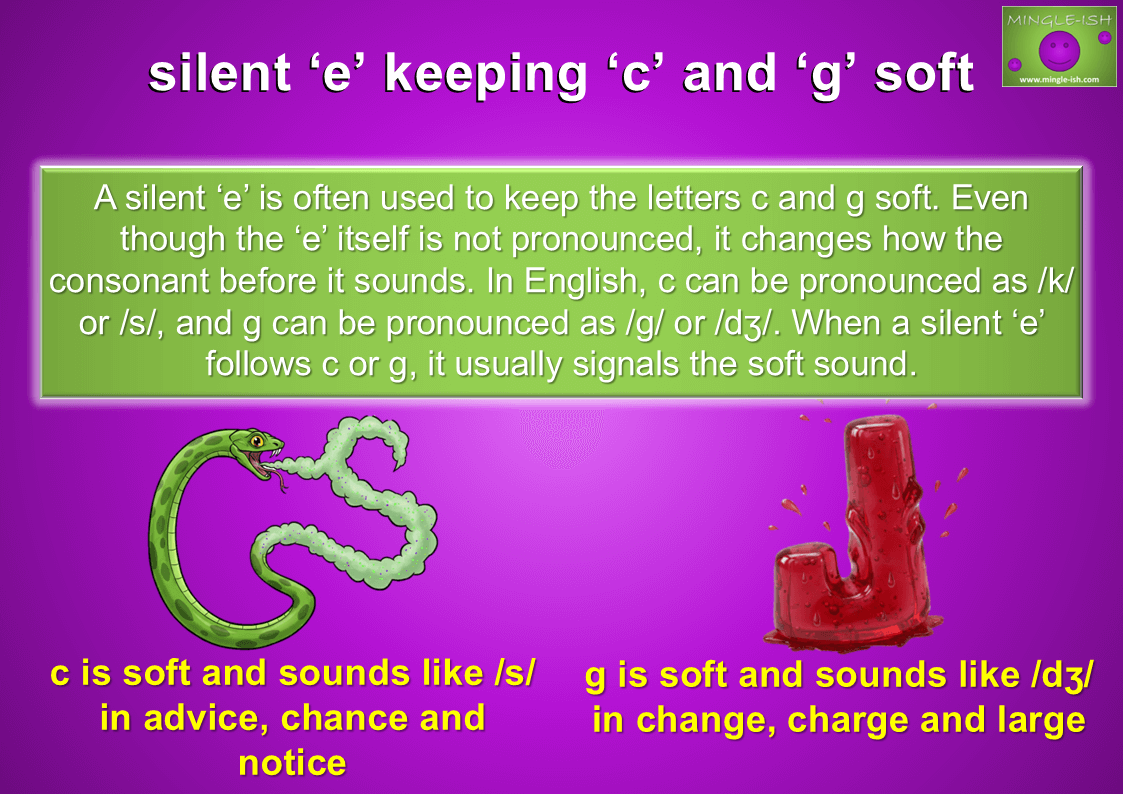
Silent ‘e’ keeping ‘c’ and ‘g’ soft
A silent ‘e’ is often used to keep the letters c and g soft. Even though the ‘e’ itself is not pronounced, it changes how the consonant before it sounds.
In English, c can be pronounced as /k/ or /s/, and g can be pronounced as /g/ or /dʒ/. When a silent ‘e’ follows c or g, it usually signals the soft sound. This helps readers know how to pronounce the word correctly.
For example:
- c is soft and sounds like /s/ in advice, chance and notice
- g is soft and sounds like /dʒ/ in change, charge and large.
Silent ‘e’ from older spelling patterns
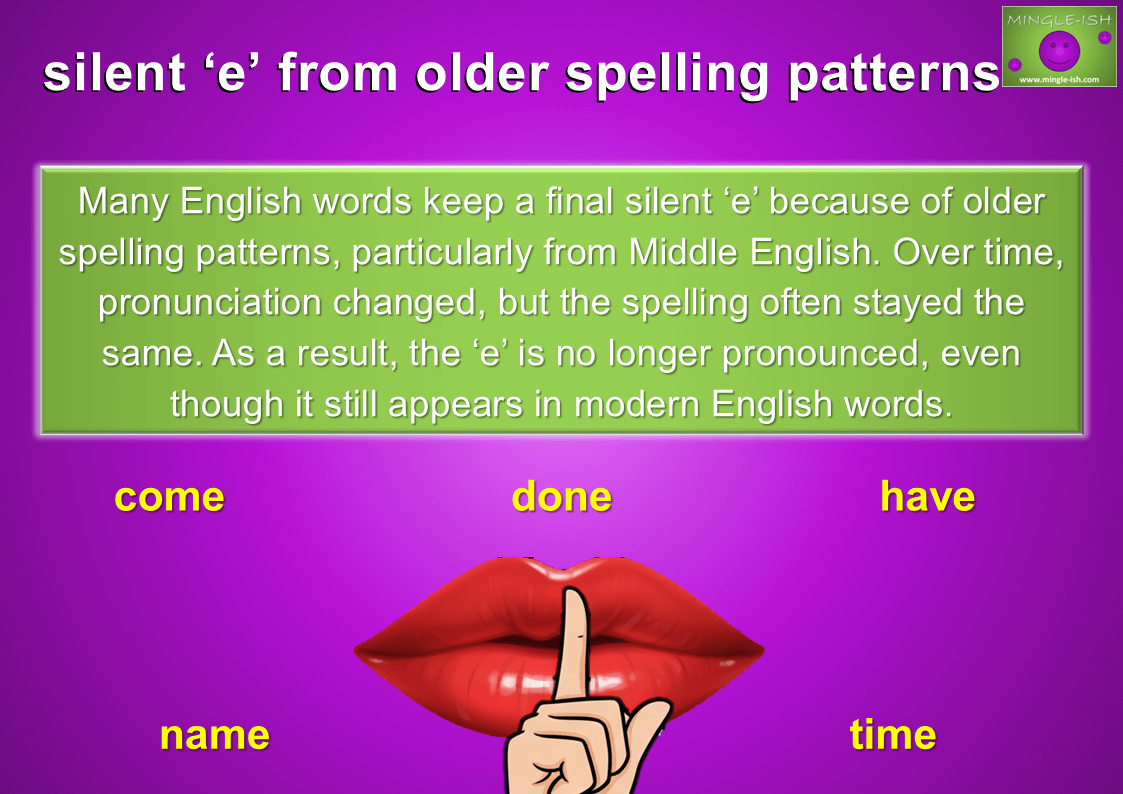
Many English words keep a final silent ‘e’ because of older spelling patterns, particularly from Middle English. Over time, pronunciation changed, but the spelling often stayed the same. As a result, the ‘e’ is no longer pronounced, even though it still appears in modern English words.
In the past, this final ‘e’ was often spoken or had a grammatical purpose. As English evolved, these sounds disappeared, but the spelling remained. This is one reason English spelling can feel inconsistent or confusing for learners.
For example:
- come
- done
- have
- name
- some
- time.
Silent ‘e’ in common function words
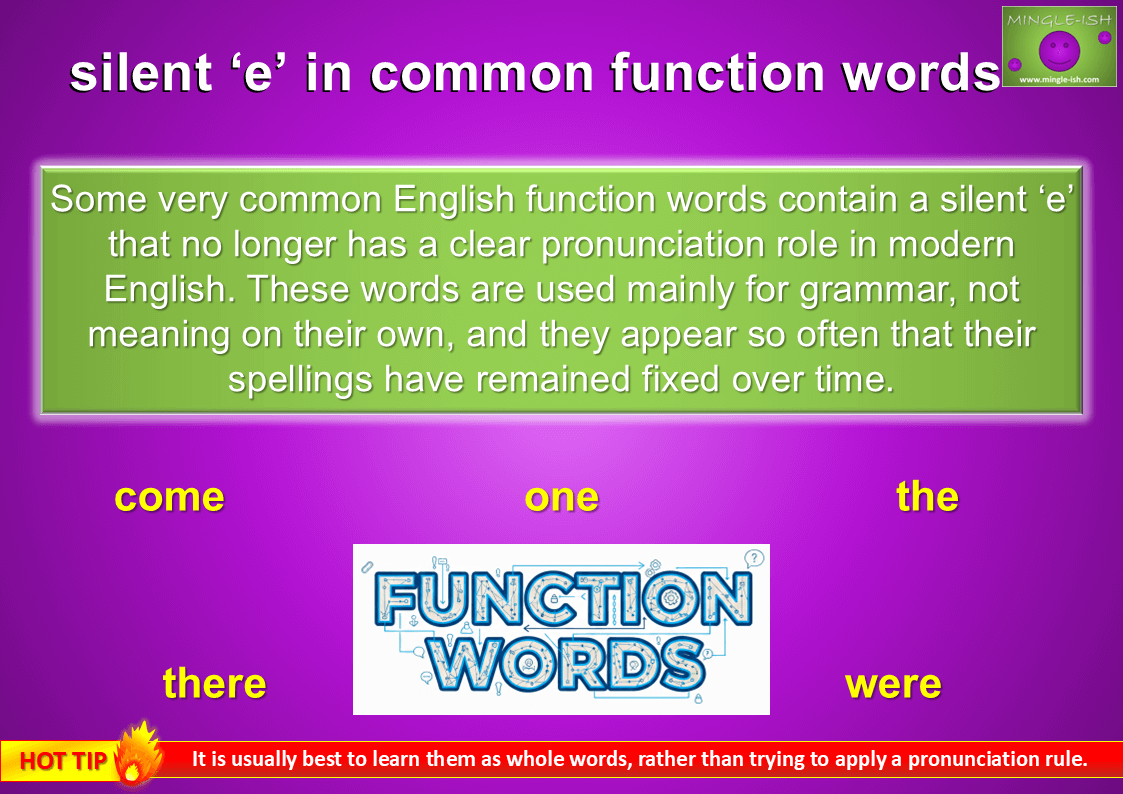
Some very common English function words contain a silent ‘e’ that no longer has a clear pronunciation role in modern English. These words are used mainly for grammar, not meaning on their own, and they appear so often that their spellings have remained fixed over time.
In many cases, the silent ‘e’ comes from older forms of English or helps keep the word visually distinct from other similar words. Even though the ‘e’ is not pronounced and does not follow the usual magic ‘e’ rule, it is still an important part of the word’s spelling.
For example, have, one, the, and were all contain a silent ‘e’ that learners might expect to hear, but do not. Other common examples include give, some, come, and there.
Because these words are so frequent, it is usually best to learn them as whole words, rather than trying to apply a pronunciation rule.
When the silent ‘e’ disappears
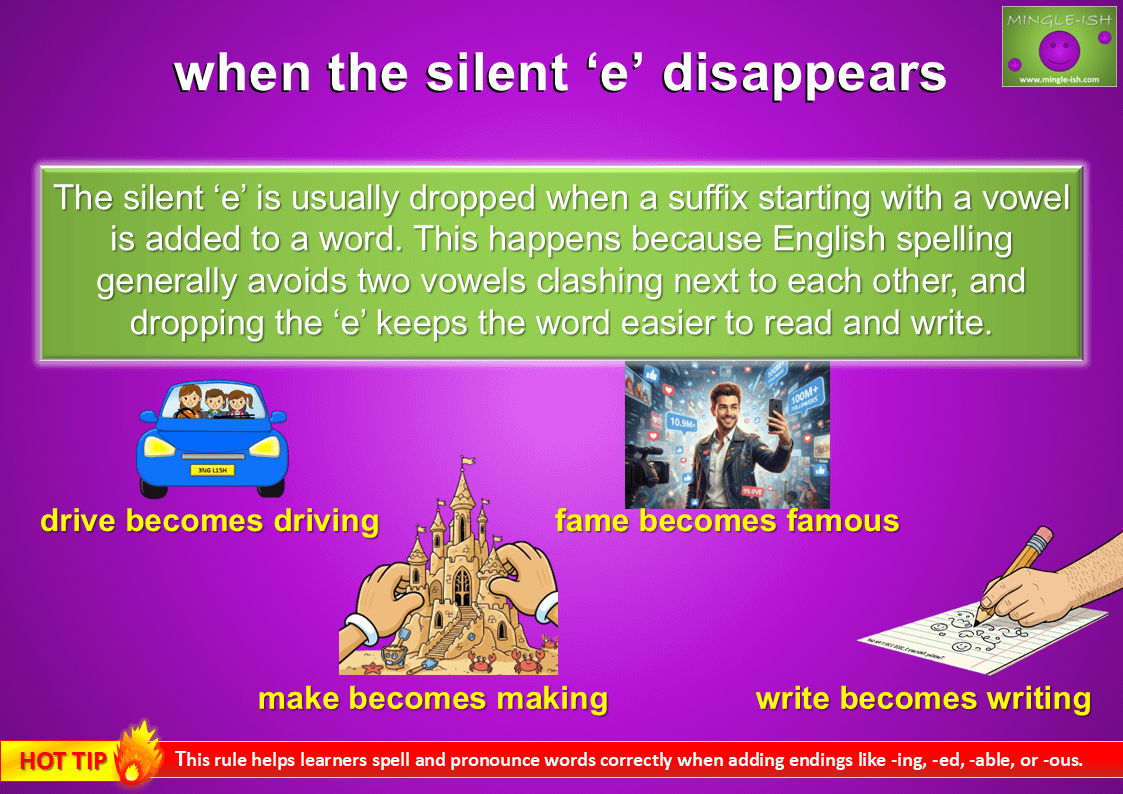
The silent ‘e’ is usually dropped when a suffix starting with a vowel is added to a word. This happens because English spelling generally avoids two vowels clashing next to each other, and dropping the ‘e’ keeps the word easier to read and write.
Even though the ‘e’ disappears, the word often keeps its long vowel sound from the original word. This rule applies to many common verbs and adjectives when forming tenses or derivatives.
For example:
- drive → driving
- fame → famous
- hope → hoping
- love → loving
- make → making
- use → using
- write → writing.
In each case, the silent ‘e’ is dropped because the suffix starts with a vowel, but the original vowel sound is preserved. Understanding this rule helps learners spell and pronounce words correctly when adding endings like -ing, -ed, -able, or -ous.
When the Final ‘E’ is not Silent
The final ‘e’ is not always silent in English. In some words, the ‘e’ is fully pronounced, especially in longer words or where it forms part of a clear vowel sound at the end of the word. These words often come from other languages, such as French, Italian, or Latin, where final vowel sounds are more common.
In these cases, the final ‘e’ usually sounds like /iː/ or /eɪ/, and it is an important part of how the word is spoken. This is why English pronunciation cannot rely on spelling rules alone. The spelling gives useful clues, but listening practice is essential for confirming how a word is pronounced.
For example, the final ‘e’ is pronounced in café, fiancée, resume, recipe, and karate. It is also pronounced in some longer or technical words such as athlete, concrete, and apostrophe.
Understanding that the final ‘e’ is sometimes pronounced helps learners avoid assuming that all ‘e’s at the end of words are silent. When in doubt, hearing the word spoken aloud is often the best way to be sure.
Silent E Quiz: English Spelling Practice for Learners
Think you can spot the silent E in tricky words? Try our quizzes and see how well you know these sneaky letters. Love a challenge? Hop over to our YouTube channel for more fun English quizzes and boost your spelling skills while having a laugh!
Final Thoughts
The silent ‘e’ may not make a sound, but it plays a big role in how English words are pronounced and understood. Once you start spotting it, reading becomes easier, pronunciation becomes clearer, and spelling begins to make more sense. A quiet letter, but a powerful one.
Related Pronunciation Topics
If you found this useful, you might also enjoy exploring other pronunciation patterns. more silent letters, vowel sounds, word stress, and voiced and voiceless sounds all link closely with how the silent ‘e’ works in real English.