
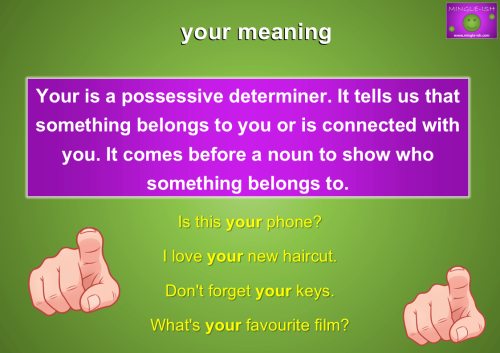
Your
Your is a possessive determiner. It tells us that something belongs to you or is connected with you. It comes before a noun to show who something belongs to.
Think of it as belonging to you.
Examples:
- Is this your phone?
- I love your new haircut.
- Don’t forget your keys.
- What’s your favourite film?
So, whenever you’re talking about something that belongs to you or is connected with you, your is the word you need.
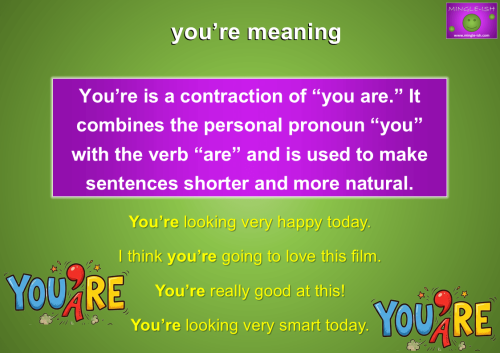
You’re
You’re is a contraction of “you are.” It combines the personal pronoun “you” with the verb “are” and is used to make sentences shorter and more natural.
Think of it as you are squashed together.
Examples:
- You’re looking very happy today.
- I think you’re going to love this film.
- You’re really good at this!
- You’re looking very smart today.
Here’s a really easy trick:
If you can replace you’re with you are and the sentence still makes sense, you’re is the word you need.
For example:
You’re going to love this.
You are going to love this. ✓
But:
I like your new shoes.
I like you are new shoes. ✗
So that’s your and you’re sorted!
Well… hopefully.
Your vs You’re (simple comparison)
| Your | You’re |
|---|---|
| Belonging to you | You are |
| Your house | You’re funny |
| Your dog | You’re right |
| Your favourite food | You’re going home |
Remember the difference
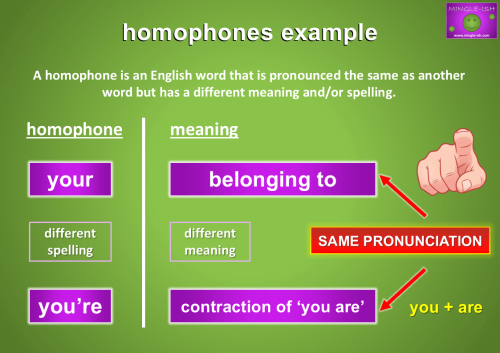
YOUR = belongs to you
YOU’RE = YOU ARE
It’s as simple as that!
Your vs You’re Examples
Here are a few more examples to help you get your head around the difference between your and you’re.
Your
- Is that your coat?
- I really like your new car.
- Have you finished your homework?
You’re
- You’re always late!
- I hope you’re feeling better.
- You’re going to miss the bus!
See the difference?
Your tells us that something belongs to you, while you’re means you are.
Common Mistakes with Your and You’re
Your and you’re are easy to mix up because they sound exactly the same. But using the wrong one can completely change whether your sentence is correct.
Here are some of the most common mistakes:
❌ Your going to love this film.
✅ You’re going to love this film.
Here, you’re means you are.
❌ I really like you’re new shoes.
✅ I really like your new shoes.
The shoes belong to you, so we need your.
❌ Your very funny!
✅ You’re very funny!
You can replace you’re with you are, so you’re is correct.
❌ Don’t forget you’re coat.
✅ Don’t forget your coat.
The coat belongs to you, so we need your.
❌ I hope your having a good day.
✅ I hope you’re having a good day.
You’re means you are: “I hope you are having a good day.”
The quick trick
Still not sure which one to use?
Try replacing you’re with you are.
If the sentence still makes sense, use you’re.
If it doesn’t, you probably need your.
Your = belonging to you
You’re = you are
Simple, right? Just remember that apostrophe!
Further study
Final thought
Your = belongs to you.
You’re = you are.
Easy, right? Just remember the apostrophe, and you’re good to go!