
“Accept” and “except” might look like they’ve been separated at birth, but they behave very differently once you put them into a sentence. One is all about agreeing or receiving something, while the other is more about leaving things out. In this guide, you’ll quickly get the hang of both, with simple examples to stop them tripping you up in real life writing, speaking, and exams.

Quick meaning

“Accept” means to receive or agree to something. “Except” means to leave something out or exclude it. They sound similar, but they behave very differently in sentences.

What does accept mean?

“Accept” is a verb used when you agree to something, receive something, or say yes to an offer.

examples of accept:

  • I accept your apology.
  • She accepted the job offer.
  • He accepted the invitation to the part.
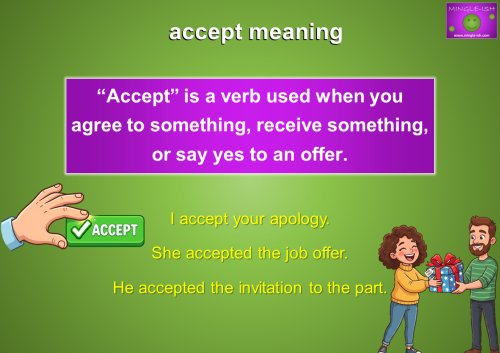
Accept meaning image showing accept as agreeing, receiving something, or saying yes with examples and an accept button.

What does except mean?

“Except” is used when you are excluding something or leaving something out.

examples of except:

  • Everyone went to the party except John.
  • I like all vegetables except broccoli.
  • The shop is open every day except Sunday.
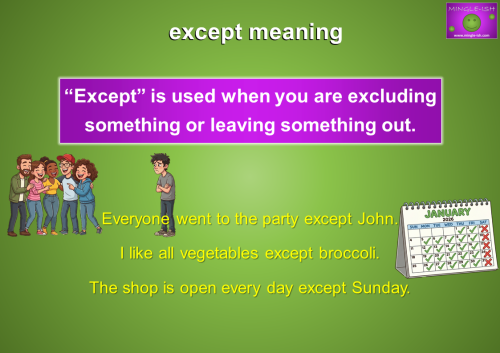
Educational graphic explaining the "except meaning" with cartoon illustrations of social exclusion and a calendar marked with daily ticks and weekend crosses.

Accept vs Except (simple comparison)

  • Accept = to receive or agree
  • Except = to exclude or leave out

If you can swap it with “agree” or “take”, it’s probably accept.
If you mean “but not” or “excluding”, it’s probably except.
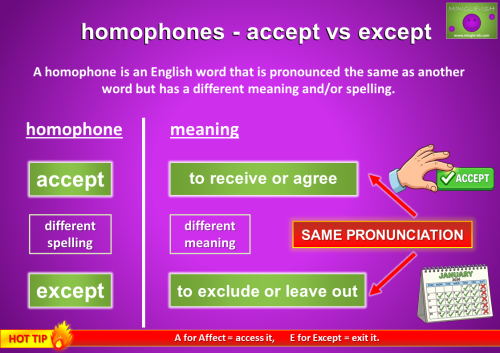
Educational infographic explaining the difference between the homophones "accept" and "except," showing their different meanings and spellings alongside illustrative icons.

Common mistakes with accept vs except

People often mix these up because they sound almost identical when spoken. A common mistake is writing “I except your offer” instead of “I accept your offer”.

Quick fix:
If it sounds like you’re saying yes, use accept.
If it sounds like you’re leaving something out, use except.

Easy memory trick for accept and except

Think of “accept” as “access it” (you take it in).
Think of “except” as “exit it” (you leave it out).

Not perfect science, but it sticks in your head.

Further study

If accept and except have finally stopped pretending to be twins in your head, why stop now? Head back to our main homophones page to explore loads more confusing word pairs and sharpen your English one tricky word at a time.

If you enjoy word puzzles and sneaky little language traps, you might also like learning about homographs and homonyms. English does love to keep things interesting.

Prefer learning by video? Pop over to our YouTube channel where you’ll find plenty more fun lessons, quizzes, pronunciation practice, grammar tips, and vocabulary videos on all sorts of topics.