
Aloud vs Allowed
What do aloud and allowed mean?
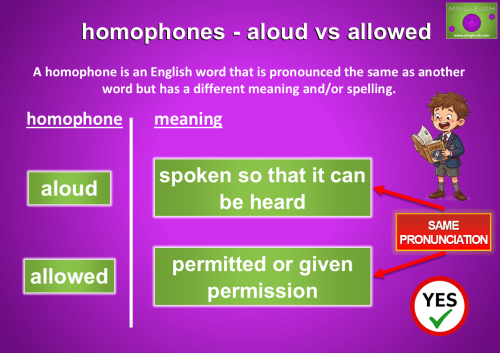
These are homophones. That means they are pronounced the same but have different spellings and meanings.
Aloud
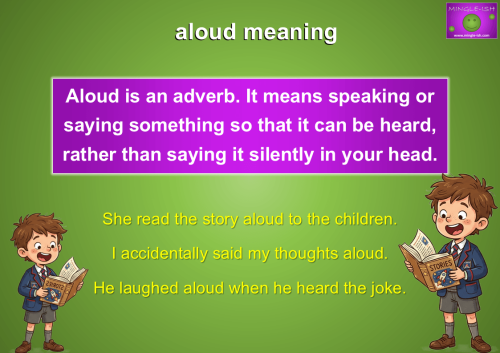
Aloud is an adverb. It means speaking or saying something so that it can be heard, rather than saying it silently in your head.
Think reading, speaking, laughing, shouting, or basically making a sound with your voice instead of keeping it to yourself.
Examples:
- She read the story aloud to the children.
- I accidentally said my thoughts aloud.
- He laughed aloud when he heard the joke.
Allowed
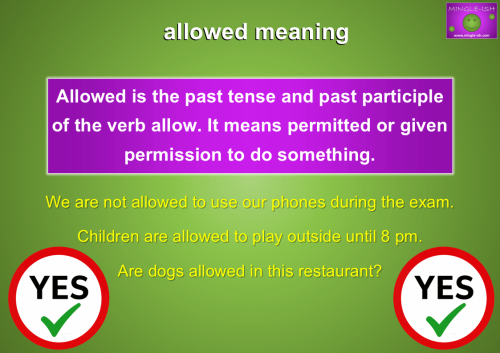
Allowed is the past tense and past participle of the verb allow. It means permitted or given permission to do something.
Think rules, permission, signs, teachers, parents, bosses, and anyone else who gets to decide what you can and cannot do.
Examples:
- We are not allowed to use our phones during the exam.
- Children are allowed to play outside until 8 pm.
- Are dogs allowed in this restaurant?
Aloud vs Allowed (simple comparison)
Aloud = spoken so that it can be heard
Allowed = permitted or given permission
If you mean spoken or read out loud, it’s probably aloud.
If you mean permitted or given permission, it’s probably allowed.
Quick trick to remember them
Aloud has the word loud hiding inside it. If something is said so that people can hear it, think aloud.
Allowed has allow at the beginning. If someone is given permission to do something, they are allowed to do it.
Aloud = out loud.
Allowed = permitted.
Common mistakes with aloud vs allowed
These words are often mixed up because they sound exactly the same.
❌ She read the letter allowed to everyone.
✅ She read the letter aloud to everyone.
❌ Are we aloud to bring our dogs?
✅ Are we allowed to bring our dogs?
❌ He said the answer allowed.
✅ He said the answer aloud.
❌ You are not aloud to park here.
✅ You are not allowed to park here.
❌ I laughed allowed when I saw the video.
✅ I laughed aloud when I saw the video.
Further study
Final thought
If something is spoken so that you can hear it, it is aloud. If someone has permission to do something, they are allowed.
English can be ridiculous, but now you are one step ahead.