
The English language is full of strange expressions involving blood. And no, thankfully, most of them aren’t actually about blood!
From getting your blood boiling to having bad blood with someone, these common blood idioms are used to talk about emotions, relationships, hard work, family and difficult situations.
In this guide, you’ll learn the meaning of common idioms with blood, see them used in real-life examples, and discover how to use them naturally in everyday English.
What is blood?
Blood is the red liquid that flows through our blood vessels and carries oxygen and nutrients around our bodies.
FUN FACT: Blood is normally an uncountable noun, so we don’t usually use a plural form in everyday English. We say blood, not bloods.
For example:
- I cut myself and blood was spurting everywhere.
- There was blood all over the murder weapon.
Common Blood Idioms in English
Blood, blood everywhere! But what does it all actually mean? From family connections to getting yourself into a sticky situation, these common blood idioms in English have some surprisingly strange meanings. Let’s take a look at each one, with a simple meaning and a real-life examples to help you get to grips with them.
bad blood
meaning: bitterness or hostility between people
examples:
- There is bad blood between us. We fell out over a fence years ago.
- There has been bad blood between the two families ever since they had an argument over the inheritance.
- There’s a lot of bad blood between the two football teams after last season’s controversial match.
- Despite working in the same office, there’s still some bad blood between them after their disagreement over the promotion.

blood brothers
meaning: men or boys who have made a strong promise to treat each other as brothers
examples:
- This means that we’re blood brothers and that we’ll always have to stand by each other.
- When they were children, they became blood brothers and promised they would always look out for each other.
- The two friends have been like blood brothers since they met at school.
- They may not be related, but they grew up together and consider themselves blood brothers.

blood is thicker than water
meaning: family relationships are more important or stronger than relationships with other people
examples:
- Do I go to my cousin’s wedding or a festival with my friends? Blood is thicker than water.
- I know we’ve had our differences, but I’ll always help my sister when she needs me. Blood is thicker than water.
- He decided to support his brother in the argument, even though he didn’t completely agree with him. Blood is thicker than water.
- My best friend wanted me to move in with her, but I chose to stay close to my family. Blood is thicker than water.

blood money
meaning: money received as a result of someone else’s suffering, death or misfortune
examples:
- I could never be a hitman; blood money makes me sick.
- He refused to accept the compensation, saying it felt like blood money after the accident.
- The company was accused of making blood money by selling weapons during the war.
- She didn’t want to inherit the money because she felt it was blood money after her uncle’s suspicious death.

blood runs cold
meaning: to suddenly feel extremely frightened or horrified
examples:
- The screams of the trapped workers made everyone’s blood run cold.
- Her blood ran cold when she realised she had left the front door unlocked all night.
- The sound of footsteps behind him made his blood run cold.
- My blood ran cold when I heard that there had been an accident on the road I had just travelled.

blood, sweat and tears
meaning: a lot of hard work and effort, especially over a long period of time
examples:
- We put in a lot of blood, sweat and tears to renovate the old house.
- Starting my own business took years of blood, sweat and tears.
- The team’s victory was the result of months of blood, sweat and tears.
- After all the blood, sweat and tears I’ve put into training, I’m determined to finish the marathon.

draw blood
meaning: to make someone bleed, usually by causing an injury
examples:
- My parrot bit me. Luckily, it didn’t draw blood. They have sharp beaks!
- The cat scratched my hand, but thankfully it didn’t draw blood.
- He fell off his bike and scraped his knee badly enough to draw blood.
- The boxer landed a punch that drew blood from his opponent’s nose.

draw first blood
meaning: to be the first person or team to score, attack or gain an advantage in a competition or conflict
examples:
- The Greens have drawn first blood. This is going to be one hell of a match.
- The home team drew first blood with an early goal in the opening ten minutes.
- She drew first blood in the debate by pointing out a major flaw in her opponent’s argument.
- The two boxers were evenly matched until one of them drew first blood with a powerful punch.

flesh and blood
meaning: a person’s close family member or relative
examples:
- Mary shopped her son to the police. How could she do that to her own flesh and blood?
- I know my brother can be difficult, but he’s my flesh and blood, so I’ll always be there for him.
- She travelled halfway across the country to help her sister because she’s her own flesh and blood.
- You can’t just abandon your parents when they’re struggling. They’re your flesh and blood, after all.

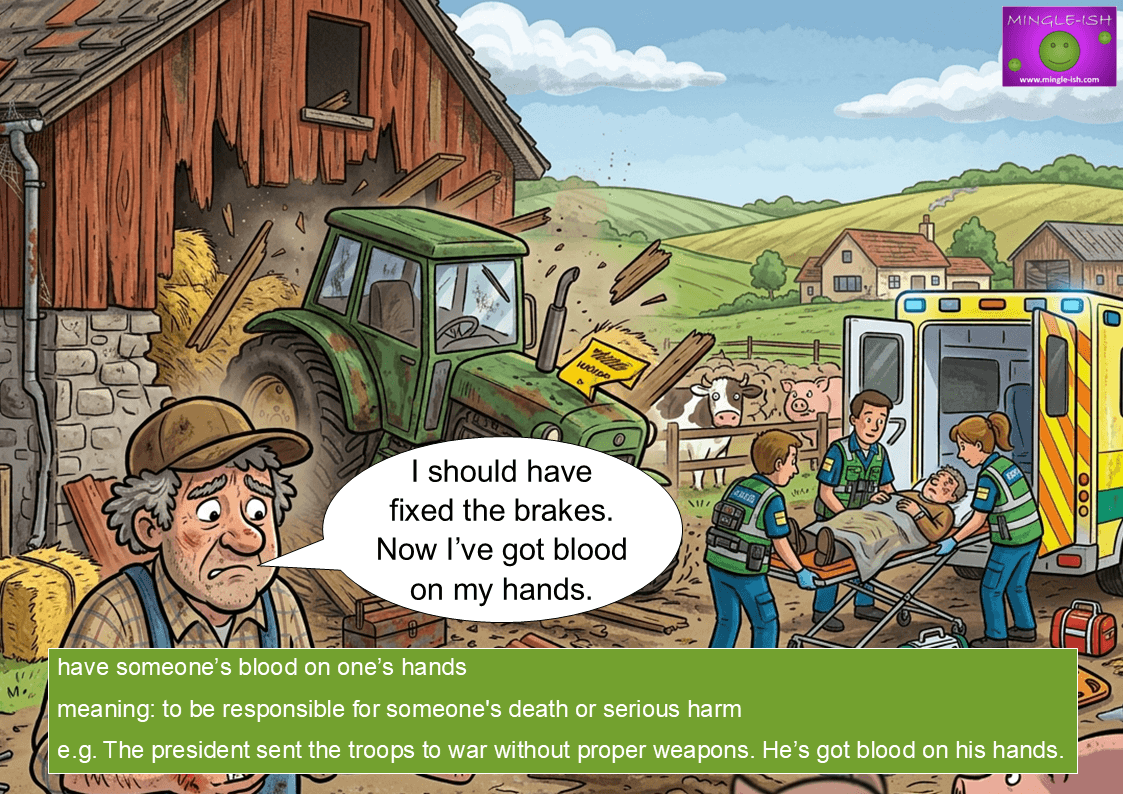
have blood on one’s hands
meaning: to be responsible for someone’s death or serious harm
examples:
- The president sent the troops to war without proper weapons. He’s got blood on his hands.
- The criminal has the blood of several innocent victims on his hands.
- If the factory continues dumping toxic waste into the river, the company could have blood on its hands.
- The commander refused to order the attack because he didn’t want the blood of innocent civilians on his hands.
in cold blood
meaning: deliberately and ruthlessly, without showing emotion or remorse
examples:
- Joey was killed in cold blood whilst walking home from a party.
- The gang murdered their rival in cold blood after the argument.
- The innocent villagers were attacked in cold blood by the soldiers.
- She was shocked to hear that the elderly man had been robbed and beaten in cold blood.

in one’s blood
meaning: a skill, talent or characteristic that is believed to have been inherited from your family
examples:
- I’m good with numbers; it’s in my blood. My dad and grandad are accountants.
- She’s a brilliant singer. Music is clearly in her blood, as both her parents are musicians.
- He’s been playing football since he was five. I suppose being sporty is in his blood.
- I’ve always loved cooking, and with three generations of chefs in the family, I guess it’s in my blood!

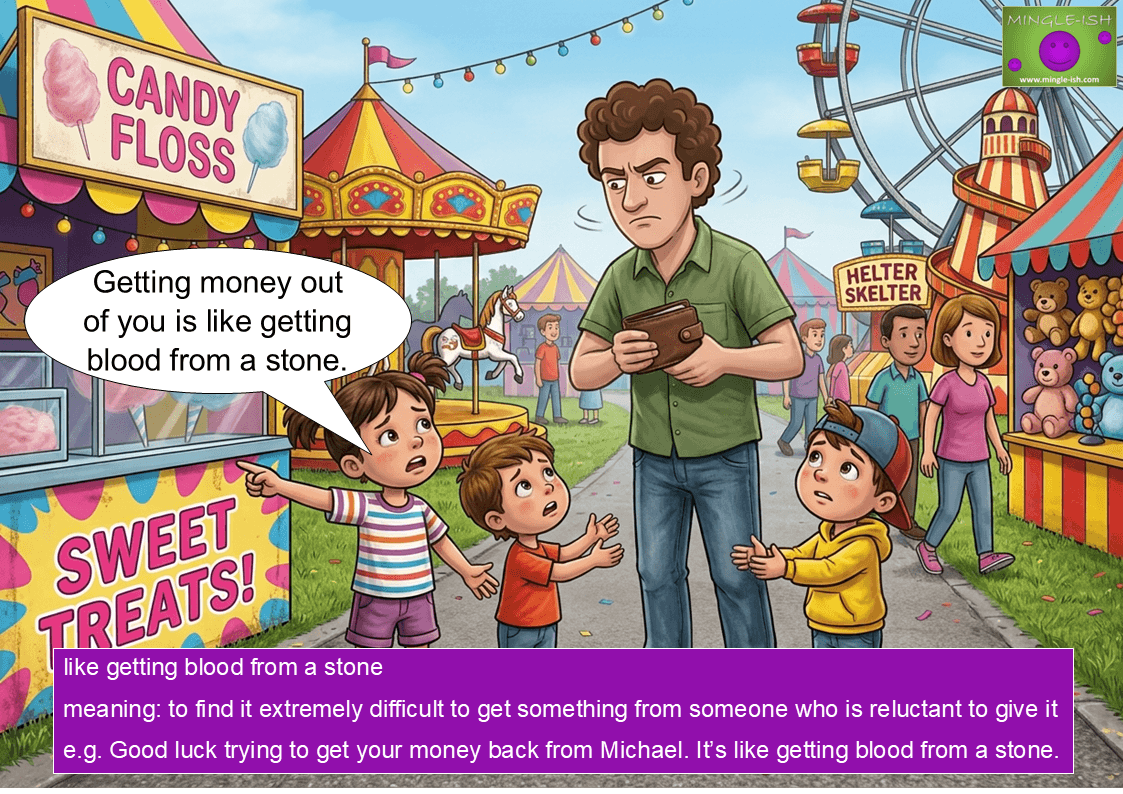
like getting blood from stone
meaning: to find it extremely difficult to get something from someone who is reluctant to give it
examples:
- Good luck trying to get your money back from Michael. It’s like getting blood from a stone.
- Getting a straight answer out of him is like getting blood from a stone.
- Trying to get my boss to approve my holiday request was like getting blood from a stone.
- Getting the children to tidy their bedrooms is like getting blood from a stone!
make one’s blood boil
meaning: to make someone extremely angry
examples:
- It makes our blood boil to think he was living under our roof and stealing from us.
- It makes my blood boil when people leave their rubbish on the beach.
- His constant lateness really makes my blood boil, especially when everyone else has made an effort to be on time.
- Nothing makes her blood boil more than seeing someone being cruel to an animal.

out for blood
meaning: to be determined to punish or get revenge on someone
examples:
- Jeff slapped his girlfriend. Her brothers are out for blood.
- The fans were out for blood after their team lost the match because of a controversial referee decision.
- After being cheated out of thousands of pounds, she was out for blood and determined to get her money back.
- The angry protesters were out for blood after the company announced plans to close the local factory.

How to Use Blood Idioms Naturally
Many blood idioms are quite informal and are most commonly used in conversation, stories, articles and everyday English.
Some are also quite strong. For example, in cold blood and blood on your hands are usually connected with serious or violent situations, while make someone’s blood boil is much more common in everyday conversation.
The best way to learn these expressions is to look at the whole phrase, rather than trying to understand every word literally.
After all, if someone says something makes their blood boil, they probably don’t need a trip to A&E. They need to calm down!
Blood Idioms in Real-Life Situations
Let’s look at how some of these expressions might appear in everyday conversations.
Talking about family:
“I know your sister annoyed you, but she’s still your flesh and blood.”
Talking about hard work:
“We’ve put blood, sweat and tears into this project.”
Talking about anger:
“It makes my blood boil when people are rude to staff.”
Talking about a disagreement:
“There’s been bad blood between them since their argument.”
Talking about new people at work:
“We could definitely use some new blood in the department.”
These examples show how English idioms with blood can appear in completely different situations.
Frequently Asked Questions About Blood Idioms
What is a blood idiom?
A blood idiom is an English expression containing the word blood where the overall meaning is different from the literal meaning of the words. For example, make someone’s blood boil means to make someone extremely angry, rather than actually making their blood boil.
What are the most common blood idioms?
Some of the most common blood idioms include blood is thicker than water, in cold blood, bad blood, blood, sweat and tears, make someone’s blood boil and flesh and blood.
What does “blood is thicker than water” mean?
Blood is thicker than water means that family relationships are often considered stronger or more important than relationships with other people.
What does “make my blood boil” mean?
If something makes your blood boil, it makes you extremely angry.
For example:
“It makes my blood boil when people are treated unfairly.”
What does “blood, sweat and tears” mean?
Blood, sweat and tears means a great deal of hard work, effort and sometimes suffering.
For example:
“She put blood, sweat and tears into her new business.”
What does “bad blood” mean?
Bad blood means feelings of anger, resentment or hostility between people or groups.
For example:
“There’s been bad blood between the two teams for years.”
Final Thoughts on Blood Idioms
English idioms don’t always make much sense when you take them literally, and blood idioms are a perfect example!
From bad blood to blood, sweat and tears, these expressions can help you understand more natural English and make your own conversations more interesting.
So, the next time someone tells you that something makes their blood boil, don’t panic. They’re probably just really, really annoyed!
Enjoyed these blood idioms? There are plenty more English idioms to discover, including more idioms with body parts, plus animal, business, sports and food idioms. You can also explore my English phrasal verbs, test yourself with English quizzes, or brush up on your grammar and pronunciation. And if you prefer watching and listening, head over to my YouTube channel for more idioms, vocabulary, phrasal verbs, pronunciation tips and English quizzes. There’s plenty more English language learning to explore at Mingle-ish!