
Have you ever confidently said a word or phrase for years, only to discover that you’ve been saying it completely wrong?
Don’t worry. You’re not alone.
In fact, there’s a name for those wonderfully inventive mistakes: eggcorns.
Eggcorns are words or phrases that have been misheard or misunderstood and replaced with something that sounds similar – but often makes perfectly good sense in its own weird little way.
And that’s what makes them so much fun.
From “old-timer’s disease” instead of “Alzheimer’s disease” to “a doggy-dog world” instead of “a dog-eat-dog world”, eggcorns show just how creative our brains can be when we’re trying to make sense of the English language.
So let’s take a look at some of the best and funniest eggcorn examples in English.
What is an Eggcorn?
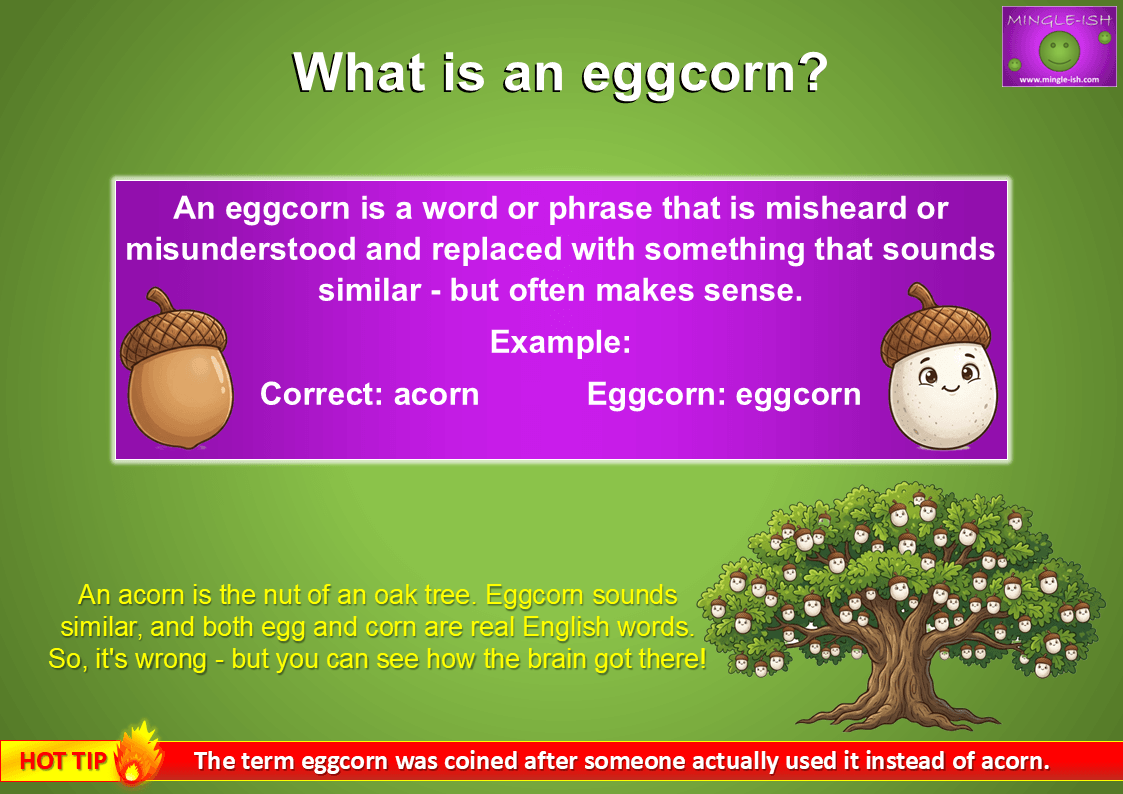
An eggcorn is a word or phrase that someone uses instead of the correct word or phrase because it sounds similar and has been misheard or misunderstood.
The important thing is that the mistaken version often seems to make sense.
For example:
Correct: acorn
Eggcorn: eggcorn
An acorn is the nut of an oak tree. An “eggcorn” sounds very similar, and both egg and corn are perfectly ordinary English words.
So you can see how someone’s brain might think, “Yep. That sounds about right.”
It isn’t right.
But it is rather clever.
The term eggcorn was coined after someone actually used “eggcorn” instead of “acorn”. The term was proposed by linguist Geoff Pullum in 2003.
eggcorn examples
Ready to discover some of the most entertaining eggcorns in English?
Here are some classic examples.
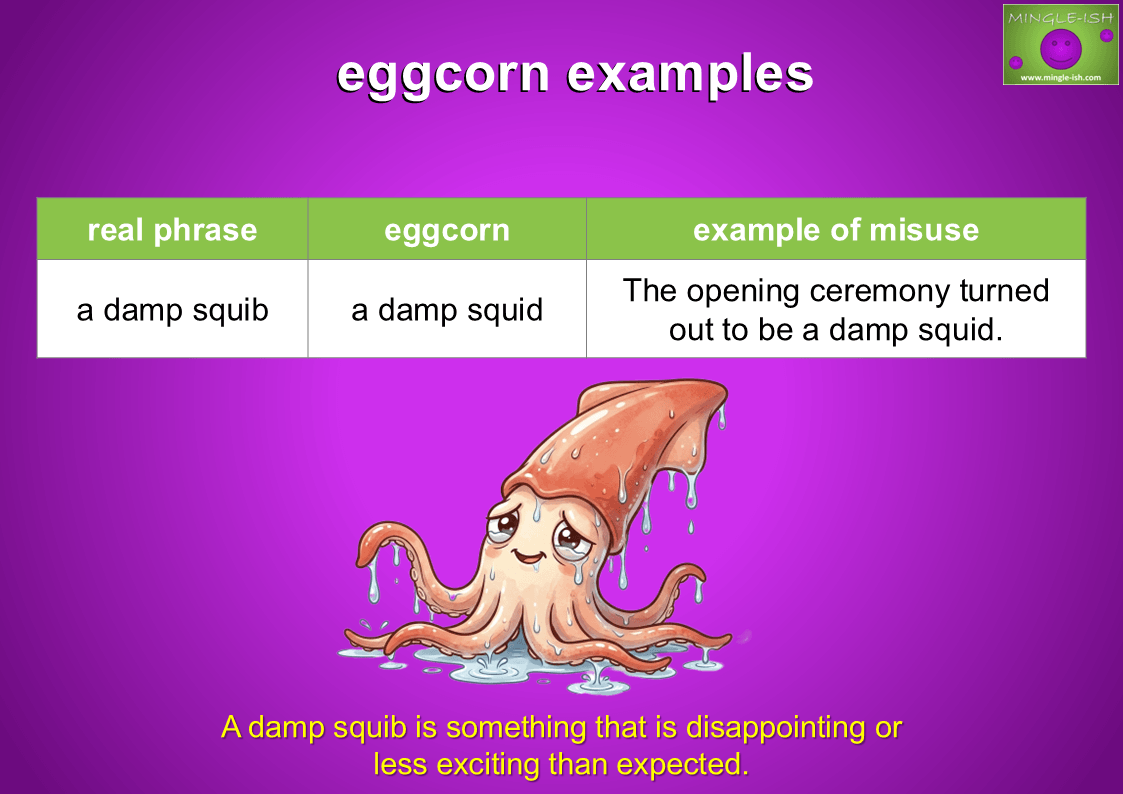
a damp squib (A damp squib is something that is disappointing or less exciting than expected.)
Eggcorn: a damp squid
Example of misuse: The opening ceremony turned out to be a damp squid.
a hair’s breadth (A hair’s breadth means a very small distance or difference.)
Eggcorn: a hair’s breath
Example of misuse: There was only a hair’s breath between 1st and 2nd place.
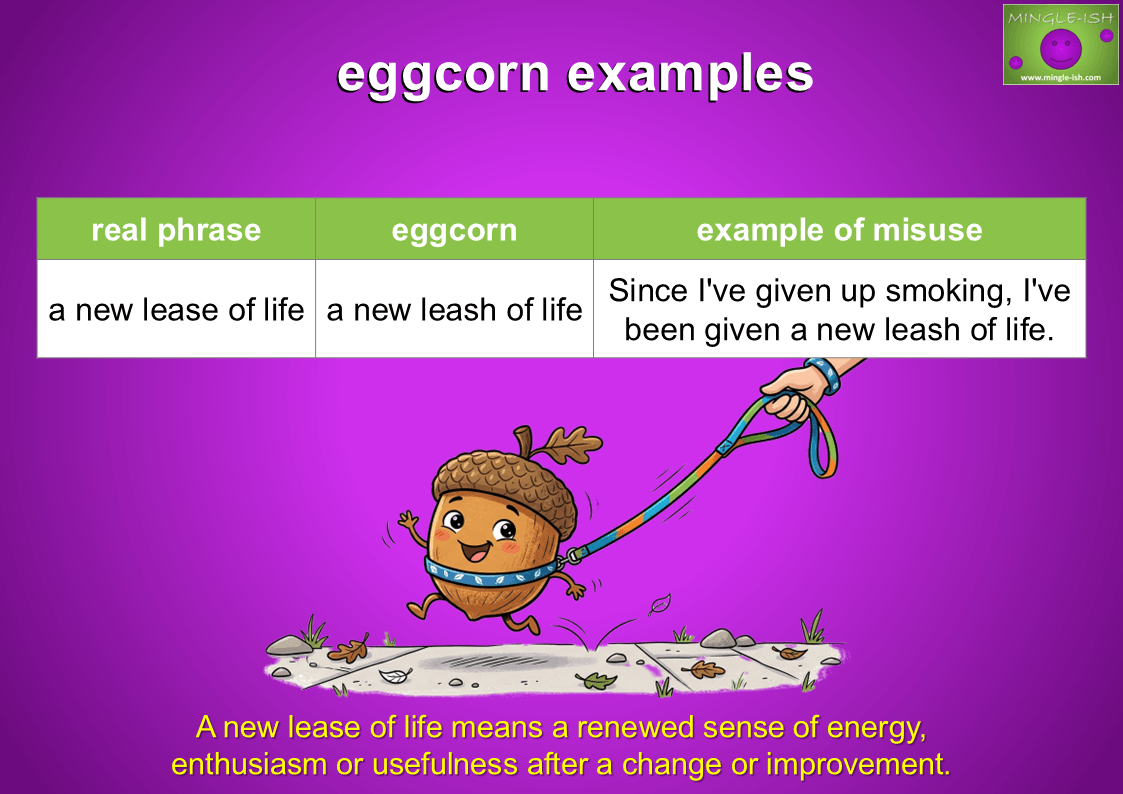
a new lease of life (A new lease of life means a renewed sense of energy, enthusiasm or usefulness after a change or improvement.)
Eggcorn: a new leash of life
Example of misuse: Since I’ve given up smoking, I’ve been given a new leash of life.
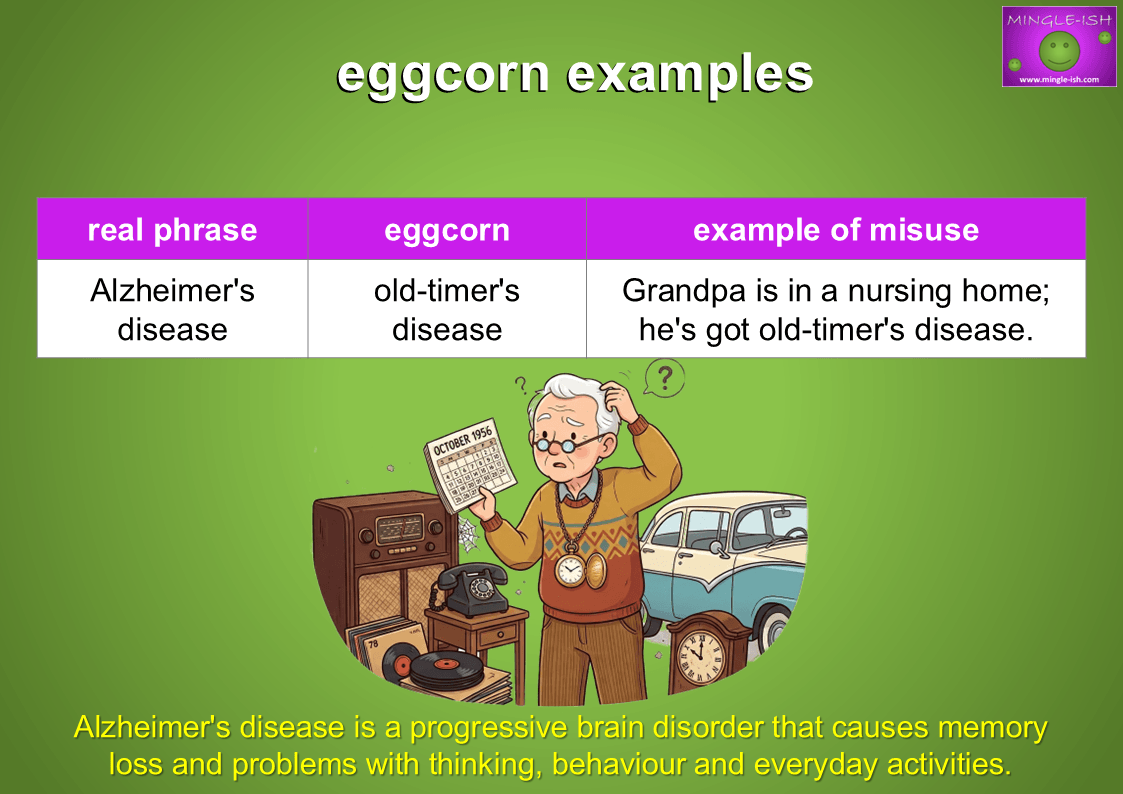
Alzheimer’s disease (Alzheimer’s disease is a progressive brain disorder that causes memory loss and problems with thinking, behaviour and everyday activities.)
Eggcorn: old-timer’s disease
Example of misuse: Grandpa is in a nursing home; he’s got old-timer’s disease.
as dusk fell (as dusk fell means as the daylight faded and darkness began to arrive)
Eggcorn: as dust fell
Example of misuse: As dust fell, the swallows went to bed.
biding one’s time (biding one’s time means waiting patiently for the right moment to do something.)
Eggcorn: biting my time
Example of misuse: I know he’ll fail; I’m just biting my time until the day comes.
cell phone (A cell phone is a mobile telephone that connects to a cellular network.)
Eggcorn: self phone
Example of misuse: I need to charge my self phone.
chickenpox (a contagious illness that causes an itchy rash and small blisters)
Eggcorn: chicken spots
Example of misuse: My daughter has caught chicken spots.
circumcised
Eggcorn: circus-sized
Example of misuse: The baby was a boy, so they circus-sized him.
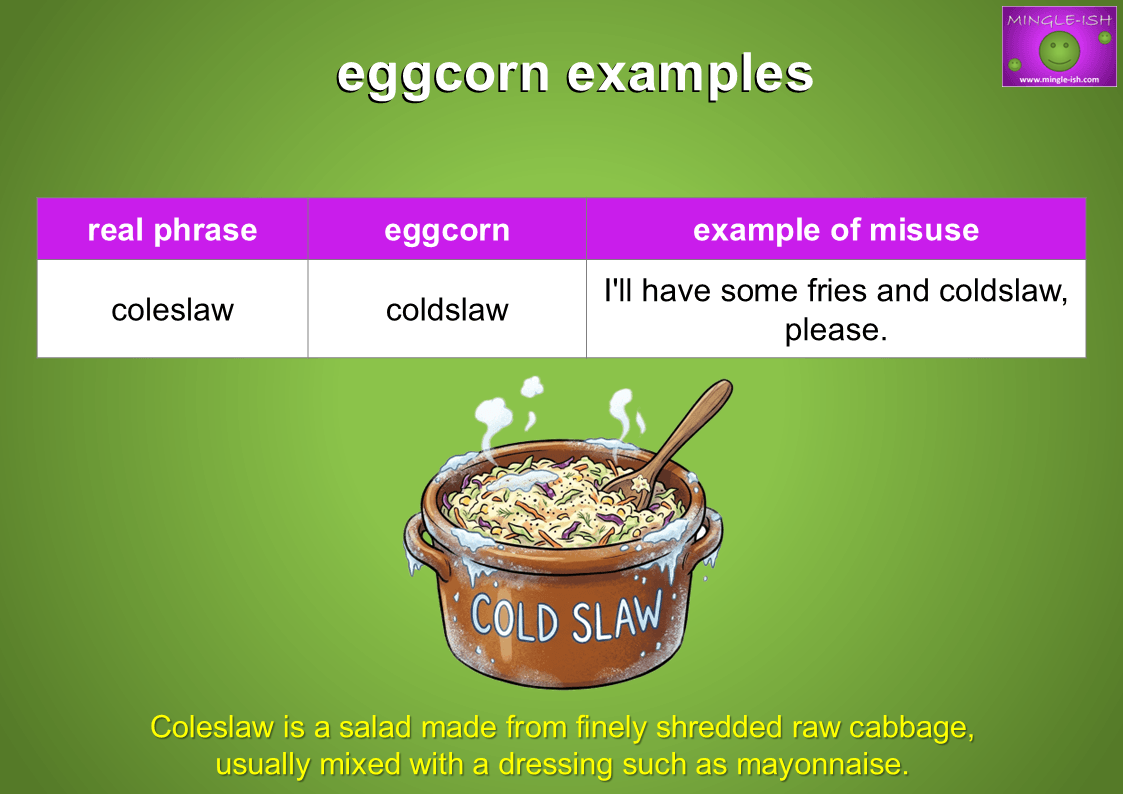
coleslaw (Coleslaw is a salad made from finely shredded raw cabbage, usually mixed with a dressing such as mayonnaise.)
Eggcorn: coldslaw
Example of misuse: I’ll have some fries and coldslaw, please.
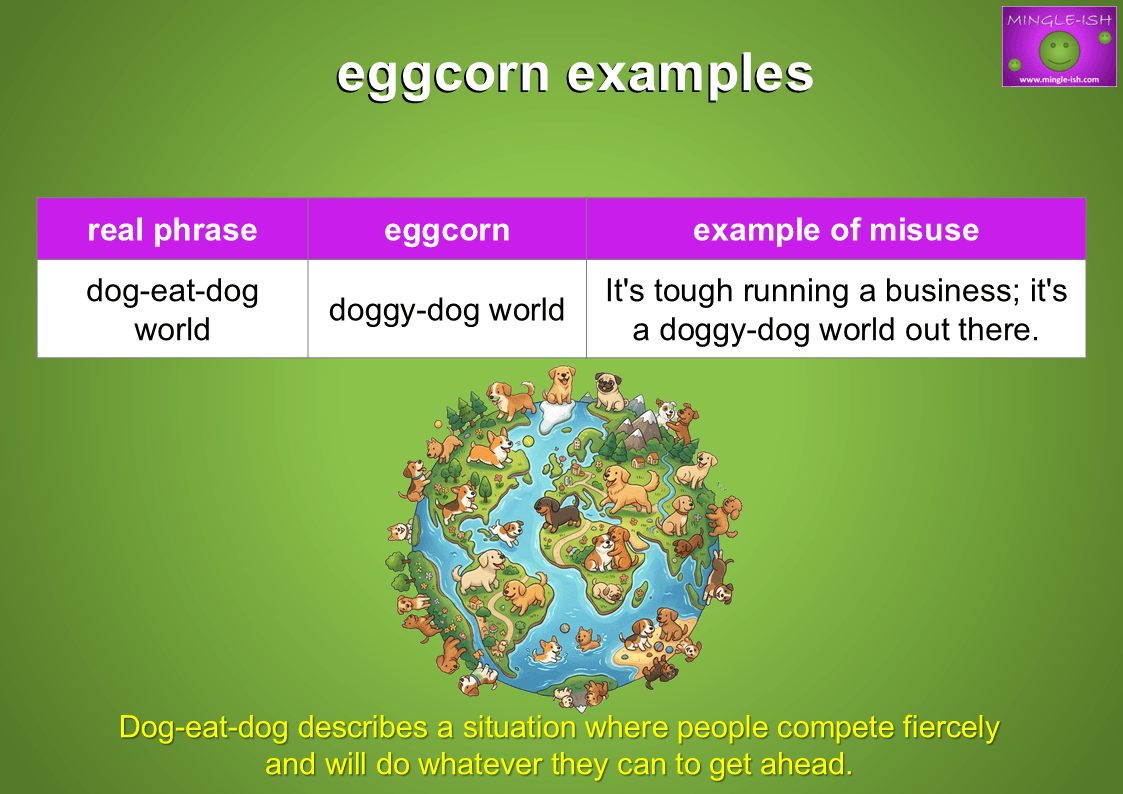
dog-eat-dog world (Dog-eat-dog describes a situation where people compete fiercely and will do whatever they can to get ahead.)
Eggcorn: doggy-dog world
Example of misuse: It’s tough running a business; it’s a doggy-dog world out there.
earbuds (small headphones that fit inside your ears)
Eggcorn: hearbuds
Example of misuse: Can you buy me some hearbuds in town? I have waxy ears.
eyeballs (the round parts of your eyes that you see when you look at someone)
Eggcorn: eyebulbs
Example of misuse: I used some new drops, and now my eyebulbs are hurting.
give free rein (to give someone complete freedom to do what they want)
Eggcorn: give free range
Example of misuse: I trust you completely; you can have free range over the decorations.
growth spurt (a period when someone grows much faster than usual)
Eggcorn: growth sprout
Example of misuse: My son’s grown a lot; he’s had a growth sprout.
hand-me-downs (clothes or belongings passed on to someone else)
Eggcorn: handy downs
Example of misuse: I never buy new clothes; my sister gives me handy downs.
iced tea (cold tea, usually served with ice)
Eggcorn: ice tea
Example of misuse: I’d love an ice tea right now.
in the midst of (in the middle of something)
Eggcorn: in the mist of
Example of misuse: I’m in the mist of painting; can I call you back?
it takes two to tango (both people involved are responsible for what happens)
Eggcorn: takes two to tangle
Example of misuse: He said she came on to him, but it takes two to tangle.
jigsaw puzzle (a puzzle made by fitting pieces together to form a picture)
Eggcorn: jig-sole puzzle
Example of misuse: My grandma got me a jig-sole puzzle for Christmas.
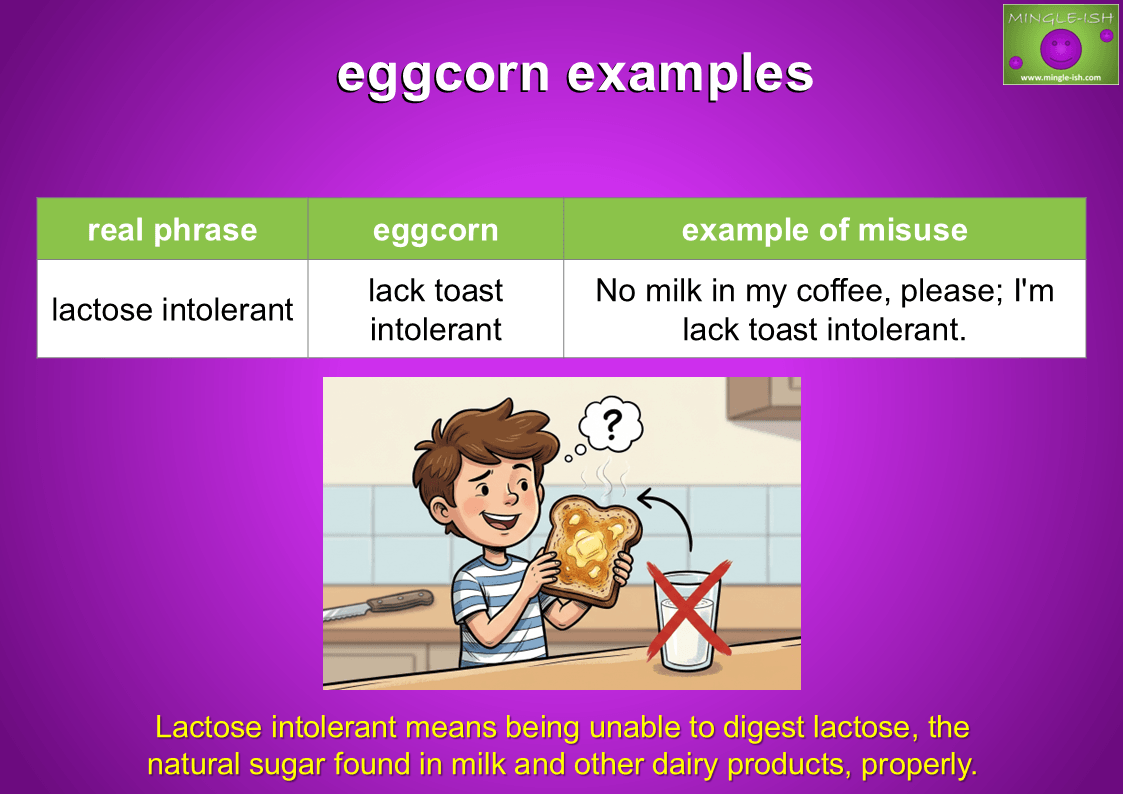
lactose intolerant (Lactose intolerant means being unable to digest lactose, the natural sugar found in milk and other dairy products, properly.)
Eggcorn: lack toast intolerant
Example of misuse: No milk in my coffee, please; I’m lack toast intolerant.
mulled wine (wine heated with spices and often served warm)
Eggcorn: mould wine
Example of misuse: You can’t beat a bit of mould wine at Christmas.
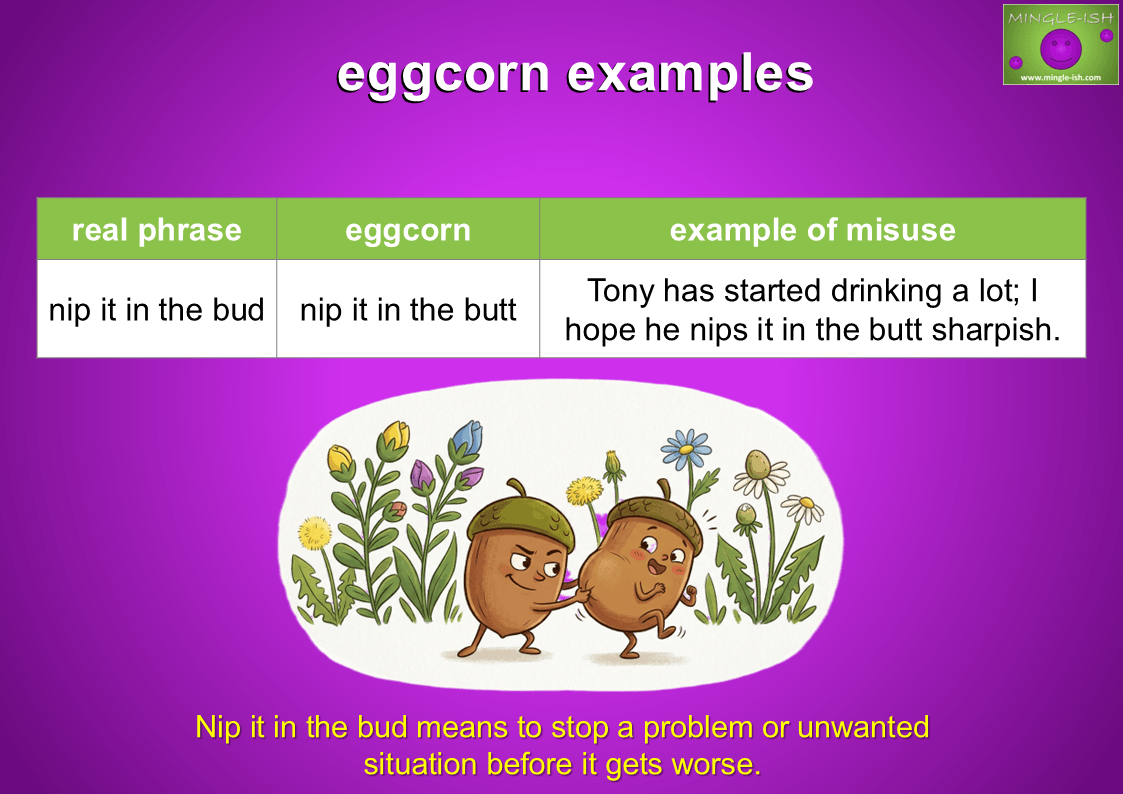
nip it in the bud (Nip it in the bud means to stop a problem or unwanted situation before it gets worse.)
Eggcorn: nip it in the butt
Example of misuse: Tony has started drinking a lot; I hope he nips it in the butt sharpish.
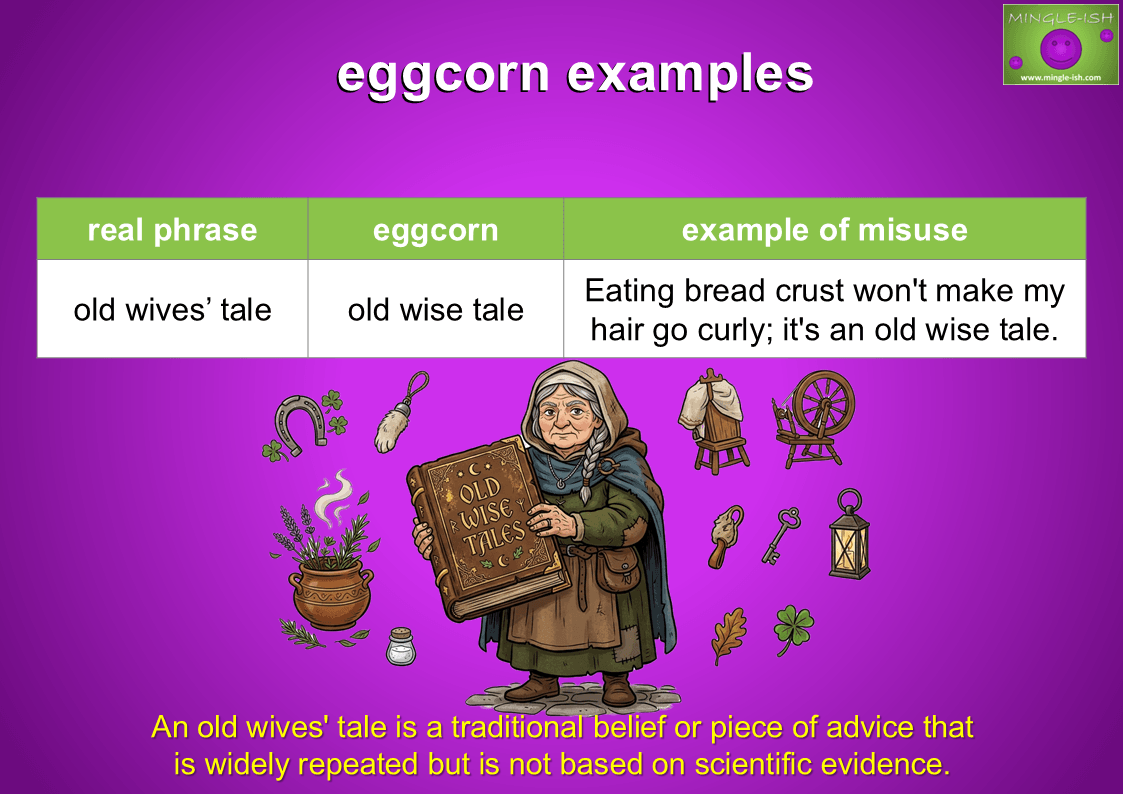
old wives’ tale (An old wives’ tale is a traditional belief or piece of advice that is widely repeated but is not based on scientific evidence.)
Eggcorn: old wise tale
Example of misuse: Eating bread crust won’t make my hair go curly; it’s an old wise tale.
out of bounds (outside the limits of an allowed area or activity)
Eggcorn: out of bounce
Example of misuse: You can’t go into that room; it’s out of bounce.
prima donna (a person who behaves as if they are more important than everyone else)
Eggcorn: pre-Madonna
Example of misuse: Since she got the leading part, she’s been such a pre-Madonna.
scantily clad (wearing very little clothing)
Eggcorn: scandally clad
Example of misuse: There are so many scandally clad women walking the streets at night.
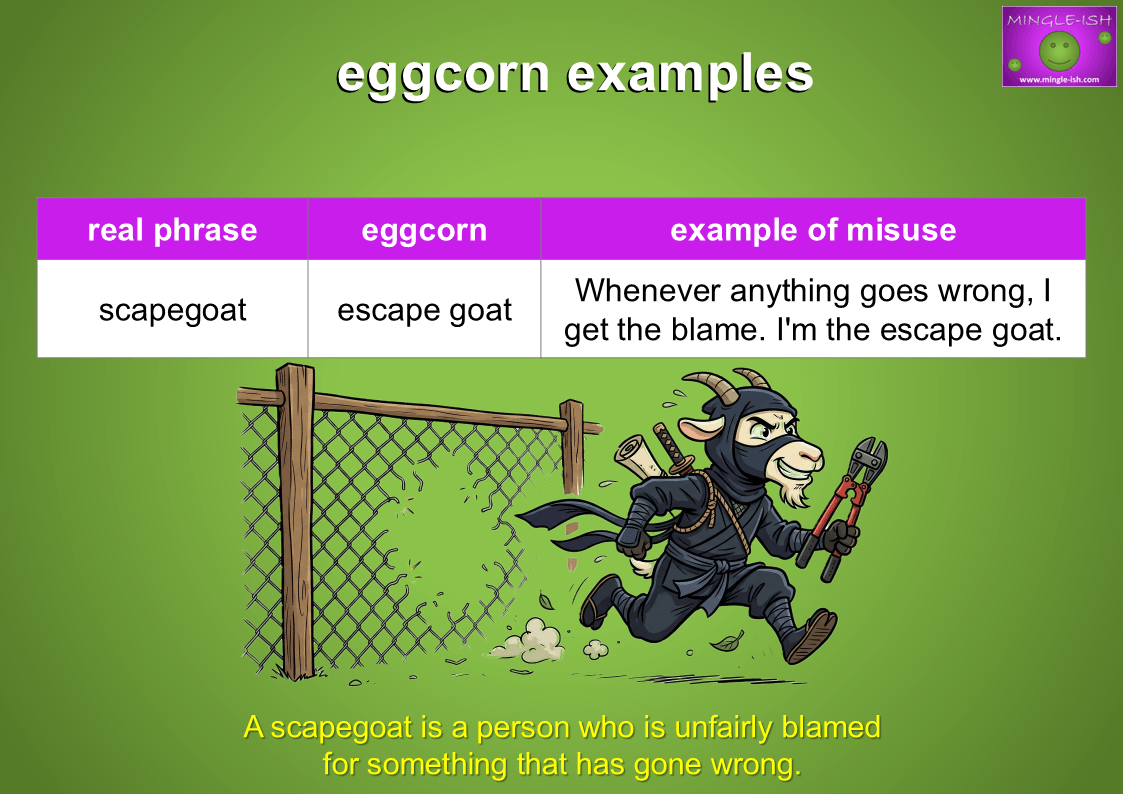
scapegoat (A scapegoat is a person who is unfairly blamed for something that has gone wrong.)
Eggcorn: escape goat
Example of misuse: Whenever anything goes wrong, I get the blame. I’m the escape goat.
sixth sense (a supposed ability to sense things that cannot be detected normally)
Eggcorn: sick sense
Example of misuse: We’re not alone in the house; I’ve got a sick sense.
spread like wildfire (to spread very quickly from one person or place to another)
Eggcorn: spread like wildflower
Example of misuse: The Zika virus is spreading like wildflower.
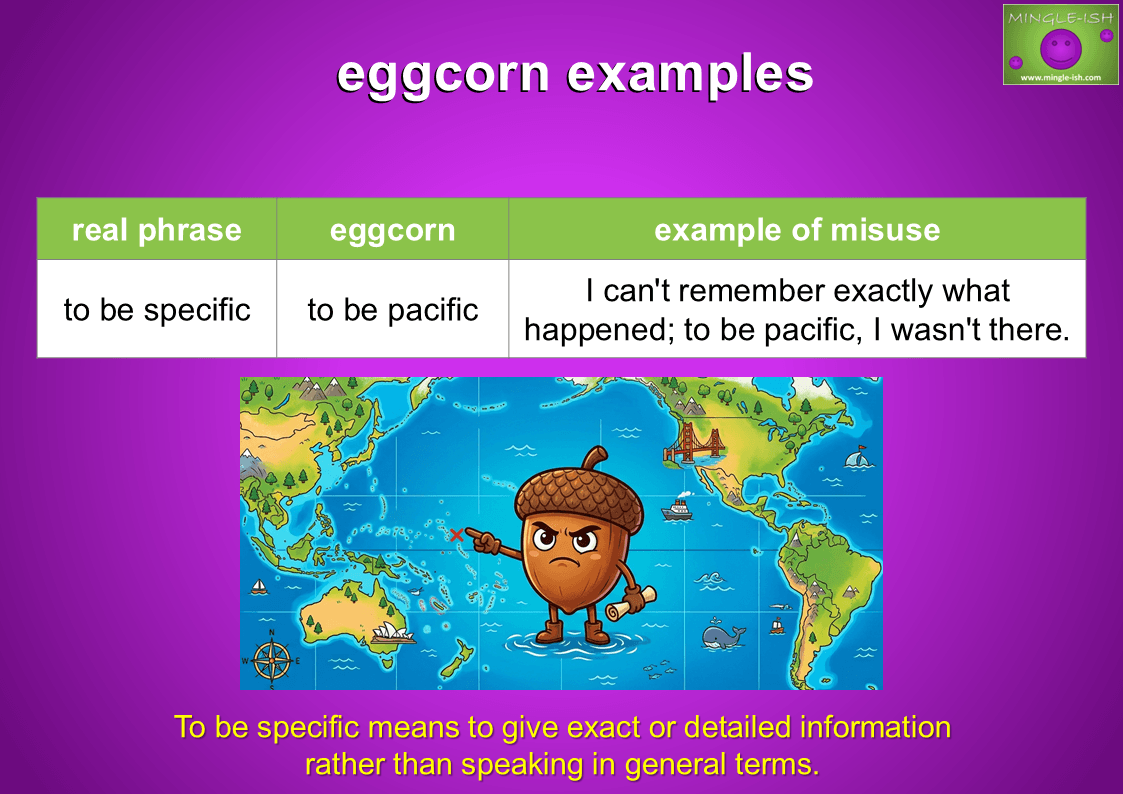
to be specific (To be specific means to give exact or detailed information rather than speaking in general terms.)
Eggcorn: to be pacific
Example of misuse: I can’t remember exactly what happened; to be pacific, I wasn’t there.
wide variety (a large range of different things)
Eggcorn: wild variety
Example of misuse: We have a wild variety of cakes available.
Why Do Eggcorns Happen?
Eggcorns usually happen because we hear language before we see it written down.
If we come across an unfamiliar word or expression, our brains naturally try to make sense of it. Sometimes we replace the unfamiliar bit with a familiar word that sounds similar – and if the new version still makes sense, we might never realise we’ve got it wrong.
English gives our brains plenty of opportunities to do this, thanks to:
- unusual spelling
- silent letters
- words borrowed from other languages
- old-fashioned expressions
- idioms that don’t make much sense literally
- words that sound very similar
So really, eggcorns aren’t that surprising.
Our brains are simply doing their best to make sense of the glorious mess that is the English language.
And sometimes they come up with something better than the original.
Well… almost.
Eggcorns vs Mispronunciations, Mondegreens and Malapropisms
Eggcorns can be confused with a few other types of language mistake, so here’s a quick guide to the differences.
Eggcorns
An eggcorn happens when someone mishears or misunderstands a word or phrase and replaces it with something similar that often makes sense.
Correct: old wives’ tale
Eggcorn: old wise tale
Mispronunciations
A mispronunciation is simply saying a word incorrectly. You still know which word you’re trying to say – you’ve just said it wrong.
Mondegreens
A mondegreen is something you’ve misheard, particularly song lyrics. If you’ve ever confidently sung completely wrong lyrics for years, you’ve probably experienced one.
Malapropisms
A malapropism is when someone uses an incorrect word that sounds similar to the correct one, often with funny results.
What’s the Difference?
| Language mistake | What happens? |
|---|---|
| Eggcorn | A word or phrase is misheard or reinterpreted as something similar |
| Mispronunciation | A word is pronounced incorrectly |
| Mondegreen | Something is misheard, especially song lyrics |
| Malapropism | A similar-sounding but incorrect word is used |
Different mistakes, same basic problem: our brains occasionally have a little freestyle session with the English language.
More Fun English
Enjoyed discovering these wonderfully weird English mistakes?
There’s plenty more where that came from.
Check out our pages on:
And don’t forget to visit the Mingle-ish YouTube channel for more fun English vocabulary, pronunciation and language-learning videos.
Because learning English doesn’t always have to be serious.
Sometimes it’s much more fun when someone accidentally puts an egg where an acorn should be.