Welcome to our guide on the silent ‘c’! Ever wondered why some words have a ‘c’ that you don’t pronounce? We’ll explore those quirky words and the rules behind this silent letter. Are you ready? Let’s dive in…

introduction to silent letters in English

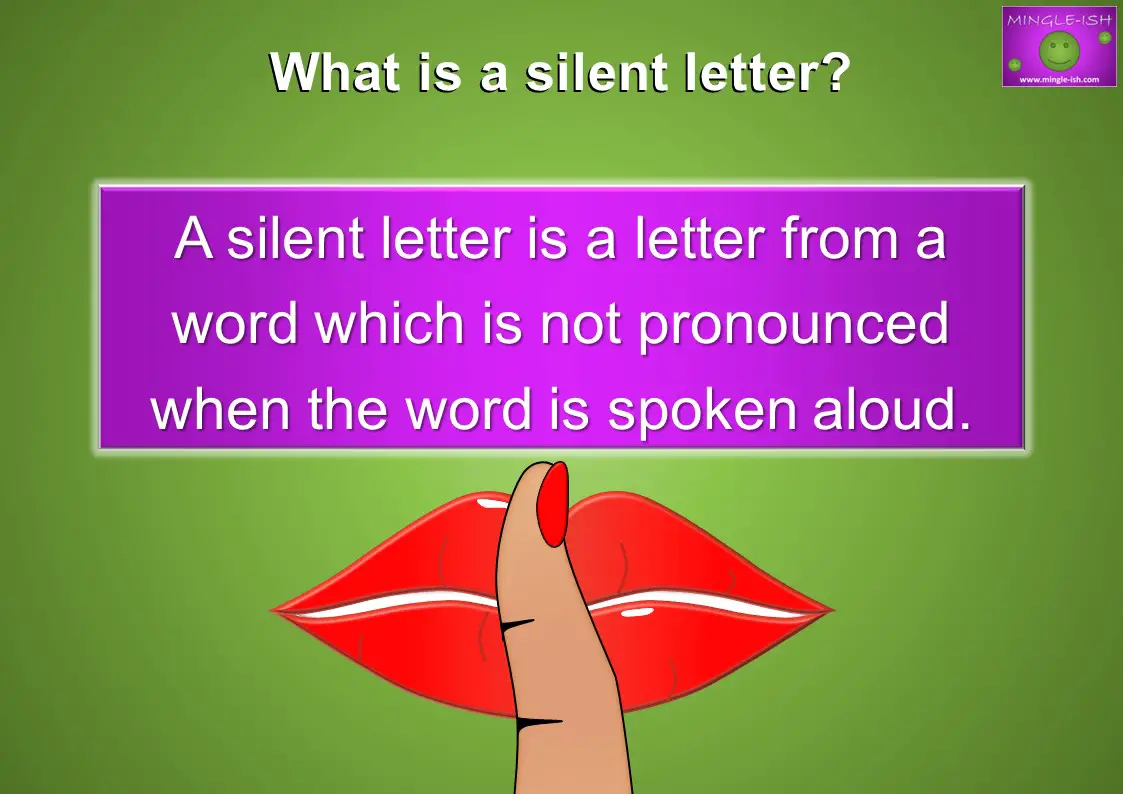
A silent letter is a letter from a word which is not pronounced when the word is spoken aloud. They still however appear in the written word. They can make spelling tricky but often provide clues about a word’s origin and meaning.


In this lesson. We’ll be specifically focusing on the silent ‘c’.

What is a Silent Letter? Definition and Example Image

common words with a silent c

Have you ever wondered why some words have a silent ‘C’? It’s one of those quirky things about the English language that keeps us on our toes. Usually, the silent ‘C’ pops up in words with Latin or Greek origins. Here’s a quick list of the most common ones to help you spot these sneaky silent ‘C’s:

  • abscess
  • ascend
  • conscious
  • conscience
  • crescent
  • descent
  • disciple
  • fascinate
  • fluorescent
  • indict
  • miscellaneous
  • muscle
  • obscene
  • resuscitate
  • scenario
  • scene
  • scent
  • science
  • scissors
  • susceptible
  • transcend

These words show how silent “C” often appears in scientific, medical, and academic terms, reflecting their Latin and Greek roots.

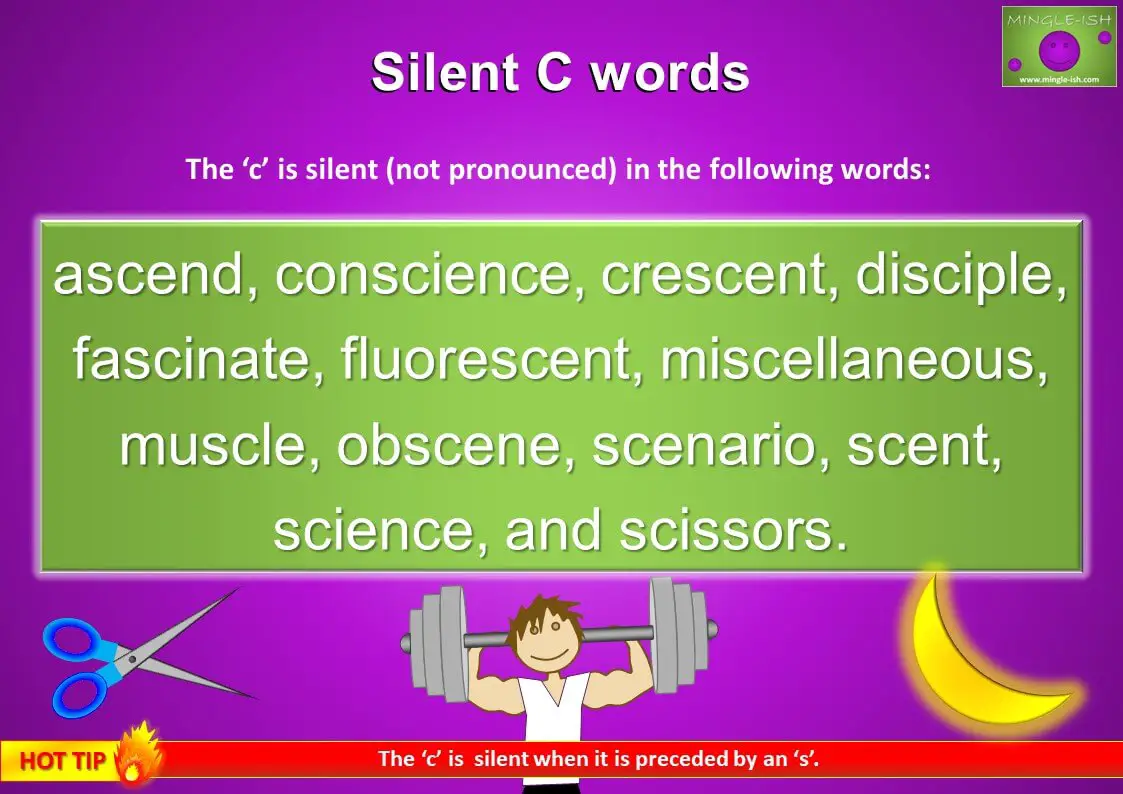
silent c words

examples of the silent ‘c’ in medical words

Here are some examples of medical words that contain a silent “C”:

  • abscess – a collection of pus that has built up within the tissue of the body.
  • crescent – in anatomy, refers to crescent-shaped structures.
  • elicit – used in medical testing and diagnosis to draw out responses or reactions.
  • fluorescent – used in medical imaging and diagnostic tests.
  • indict – to formally accuse of or charge with a serious crime (used in legal context, but originally from medical terminology).
  • miscellaneous – though not exclusively medical, it can be used to refer to a collection of various medical conditions or elements.
  • muscle – a tissue in the body that has the ability to contract, producing movement or maintaining the position of parts of the body.
  • resuscitate – to revive someone from unconsciousness or apparent death.
  • susceptible – refers to the likelihood of developing a disease or condition.
  • transcend – In medical context, can refer to surpassing normal limits, such as in treatments or medical research.
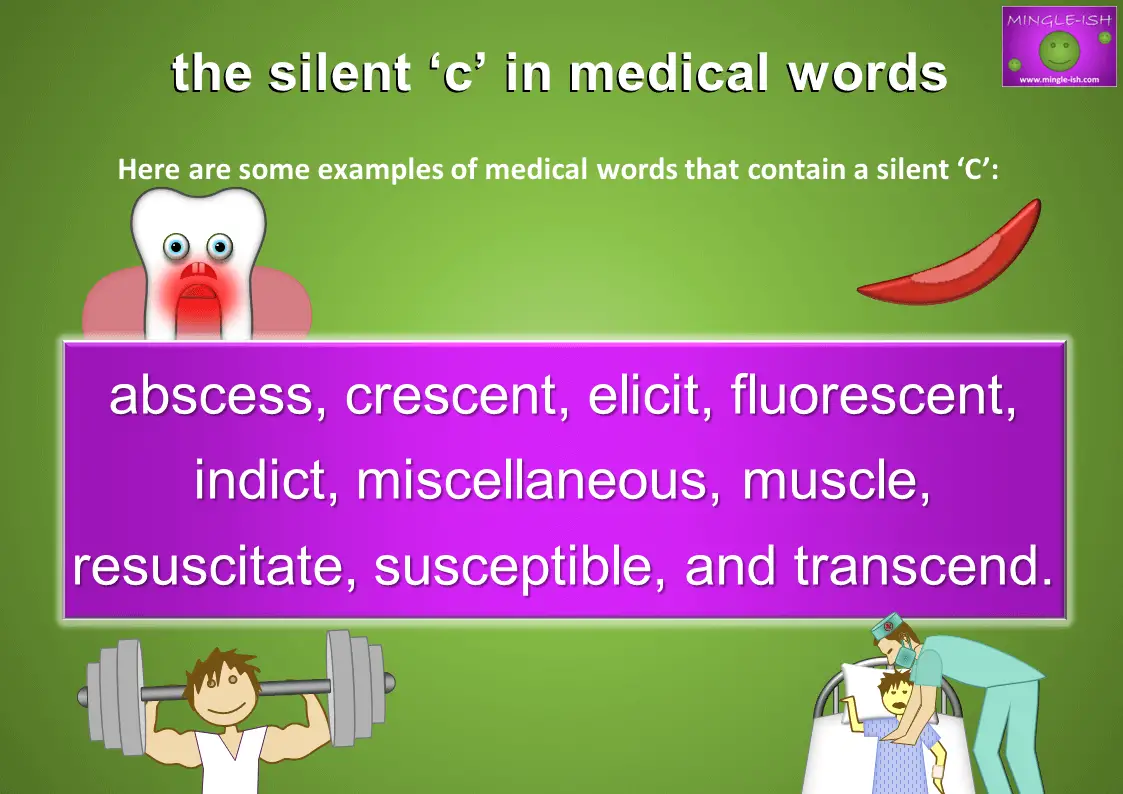
Examples of Medical Words with Silent 'C' - Educational Graphic

examples of the silent ‘c’ in scientific words

  • indict – in scientific contexts, it can relate to charges of scientific misconduct
  • miscellaneous – in scientific contexts, it can refer to a diverse collection of elements or samples
  • fluorescent – having the property of emitting visible light when exposed to ultraviolet light. commonly used in scientific research and diagnostics
  • susceptible – in medical and scientific contexts, it often refers to susceptibility to diseases or conditions.
  • elicit – in scientific research, it often refers to evoking responses during experiments.
  • transcend – in scientific research, it can refer to surpassing existing theories or findings.
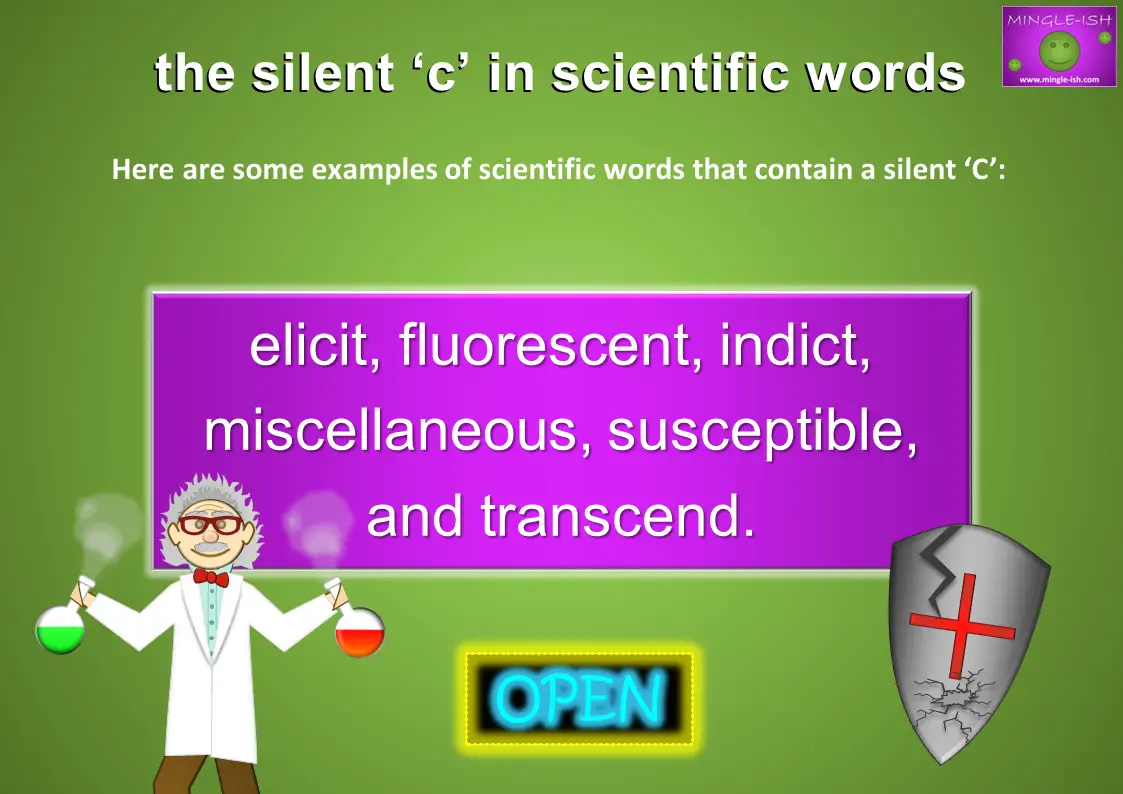
The Silent 'C' in Scientific Words Examples

silent c rules

There are some rules you can learn and some patterns to look out for to help you decide if the ‘c’ is silent or not. Let’s take a look and the most common rules.

after an ‘s’

The ‘c’ is typically silent when it is preceded by an ‘s’, and followed by an ‘e’, or an ‘i’. For example:

  • abscess
  • ascend
  • ascent
  • crescent
  • descend
  • descent
  • disciple
  • fascinate
  • fluorescent
  • muscle
  • obscene
  • scene
  • scent
  • science
  • scissors.
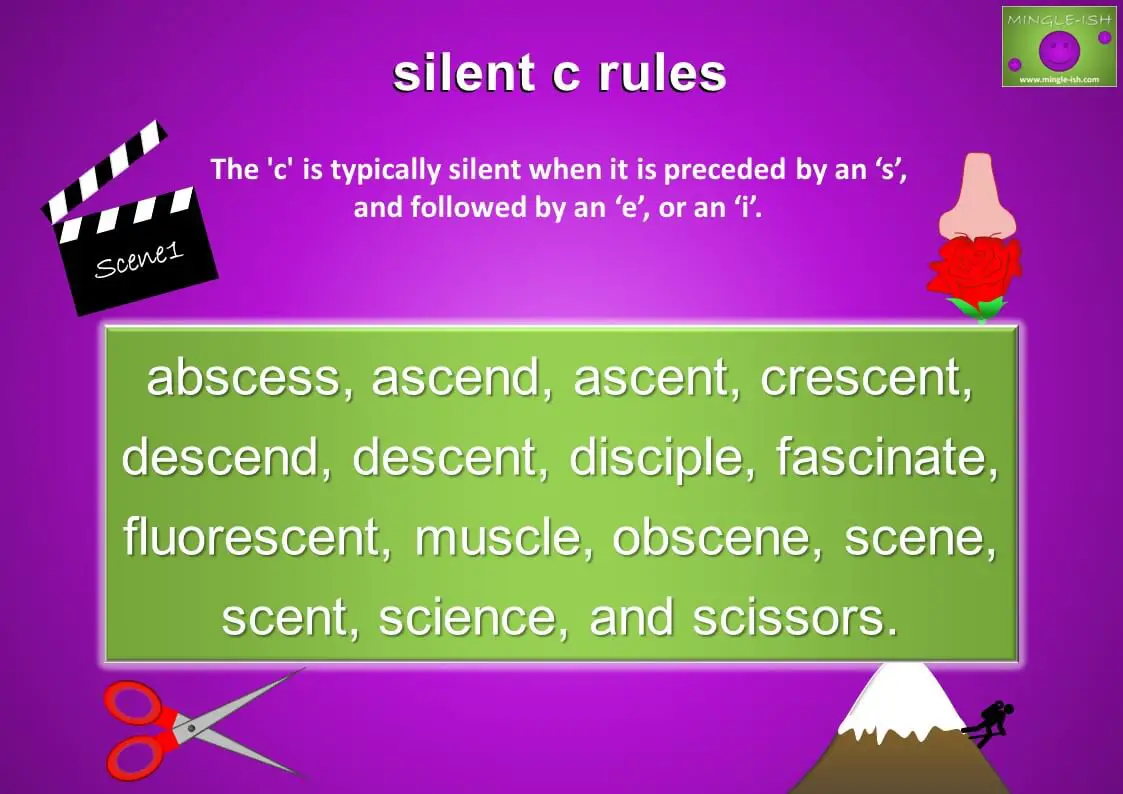
silent C rules - The 'c' is typically silent when it is preceded by an ‘s’, and followed by an ‘e’, or an ‘i’.

before a ‘k’

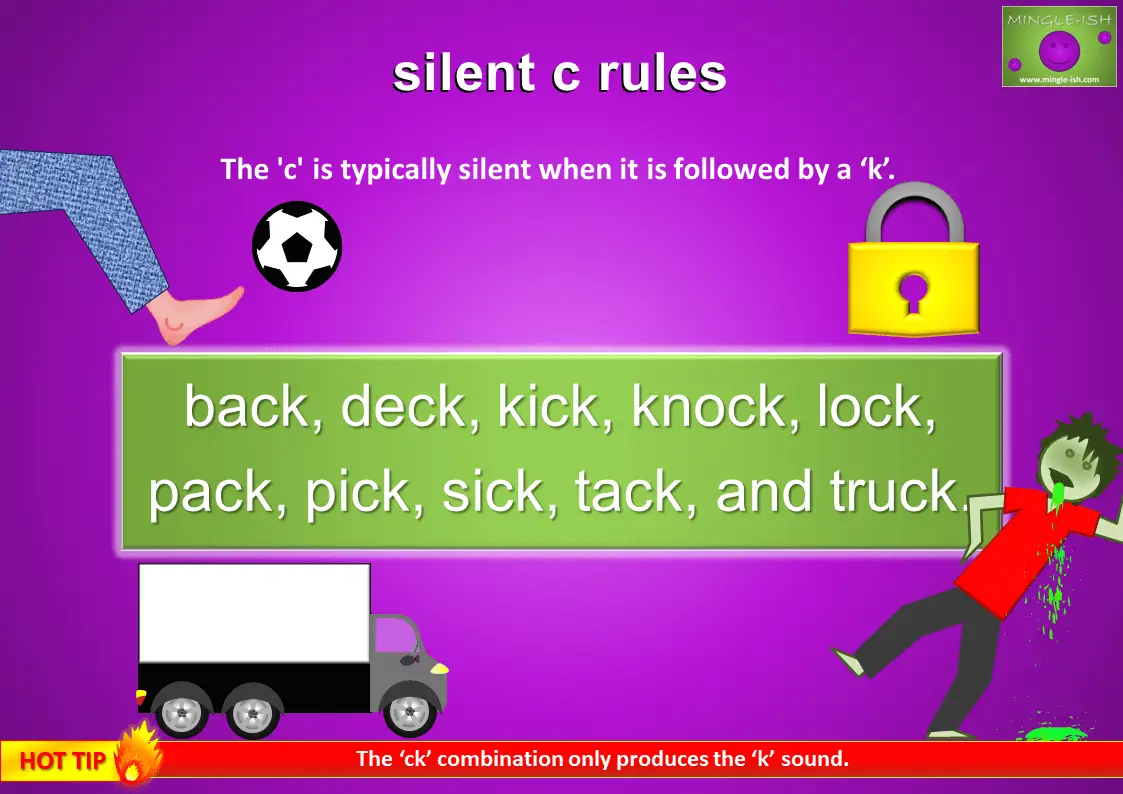
The ‘c’ is typically silent when it is followed by a ‘k’. For example:

  • back
  • deck
  • kick
  • knock
  • lock
  • pack
  • pick
  • sick
  • tack
  • truck.
silent C rules - The 'c' is typically silent when it is followed by a ‘k’.

before a ‘q’

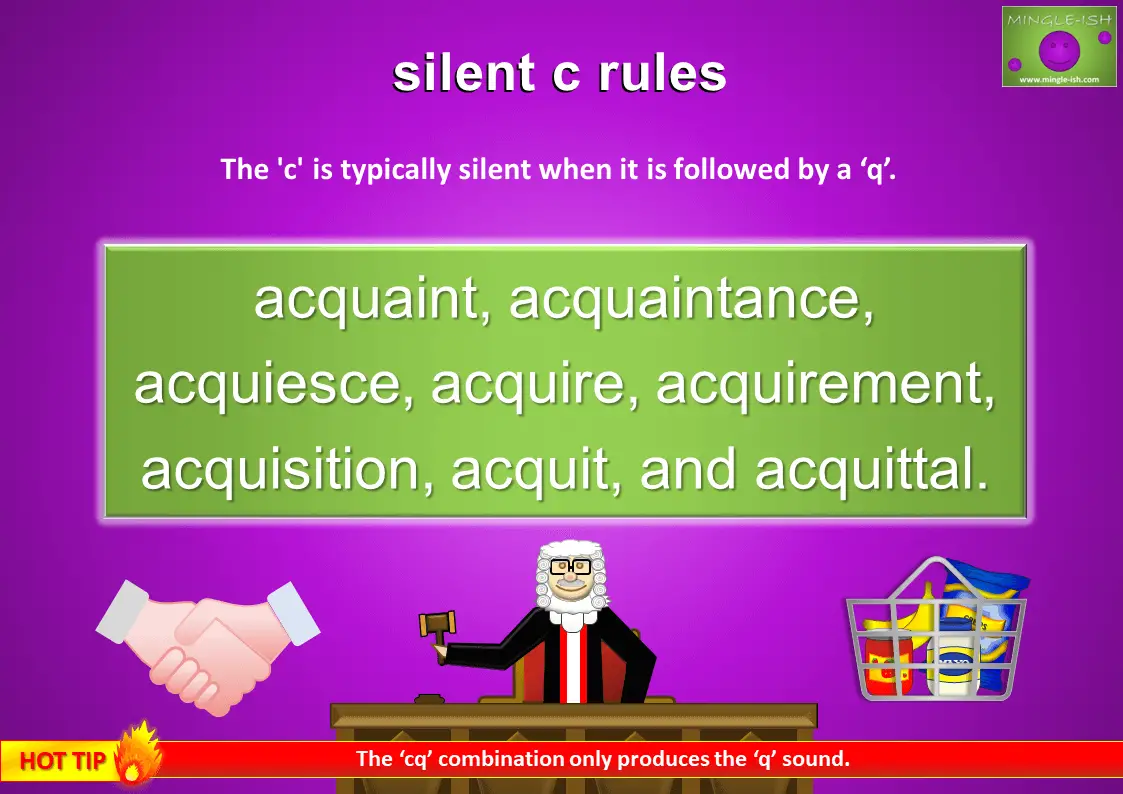
The ‘c’ is typically silent when it is followed by a ‘q’, The ‘q’ is the only letter pronounced.

  • acquaint
  • acquaintance
  • acquiesce
  • acquire
  • acquirement
  • acquisition
  • acquit
  • acquittal.
Graphic showing the rule that 'c' is silent when followed by 'q' in words like 'acquaint,' 'acquire,' and 'acquittal

Recap: What You’ve Learnt About the Silent ‘C’

Let’s rewind and spotlight the key points so your brain remembers the silent ‘C’ like an old friend. The silent ‘C’ most often shows up in combinations like sc where the ‘C’ doesn’t make a sound, such as in scene, muscle or science. It also often hides before ‘k’ and before ‘q’ where it isn’t pronounced, like knock or acquiesce. These patterns come from lots of Latin and Greek influences in English, which is why the spelling doesn’t always match the way we speak.

How confident are you now? Try this quick quiz below to test your silent‑‘C’ superpowers.

Silent ‘C’ Quiz: Test Your Skills

Think you’ve got the silent ‘C’ down? Watch our quick quiz to see if you can spot all the sneaky ‘C’s!. Don’t forget to visit our YouTube channel for more fun quizzes and tricky English challenges – you never know what other letters might be hiding!

Additional Studies: Keep Your English Sleuthing Skills Sharp
If you’ve enjoyed unmasking the silent ‘C’, there’s plenty more linguistic mischief waiting for you! Why stop at just one letter when English is full of sneaky silent letters, tricky spellings, and quirky pronunciation rules?

Explore our other fun guides and quizzes:

  • Silent Letters Galore – discover silent K, P, G and more, and see which letters are hiding in plain sight.

  • Phrasal Verb Challenges – test your knowledge of English verbs that love to sneak around with little helpers like write up, turn off, and pick out.

  • Common Pronunciation Tips – perfect for ESL learners wanting to sound more natural and confident in English.