
Contents
State Verbs in English
Dive into stative verbs like a pro! Find an A–Z list, see them in action with examples, dodge the common mistakes, and try a quick quiz to test yourself. Perfect for boosting your English fast, having fun, and sounding smarter without even trying.
What Are State Verbs?
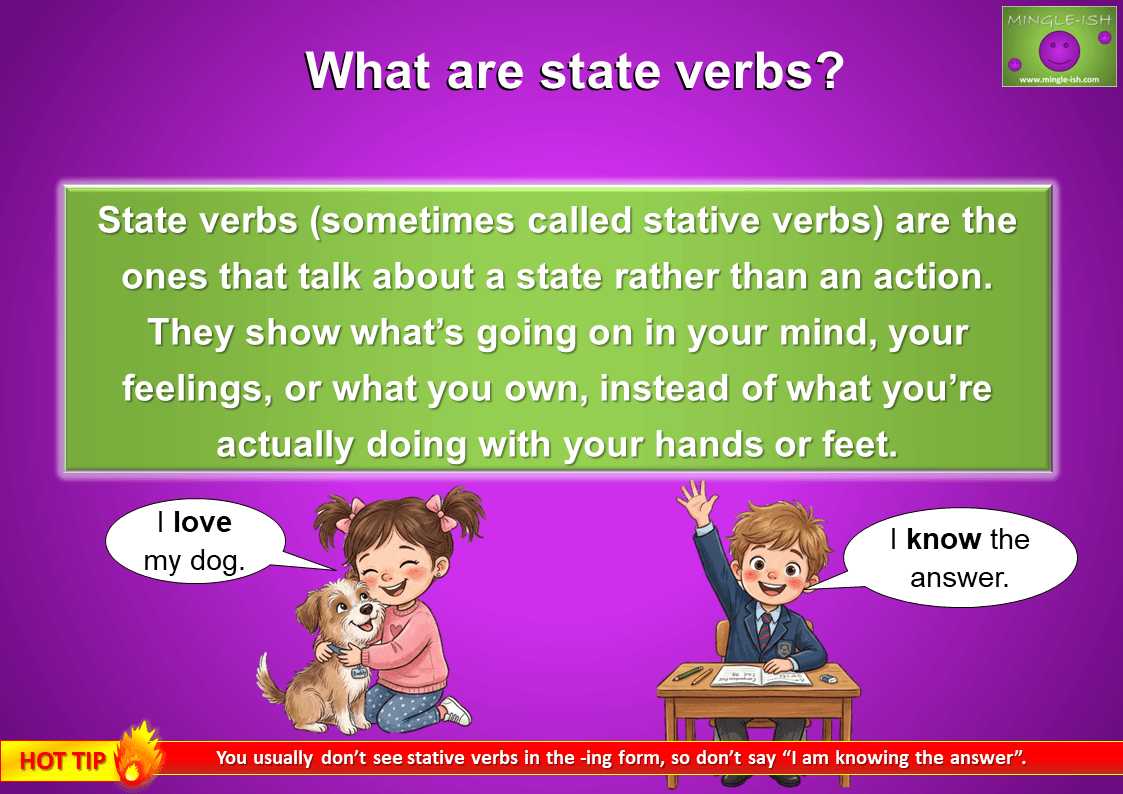
State verbs (sometimes called stative verbs) are the ones that talk about a state rather than an action. They show what’s going on in your mind, your feelings, or what you own, instead of what you’re actually doing with your hands or feet. Think of verbs like love, know, believe, have, seem – you can’t really “do” them like you can “run” or “jump.”
A few quick examples to make it crystal:
- I love chocolate.
- She knows the answer.
- They own a cute little flat.
Unlike action verbs, you usually don’t see stative verbs in the -ing form, so don’t say “I am knowing the answer” – that’s a big no-no.
Stative Verbs vs Action Verbs
Right, here’s where things get interesting, and where a lot of learners quietly panic and hope no one notices.
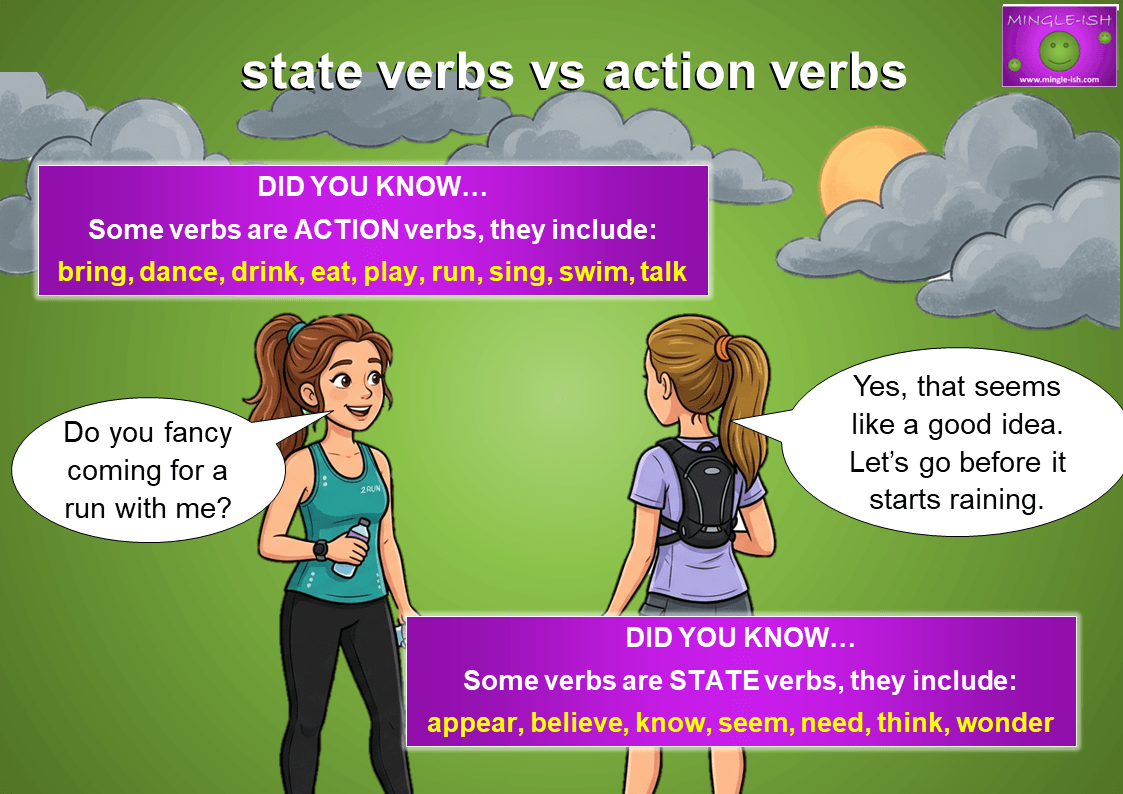
Stative verbs (also called state verbs) describe a condition, a feeling, a thought, or something you own. Nothing is “happening” physically. It’s all going on in your head or just… existing.
Action verbs, on the other hand, are all about doing. Something is moving, changing, or actually happening in real life.
Think of it like this. If you can see it happening like a mini film, it’s probably an action verb. If it’s more like a thought bubble, it’s probably a stative verb.
Side-by-side examples
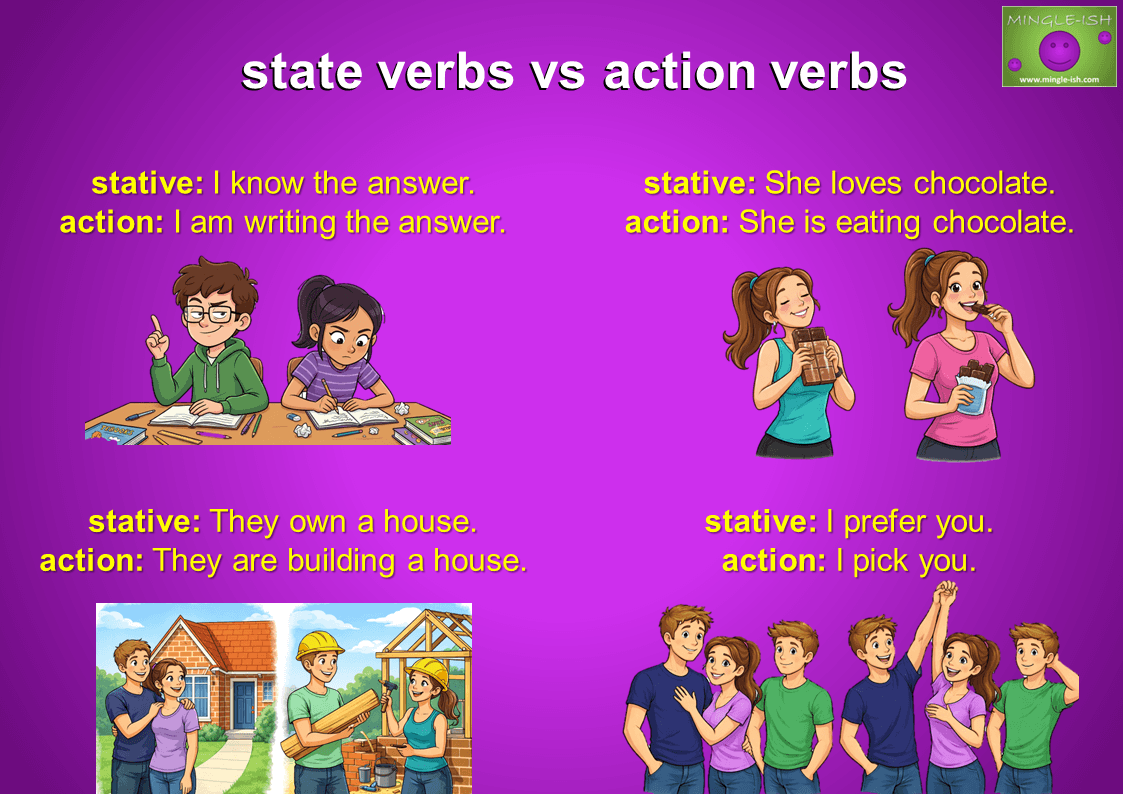
Stative: I know the answer.
Action: I am writing the answer.
Stative: She loves chocolate.
Action: She is eating chocolate.
Stative: They own a house.
Action: They are building a house.
Stative: I prefer you.
Action: I pick you.
The most common mistake
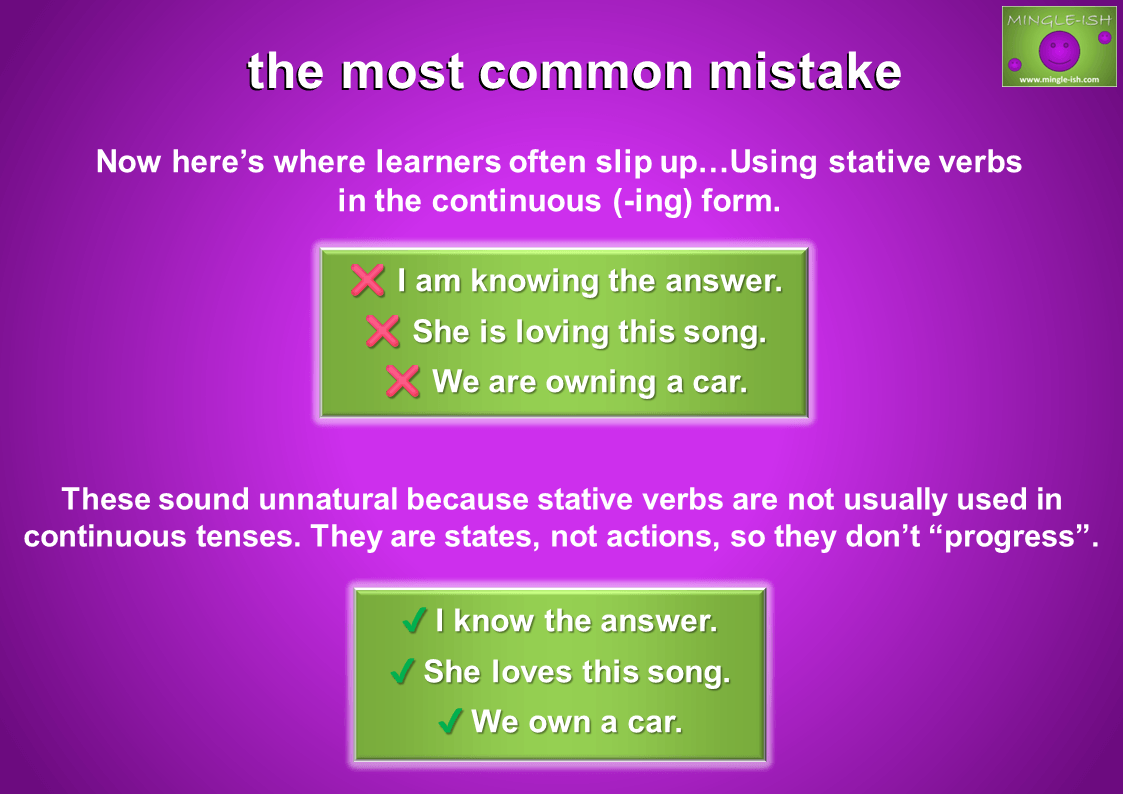
Now here’s where learners often slip up…Using stative verbs in the continuous (-ing) form.
❌ I am knowing the answer.
❌ She is loving this song.
❌ We are owning a car.
These sound unnatural because stative verbs are not usually used in continuous tenses. They are states, not actions, so they don’t “progress”.
✔ I know the answer.
✔ She loves this song.
✔ We own a car.
Much better. Less chaos. Everyone’s happy.
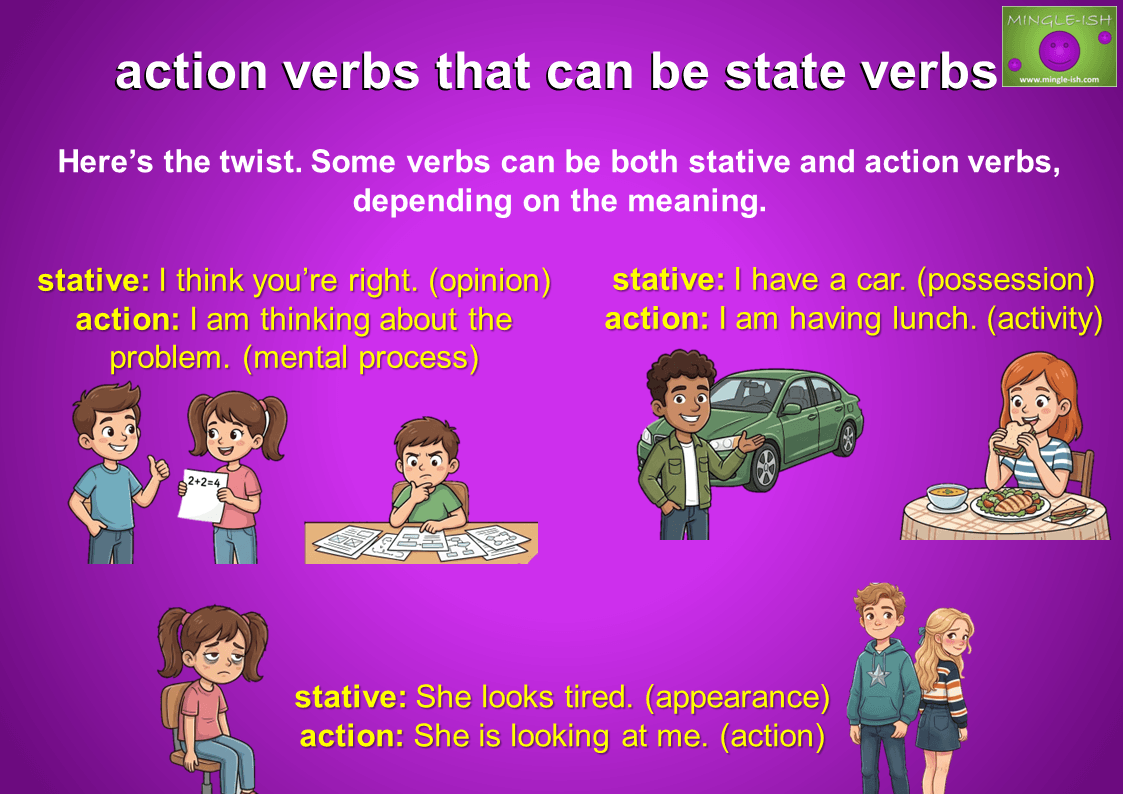
action verbs that can be state verbs
But wait… some verbs are sneaky. Here’s the twist. Some verbs can be both stative and action verbs, depending on the meaning.
Stative: I think you’re right. (opinion)
Action: I am thinking about the problem. (mental process)
Stative: I have a car. (possession)
Action: I am having lunch. (activity)
Stative: She looks tired. (appearance)
Action: She is looking at me. (action)
So yes, English likes to keep you on your toes.
List of Common Stative Verbs
Ready to meet the verbs that like to chill? Stative verbs, also known as state verbs, don’t usually do the running-around stuff of action verbs. They’re all about feelings, thoughts, senses, and possession – basically the introverts of the verb world. Here’s a neat A–Z list grouped into categories so you can find them fast.
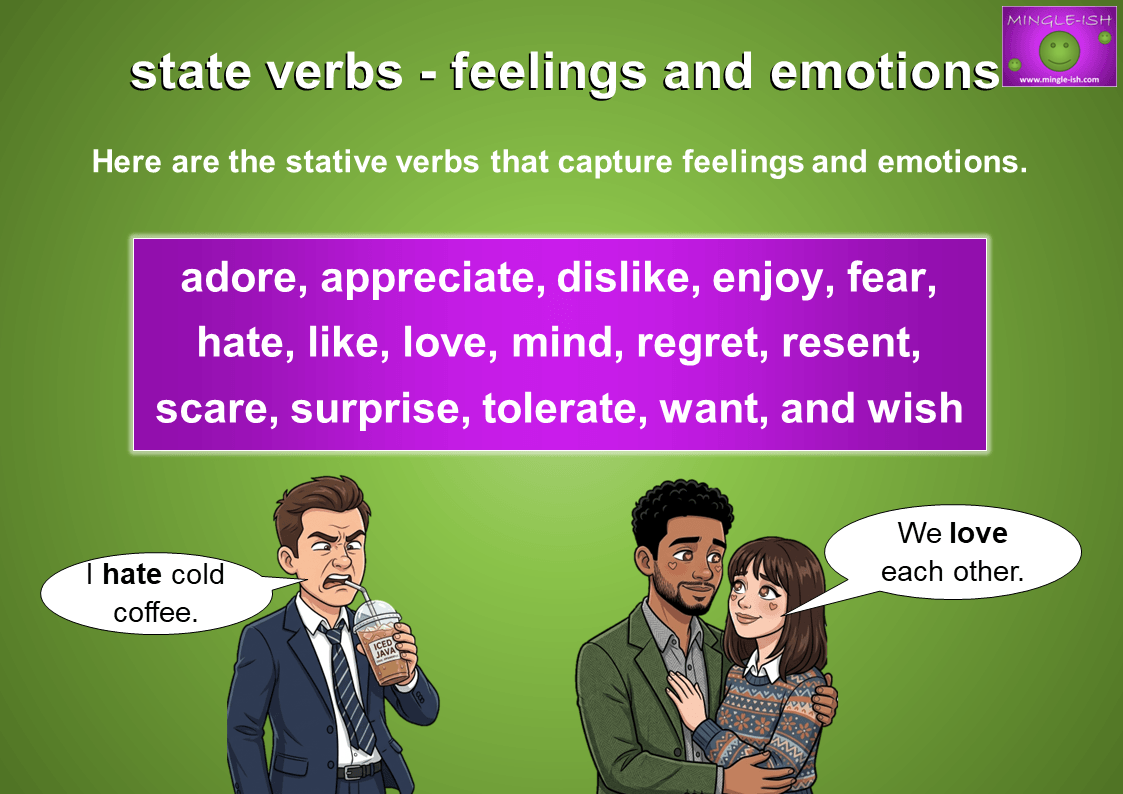
feelings and emotions
Here is the list of feelings and emotions verbs, used as stative verbs with real-life examples for each:
- Adore: Used to express deep love or respect.
Example: I absolutely adore the way the city looks when it snows. - Appreciate: Used to recognize the full worth of something.
Example: I really appreciate all the hard work you put into this report. - Dislike: Used to feel a lack of approval or enjoyment.
Example: Most people dislike standing in long queues at the supermarket. - Enjoy: Used to take pleasure in a state or activity.
Example: I enjoy quiet mornings with a cup of coffee before the house wakes up. - Fear: Used to be afraid of something as a general condition.
Example: Many hikers fear encountering bears while exploring the deep woods. - Hate: Used to feel intense dislike.
Example: I hate it when my computer updates right in the middle of a meeting. - Like: Used to find something pleasant or satisfactory.
Example: I like the new layout of the office; it feels much more open. - Love: Used to have a strong affection for someone or something.
Example: They love spending their weekends hiking in the countryside. - Mind: Used to be distressed or annoyed by something (usually in the negative).
Example: I don’t mind the rain as long as I have a sturdy umbrella. - Regret: Used to feel sad or disappointed over a past action or loss.
Example: I regret not taking more photos during our holiday last year. - Resent: Used to feel bitterness or indignation at something.
Example: He resents the fact that he has to work every Saturday. - Scare: Used to describe a state of being frightened (often as “scares me”).
Example: The thought of public speaking really scares me. - Surprise: Used to describe the state of finding something unexpected.
Example: It doesn’t surprise me that the show sold out so quickly. - Tolerate: Used to allow or endure something without liking it.
Example: I can tolerate loud music during the day, but not late at night. - Want: Used to have a desire for something.
Example: After a long day at work, I just want to sit on the sofa and relax. - Wish: Used to feel a desire for something that is not the case.
Example: I wish I had more free time to practice playing the guitar.
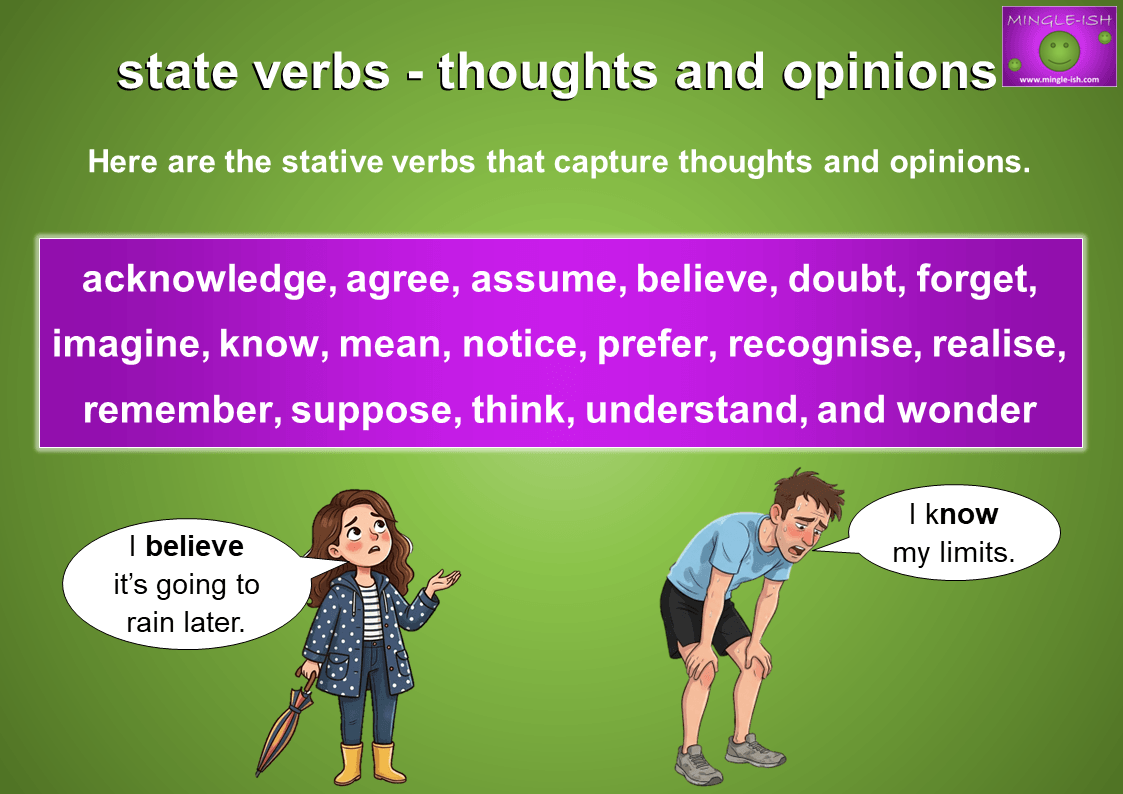
thoughts and opinions
Here is the list of mental state verbs, used as stative verbs with real-life examples to show how they describe a condition of the mind:
- Acknowledge: Used to show awareness or acceptance of a fact.
Example: I acknowledge that the project is difficult, but I believe we can finish it on time. - Agree: Used to express having the same opinion as someone else.
Example: Most scientists agree that sleep is essential for brain health. - Assume: Used to take something as true without needing immediate proof.
Example: I assume the meeting is still on since nobody sent a cancellation email. - Believe: Used to have a firm conviction in the truth of something.
Example: I believe that honesty is the most important trait in a friend. - Doubt: Used to feel uncertain or lack confidence in something.
Example: I doubt the train will arrive on time given the heavy snow. - Forget: Used to describe the state of being unable to recall information.
Example: I always forget where I put my keys the moment I walk through the door. - Imagine: Used to form a mental concept or belief about a situation.
Example: I imagine it must be very quiet living so far out in the countryside. - Know: Used to possess information or a specific skill.
Example: She knows exactly how to fix the engine when it starts making that noise. - Mean: Used to convey a specific sense, significance, or intention.
Example: I didn’t mean to offend anyone; it was just a misunderstanding. - Notice: Used to become aware of something through observation.
Example: I notice a small crack in the window that wasn’t there yesterday. - Prefer: Used to like one thing better than another as a general rule.
Example: When traveling, I usually prefer taking the train over flying. - Recognise: Used to identify someone or something from previous knowledge.
Example: I recognise his voice from the podcast I listen to every morning. - Realise: Used to suddenly understand or become aware of a fact.
Example: I realise now that I’ve been holding the map upside down this whole time. - Remember: Used to have a past image or idea remain in the mind.
Example: I still remember the lyrics to every song on that album. - Suppose: Used to think something is probable based on the circumstances.
Example: I suppose we should start cooking dinner if we want to eat by eight. - Think: Used to hold a specific opinion or belief.
Example: I think that blue is the perfect color for the living room walls. - Understand: Used to perceive the intended meaning or nature of something.
Example: I understand the math formula now that you’ve explained it clearly. - Wonder: Used to have a desire to know something or feel curious.
Example: I wonder what the world will look like fifty years from now.
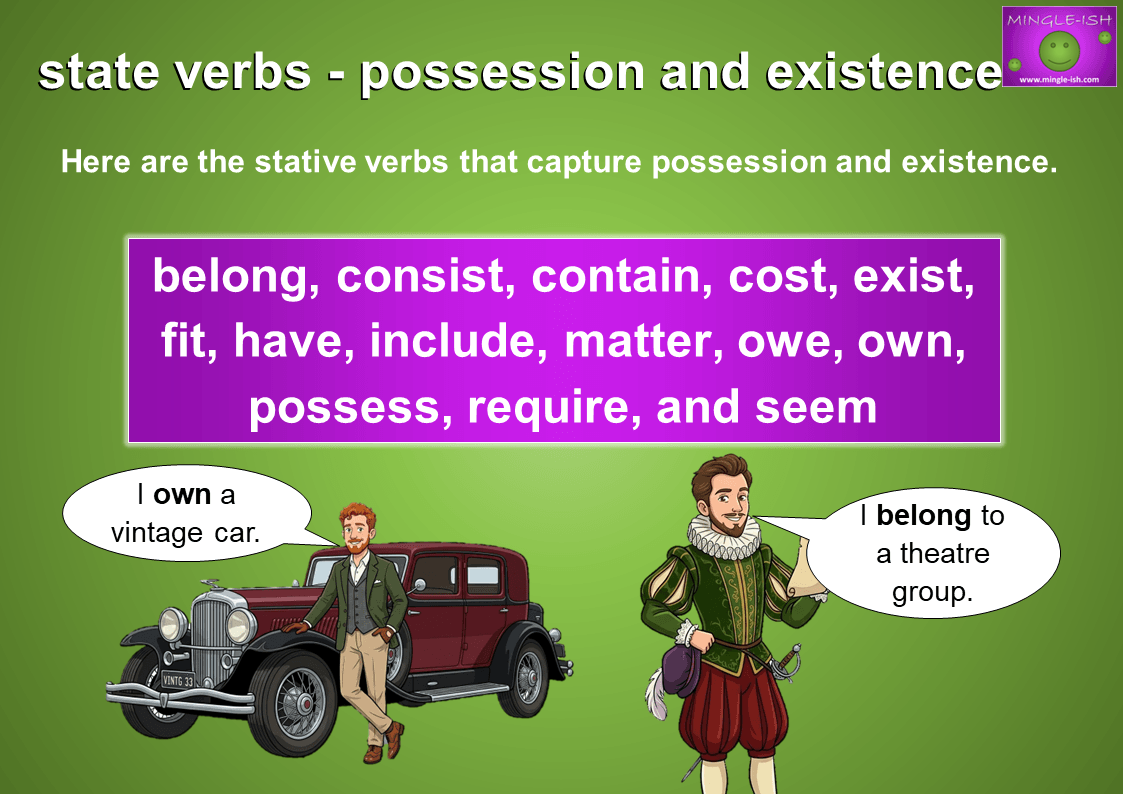
possession and existence
Here is the list of possession and existence verbs, used as stative verbs with real-life examples for each:
- Belong: Used to show that someone is the owner of something.
Example: That blue umbrella by the door belongs to my neighbour upstairs. - Consist: Used to describe the things or people that make up a whole.
Example: A standard deck of playing cards consists of fifty-two cards in four suits. - Contain: Used to describe what is held inside something else.
Example: This orange juice contains no added sugar or artificial preservatives. - Cost: Used to state the price required to buy or do something.
Example: It costs a lot more to heat a house during the winter months. - Exist: Used to describe the state of being real or present.
Example: Many scientists believe that liquid water might exist on other planets. - Fit: Used to describe being the right size or shape for something.
Example: I don’t think these giant suitcases will fit in the boot of such a small car. - Have: Used to indicate possession or a characteristic.
Example: She has a very rare collection of vintage postage stamps. - Include: Used to show that something is part of a larger group or total.
Example: The price of the hotel room includes a full breakfast and access to the gym. - Matter: Used to describe something that is important or significant.
Example: It doesn’t matter if we arrive a few minutes late; the show starts with a long intro. - Owe: Used to describe a debt or an obligation to someone.
Example: I still owe my brother twenty pounds for the concert tickets he bought. - Own: Used to describe legal possession of something.
Example: They finally own their house outright after paying off the mortgage. - Possess: Used to describe having a particular quality or physical item.
- Example: Some athletes possess a natural talent that is obvious from a very young age.
- Require: Used to describe a state of necessity.
Example: This complicated recipe requires several ingredients that are hard to find. - Seem: Used to describe the outward appearance or impression of a state.
Example: You seem much happier now that you have started your new job.
senses and perception
Finally, here is the list for the senses and perception category. These verbs describe the automatic way we experience the world around us as a constant state.
- Appear: Used to describe the outward impression or state of something.
Example: The sun appears to be moving across the sky, but it is actually the Earth rotating. - Hear: Used to describe the physical ability to perceive sound.
Example: I can hear the distant sound of a lawnmower from somewhere down the street. - Look: Used to describe the appearance or characteristic of a person or object.
Example: You look exactly like your father when you smile like that. - See: Used to describe the physical state of visual perception.
Example: From the top of the hill, we can see the entire coastline for miles. - Smell: Used to describe the quality or scent that an object gives off.
Example: Freshly baked bread always smells incredible when you walk past a bakery. - Sound: Used to describe the impression created by a noise or an idea.
Example: That sounds like a wonderful plan for our anniversary dinner. - Taste: Used to describe the flavour or quality of a food or drink.
Example: This homemade lemonade tastes much better than the store-bought version.
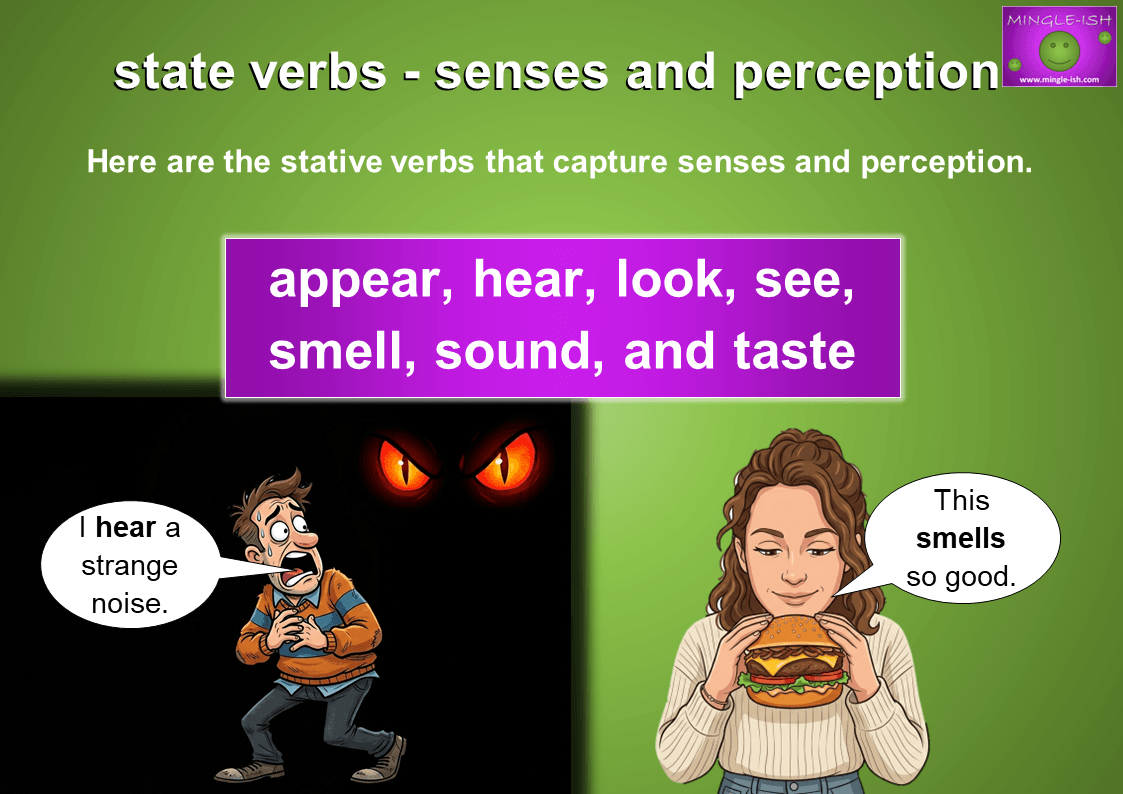
These verbs aren’t into continuous tense drama – they like to keep things simple. So while action verbs are out there jogging in the park, stative verbs are sipping tea and quietly showing their meaning.
Can Stative Verbs Be Used in Continuous Tenses?
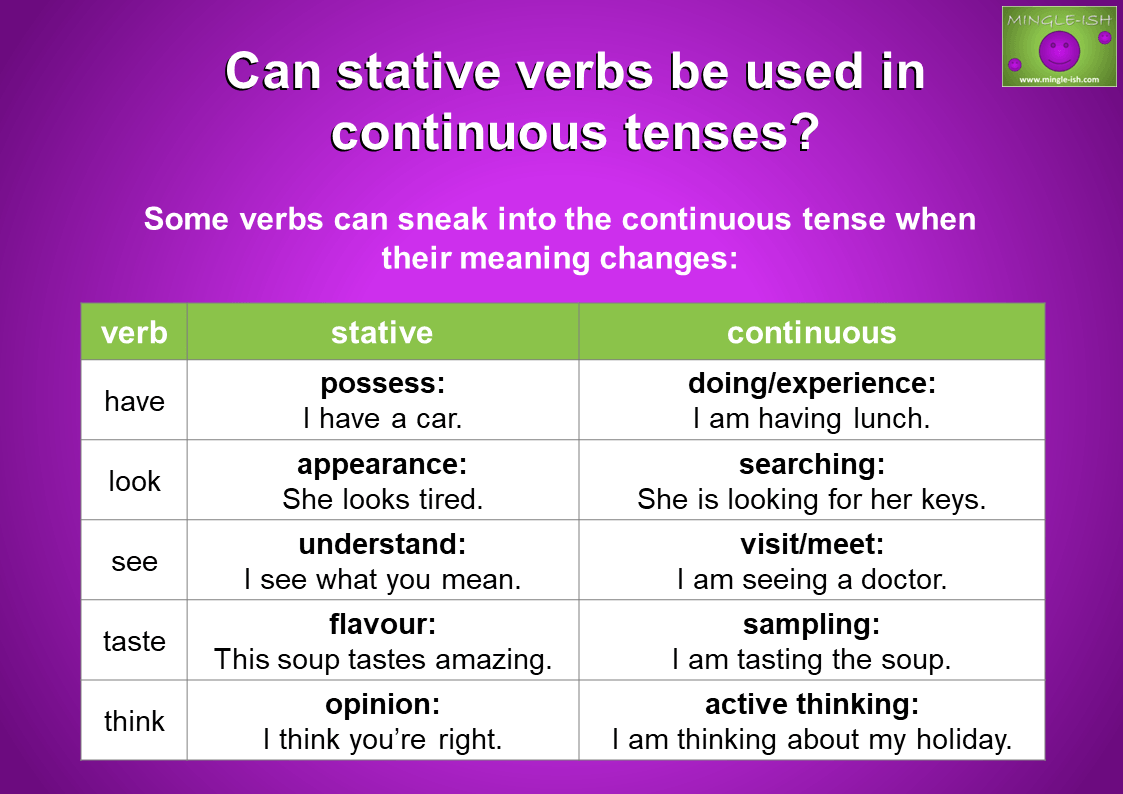
Stative verbs are the chill ones – they just exist, know, or belong. No -ing needed. “I am knowing the answer” or “She is loving pizza”? Nope, sounds weird.
Some verbs can sneak into the continuous club when their meaning changes:
| Verb | Stative | Continuous | Example |
|---|---|---|---|
| Have | Possess | Doing / experience | “I have a car.” / “I am having lunch.” |
| Look | Appearance | Searching | “She looks tired.” / “She is looking for her keys.” |
| See | Understand | Visit / meet | “I see what you mean.” / “I am seeing a doctor.” |
| Taste | Flavour | Sampling | “This soup tastes amazing.” / “I am tasting the soup.” |
| Think | Opinion | Active thinking | “I think you’re right.” / “I am thinking about my holiday.” |
Hot Tip: Stative = chill, no -ing. Action = party in continuous tense!
Tips to Remember Stative Verbs Easily
Stative verbs can be sneaky little things, but don’t worry – you can totally tame them with a few easy tricks. Here’s how to spot them without scratching your head:
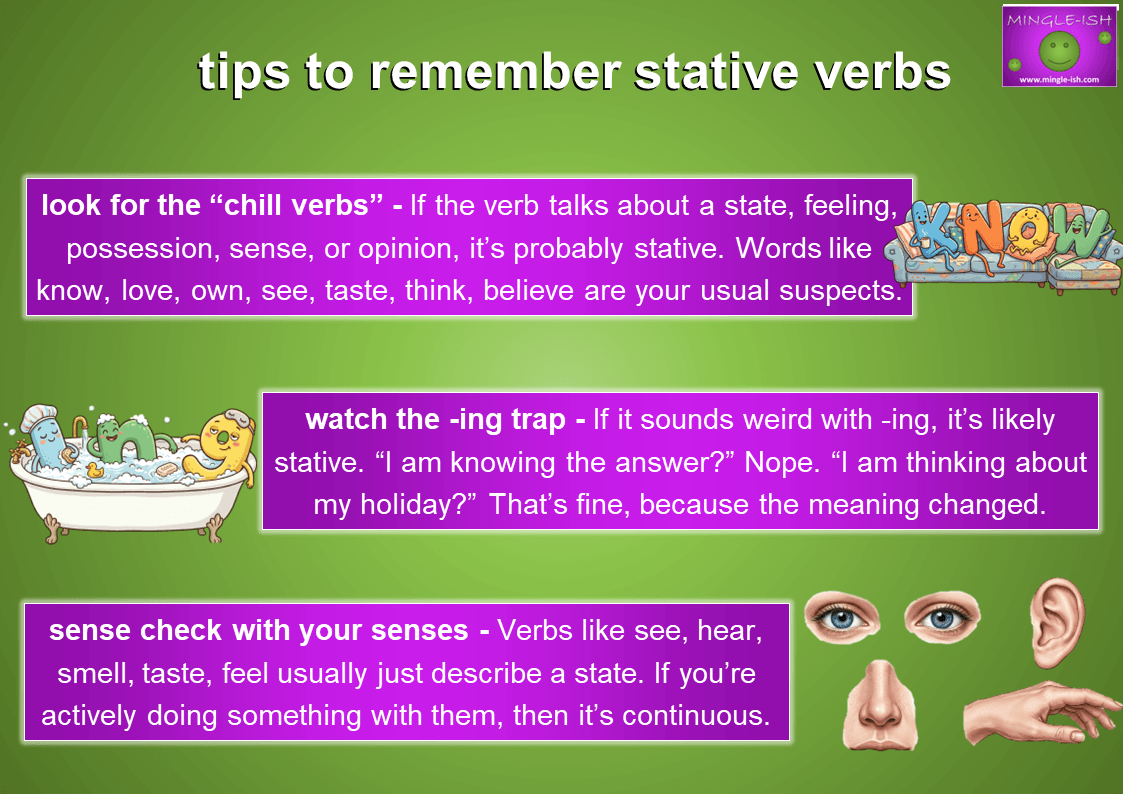
Look for the “chill verbs” – If the verb talks about a state, feeling, possession, sense, or opinion, it’s probably stative. Words like know, love, own, see, taste, think, believe are your usual suspects.
Watch the -ing trap – If it sounds weird with -ing, it’s likely stative. “I am knowing the answer?” Nope. “I am thinking about my holiday?” That’s fine, because the meaning changed.
Sense check with your senses – Verbs like see, hear, smell, taste, feel usually just describe a state. If you’re actively doing something with them, then it’s continuous.
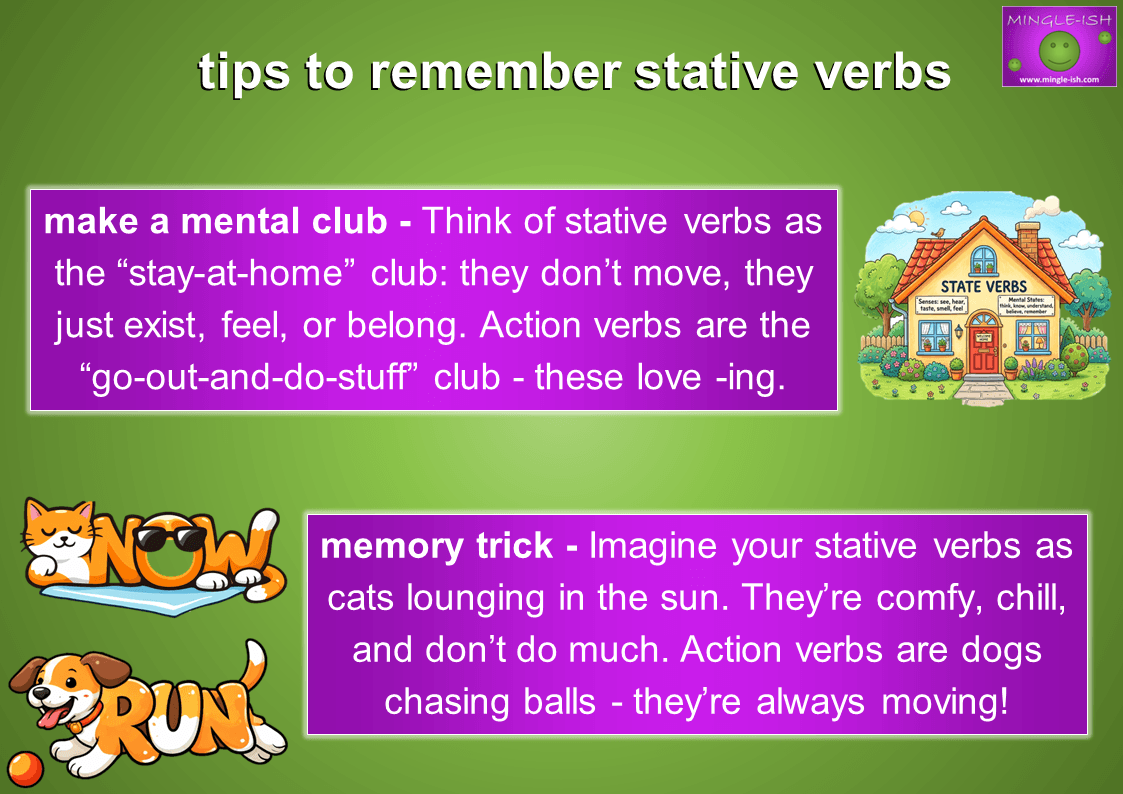
Make a mental club – Think of stative verbs as the “stay-at-home” club: they don’t move, they just exist, feel, or belong. Action verbs are the “go-out-and-do-stuff” club—these love -ing.
Memory trick – Imagine your stative verbs as cats lounging in the sun. They’re comfy, chill, and don’t do much. Action verbs are dogs chasing balls – they’re always moving!
Follow these simple patterns, and you’ll start spotting stative verbs like a pro – without even thinking.
State Verbs Quiz: Test Your Knowledge
Think state verbs are easy? This quick quiz will show you what you really know. Jump in, pick your answers, and see if you can spot the tricky ones before they catch you out.
Stative Verbs FAQs
Got questions? Of course you do. Stative verbs love to keep things interesting. Let’s clear things up:
What is a stative verb?
A stative verb describes a state, not an action. Think feelings, thoughts, possession, senses, and opinions. These verbs don’t “do” much—they just exist. Examples include know, love, believe, own, see, want.
Can stative verbs be continuous?
Usually, no. Stative verbs don’t like the -ing form. “I am knowing the answer” sounds wrong. But some verbs can switch teams when the meaning changes. “I am thinking about it” works because it becomes an action.
What are examples of stative verbs?
Common ones include believe, hate, know, like, love, need, own, prefer, remember, see, think, understand, want.
Why do some stative verbs use -ing sometimes?
Because they’re being sneaky. The meaning changes from a state to an action. For example, “I think you’re right” is a state (opinion), but “I am thinking about it” is an action (process).
What is the difference between stative and action verbs?
Stative verbs describe conditions or states. Action verbs describe things you can actually do. If it feels like movement or activity, it’s probably an action verb. If it feels like “just existing”, it’s likely stative.
Are all sense verbs stative?
Not always. Verbs like see, hear, taste, smell, feel are usually stative, but they can become action verbs when you actively do them. For example, “The soup tastes good” vs “I am tasting the soup.”
How can I remember stative verbs easily?
Think cats vs dogs. Cats = stative (chill, doing nothing). Dogs = action (running, jumping, chaos). Simple, memorable, done.
Final Thoughts
So, there you have it – stative verbs are basically the chill heroes of English. They exist, know, feel, and belong without all the -ing drama. Some like to sneak into the continuous party when their meaning changes, but for the most part, they’re content just hanging out in their stative zone.
Remember: spot the “stay-at-home” verbs, watch out for the weird -ing ones, and let your mental cat-and-dog club guide you – cats = stative, dogs = action.
Don’t stress if you mix them up sometimes. With a bit of practice, spotting stative verbs will feel as easy as spotting the sunniest spot for a catnap. Keep an eye out, play with examples, and soon you’ll be a stative verb whisperer!
Further Learning
Want to explore more English fun? Check out these pages:
Action verbs – Learn how to spot the “go-out-and-do-stuff” verbs that love -ing.
Auxiliary verbs – Discover the little helper verbs that make everything possible.
Idioms and phrasal verbs – Unlock the quirky phrases native speakers actually use.
Modal verbs – See how can, could, should, and might spice up your sentences.
grammar – The ultimate hub for tips, rules, and clever tricks.
Regular verbs – Master the dependable verbs that play by the rules.
Verb tense structures – Past, present, future, and all the in-between twists.
And for even more fun, head over to my YouTube channel for videos that make learning English easy, practical, and way more entertaining.