Some adjectives in English require a specific preposition after them. The preposition helps the sentence make sense and sound natural. If you’re not sure what a preposition is, follow this link to learn more, as they are an important (and sometimes tricky) part of English grammar.

For ESL and EFL learners, understanding adjective + preposition combinations is essential.

This page will guide you through common adjectives with prepositions, explain the rules, and provide examples and quizzes to help you master them.

What Are Adjectives with Prepositions?

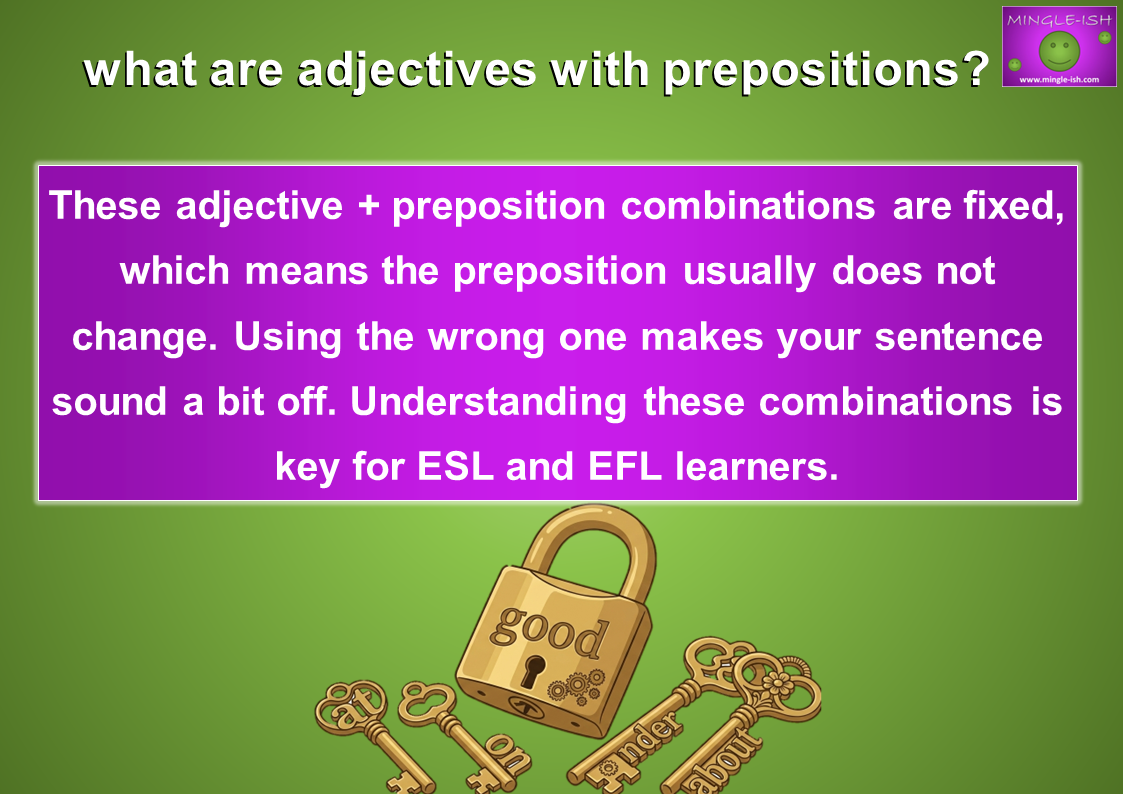
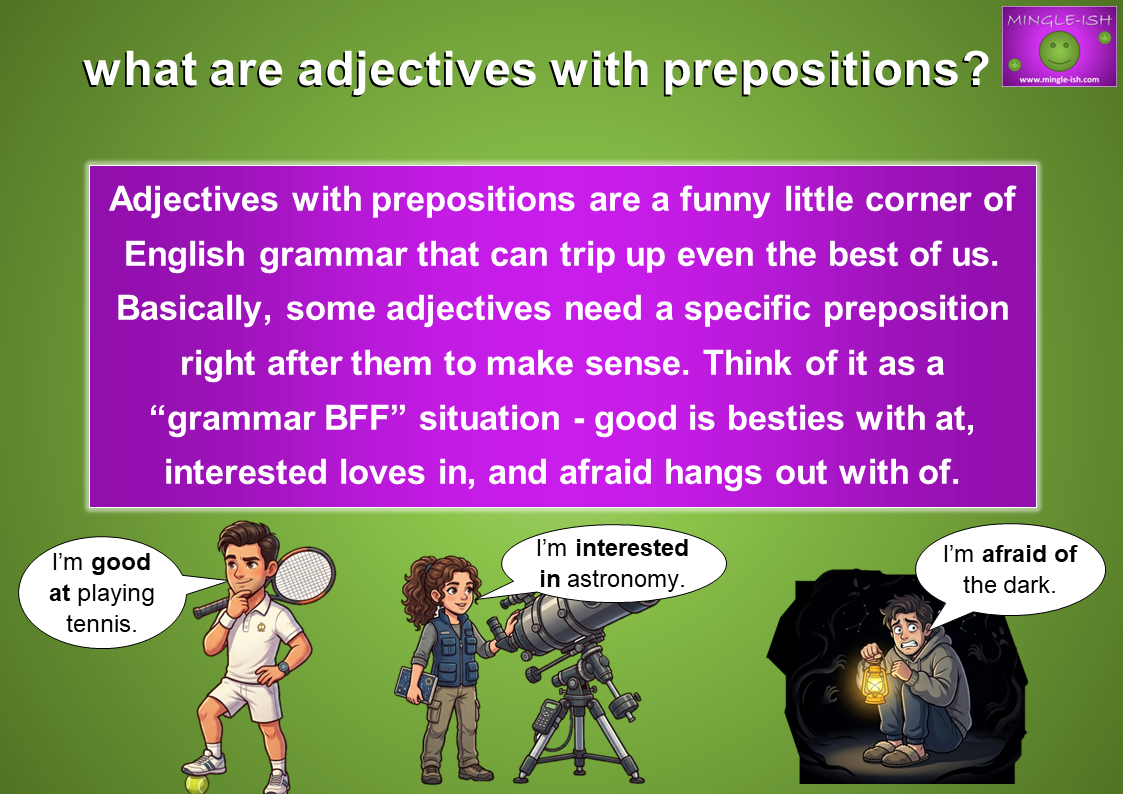
Adjectives with prepositions are a funny little corner of English grammar that can trip up even the best of us. Basically, some adjectives need a specific preposition right after them to make sense. Think of it as a “grammar BFF” situation—good is besties with at, interested loves in, and afraid hangs out with of.

These adjective + preposition combinations are fixed, which means the preposition usually does not change. Using the wrong one makes your sentence sound a bit off, like a cat wearing shoes—technically possible, but weird.

Understanding these combinations is key for ESL and EFL learners. They’re part of the essential adjective preposition rules, help you master adjective preposition combinations in English, and are a core part of common English grammar patterns.

In short: get your adjective + preposition combos right, and your sentences will flow naturally, your writing will sound polished, and your English exam scores will thank you.

Illustration explaining adjectives with prepositions in English grammar with examples good at, interested in, and afraid of for ESL learners
Adjective + preposition combinations in English grammar shown as a lock and key visual explaining fixed adjective preposition rules for ESL learners

common adjectives with prepositions list

Below, you’ll find a carefully organised list of common adjectives with prepositions, grouped by preposition to make learning easier. This will help you understand common adjective preposition combinations in English, improve your accuracy, and avoid typical ESL and EFL grammar mistakes. Whether you’re preparing for an English exam or just want to sound more natural, mastering these English grammar patterns will make a noticeable difference.


Have a go at speaking out loud and answering the questions.

Adjectives with About

About is a busy little preposition. It usually means on the topic of or connected to. If you’re talking about homework, worrying about exams, or excited about the weekend, you’re linking your feeling or conversation to a thing. It points the spotlight at the subject. Simple, small, but secretly powerful.

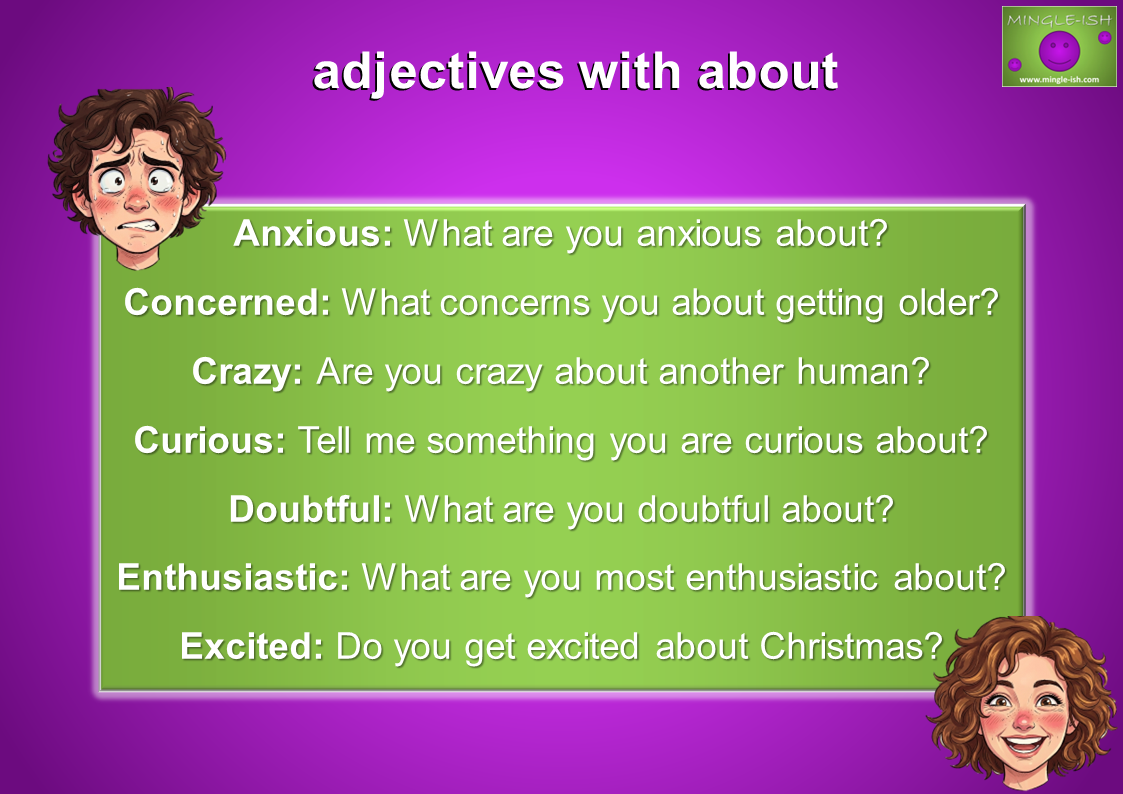
  • Anxious: What are you anxious about?
  • Concerned: What concerns you about getting older?
  • Crazy: Are you crazy about another human?
  • Curious: Tell me something you are curious about?
  • Doubtful: What are you doubtful about?
  • Enthusiastic: What are you most enthusiastic about?
  • Excited: Do you get excited about Christmas?
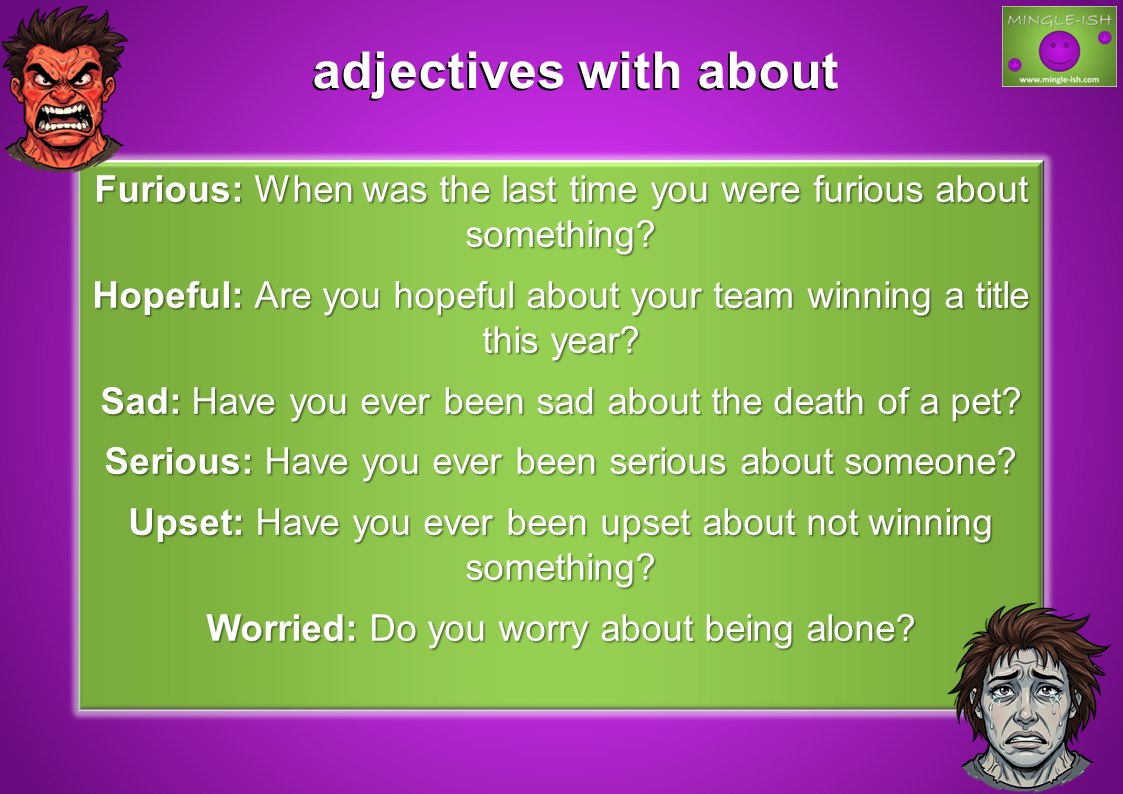
  • Furious: When was the last time you were furious about something?
  • Hopeful: Are you hopeful about your team winning a title this year?
  • Sad: Have you ever been sad about the death of a pet?
  • Serious: Have you ever been serious about someone?
  • Upset: Have you ever been upset about not winning something?
  • Worried: Do you worry about being alone?
Infographic showing a list of adjectives paired with the preposition "about" and example questions, featuring cartoon illustrations of an anxious man and an excited woman.
Infographic displaying English adjectives paired with the preposition "about," featuring practice questions and cartoon faces of a furious man and an upset person.

Adjectives with At

At is the laser-pointer of prepositions. It zooms in on a specific point. A point in time, at 6 o’clock. A point in space, at the bus stop. A point in a situation, at the party, at work, at school. It doesn’t wander about. It stands still and says, right here, right now.

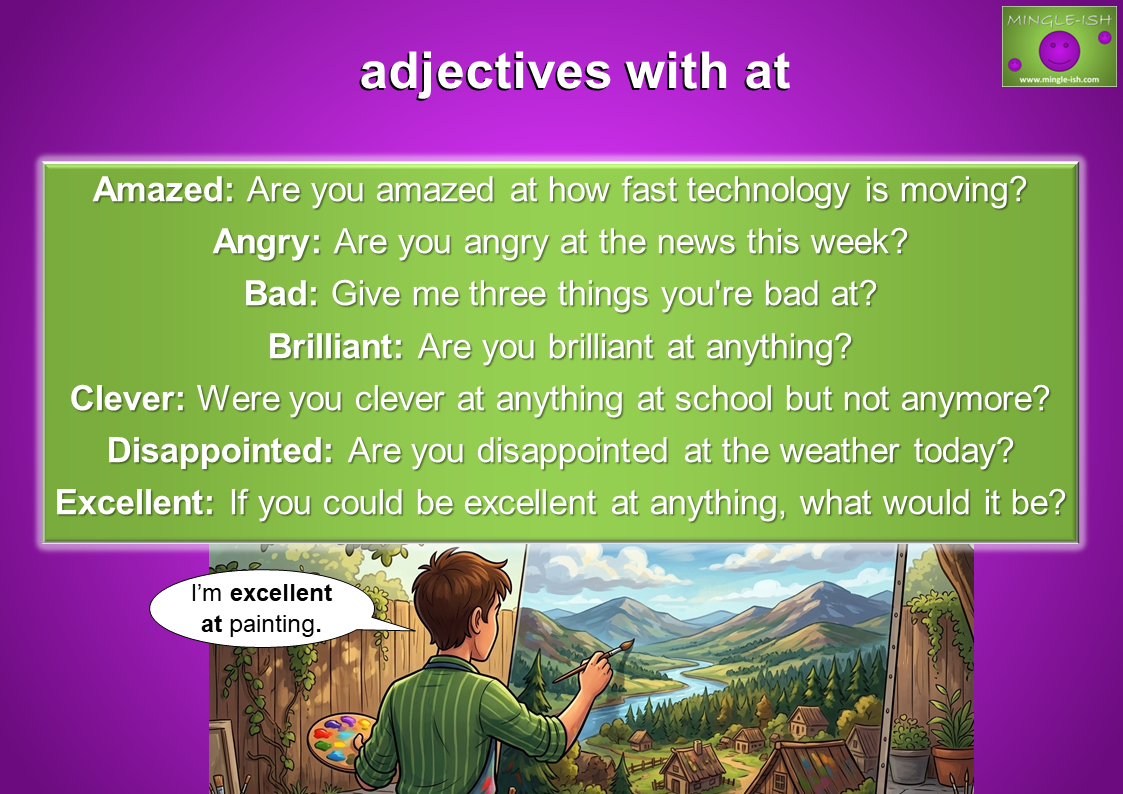
  • Amazed: Are you amazed at how fast technology is moving?
  • Angry: Are you angry at the news this week?
  • Bad: Give me three things you’re bad at?
  • Brilliant: Are you brilliant at anything?
  • Clever: Were you clever at anything at school but not anymore?
  • Disappointed: Are you disappointed at the weather today?
  • Excellent: If you could be excellent at anything, what would it be?
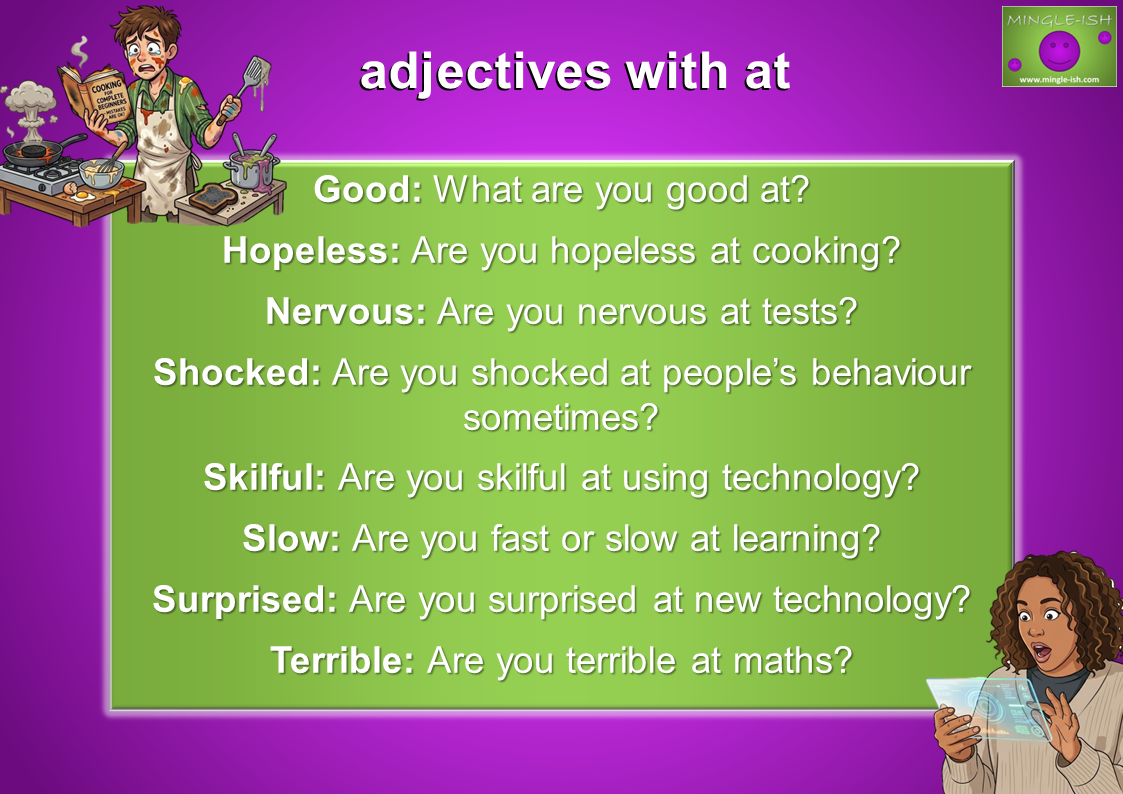
  • Good: What are you good at?
  • Hopeless: Are you hopeless at cooking?
  • Nervous: Are you nervous at tests?
  • Shocked: Are you shocked at people’s behaviour sometimes?
  • Skilful: Are you skilful at using technology?
  • Slow: Are you fast or slow at learning?
  • Surprised: Are you surprised at new technology?
  • Terrible: Are you terrible at maths?
Educational infographic titled "adjectives with at" featuring a list of example sentences and a cartoon of a man painting a landscape.
Grammar educational slide titled "adjectives with at" with a list of questions and cartoon illustrations of a messy cook and a surprised woman with a tablet.

Adjectives with For

For is the “helper” preposition. It’s like a little tag saying this is meant for that. Want something for someone? That thing exists for them. Talking about a reason? It’s the explanation for it. Counting time or purpose? Yup, that’s for. Basically, for is everywhere, quietly doing its job, making connections, assigning reasons, and pointing out who or what gets what.

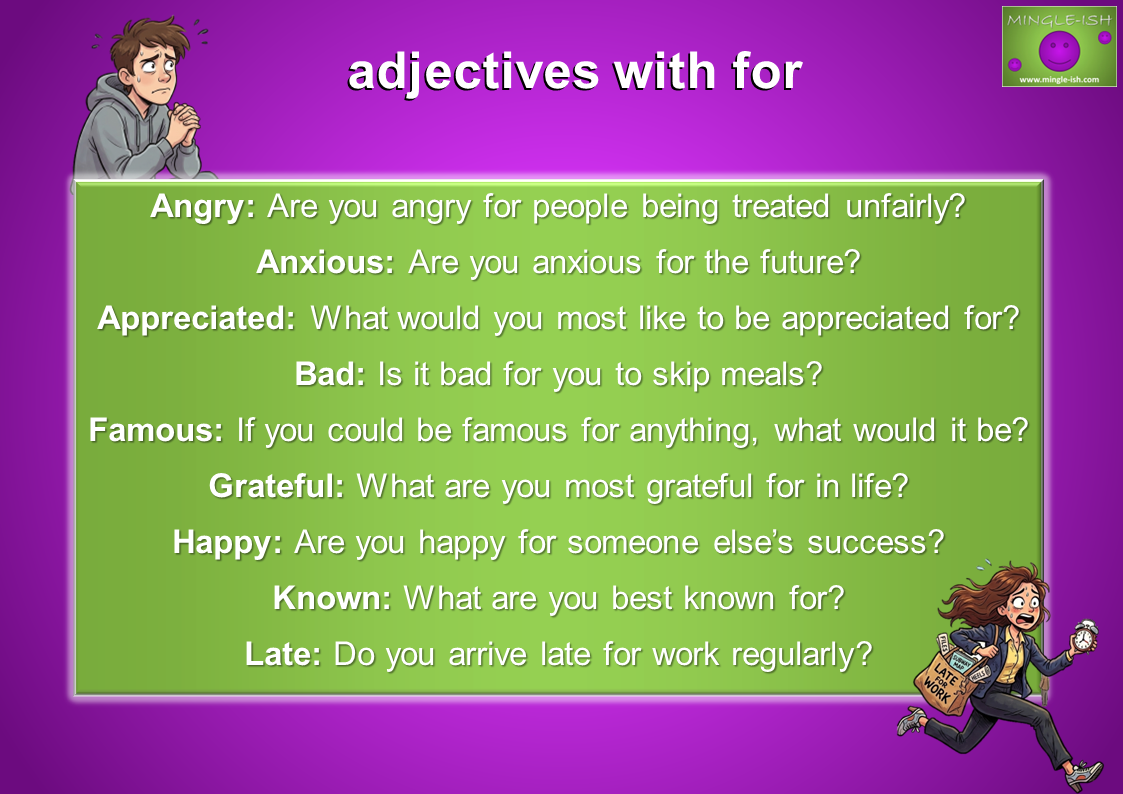
  • Angry: Are you angry for people being treated unfairly?
  • Anxious: Are you anxious for the future?
  • Appreciated: What would you most like to be appreciated for?
  • Bad: Is it bad for you to skip meals?
  • Famous: If you could be famous for anything, what would it be?
  • Grateful: What are you most grateful for in life?
  • Happy: Are you happy for someone else’s success?
  • Known: What are you best known for?
  • Late: Do you arrive late for work regularly?
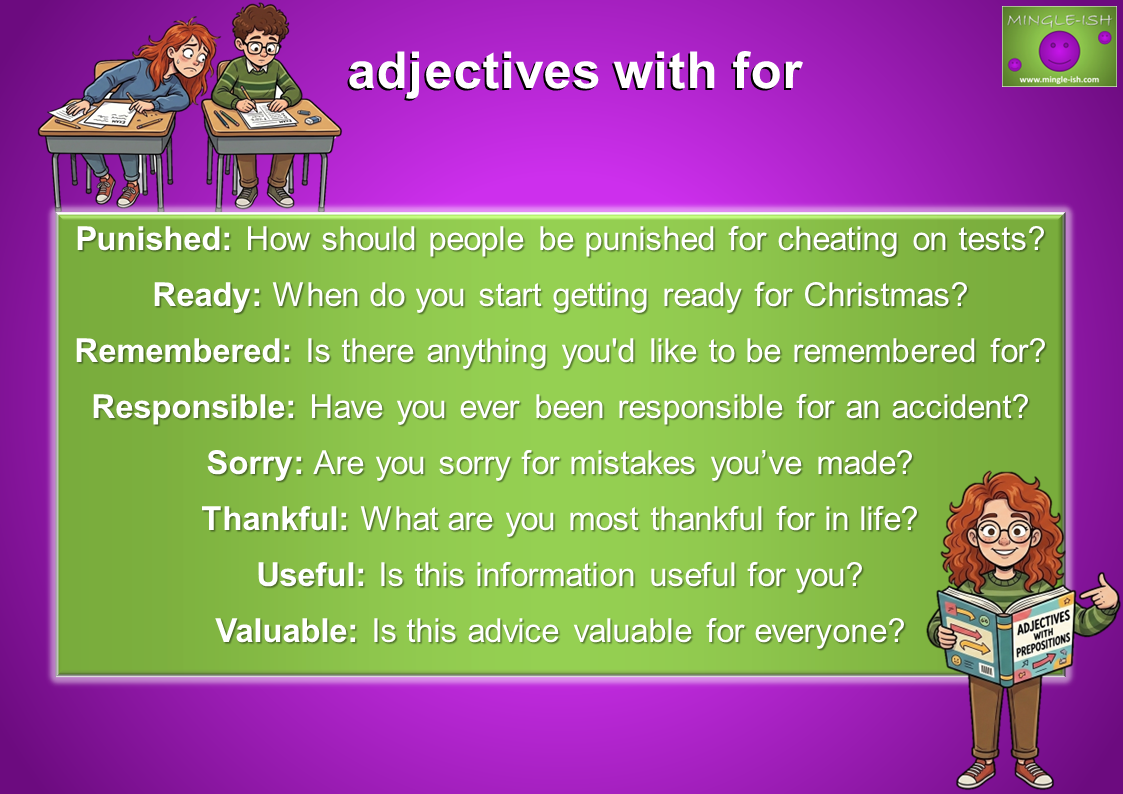
  • Punished: How should people be punished for cheating on tests?
  • Ready: When do you start getting ready for Christmas?
  • Remembered: Is there anything you’d like to be remembered for?
  • Responsible: Have you ever been responsible for an accident?
  • Sorry: Are you sorry for mistakes you’ve made?
  • Thankful: What are you most thankful for in life?
  • Useful: Is this information useful for you?
  • Valuable: Is this advice valuable for everyone?
Adjectives with for examples including angry for, anxious for, appreciated for, famous for, grateful for, happy for, known for and late for with question sentences
Adjectives with for examples including punished for, ready for, remembered for, responsible for, sorry for, thankful for, useful for and valuable for with question sentences

Adjectives with From

From is the “origin story” preposition. It’s like a little arrow pointing backwards saying this started there. Got a place? You’re from it. Got a person? It came from them. Talking about distance, separation, or where something began? That’s from. Basically, from is always looking back, tracing beginnings, marking sources, and quietly reminding us where things came from.

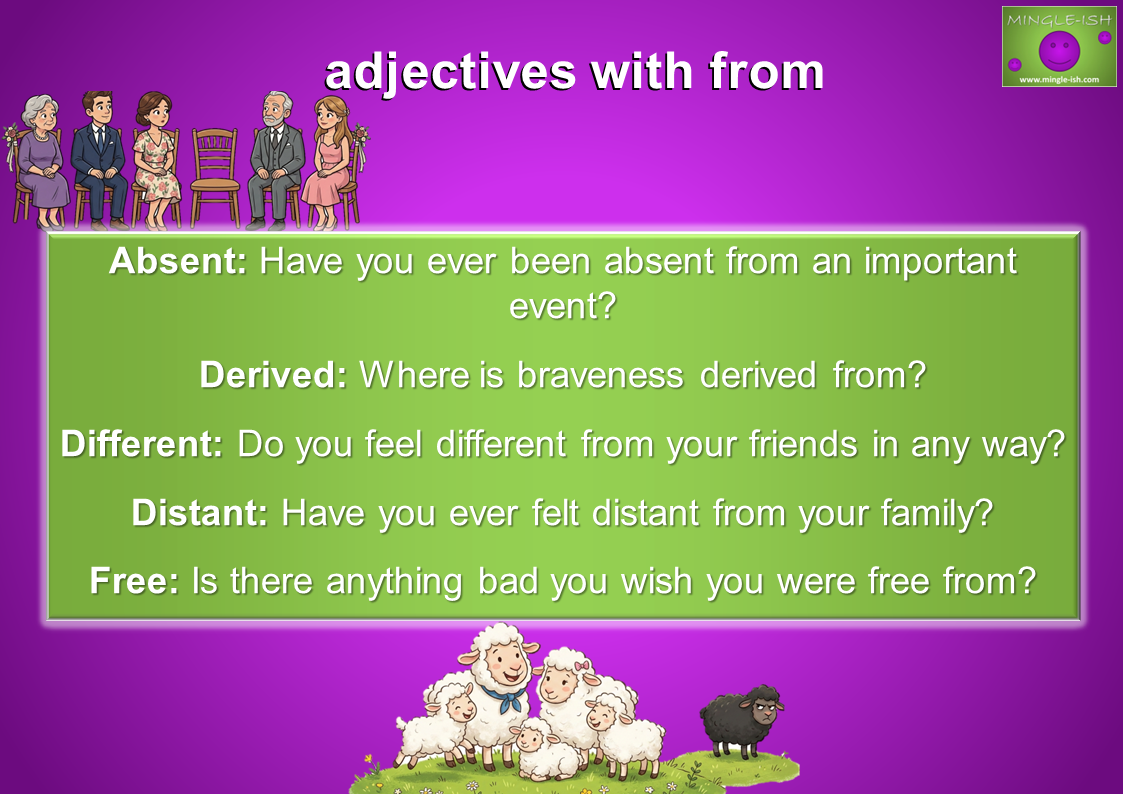
  • Absent: Have you ever been absent from an important event?
  • Derived: Where is braveness derived from?
  • Different: Do you feel different from your friends in any way?
  • Distant: Have you ever felt distant from your family?
  • Free: Is there anything bad you wish you were free from?
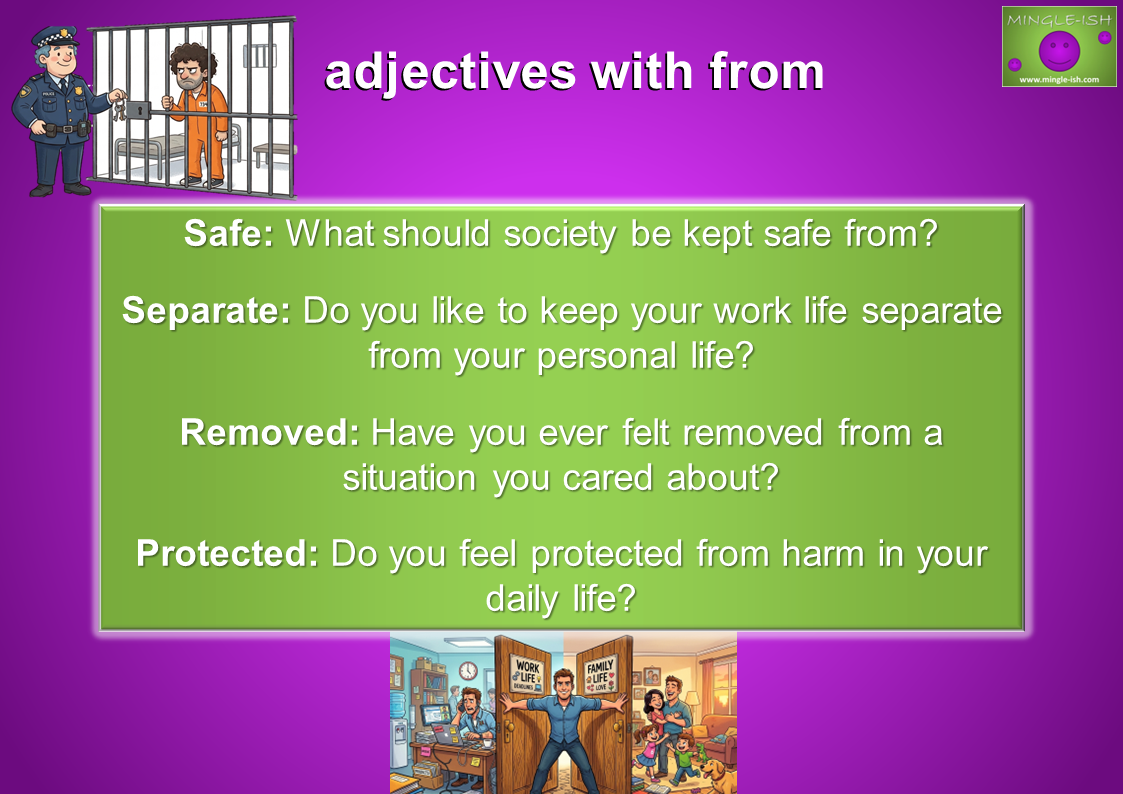
  • Safe: What should society be kept safe from?
  • Separate: Do you like to keep your work life separate from your personal life?
  • Removed: Have you ever felt removed from a situation you cared about?
  • Protected: Do you feel protected from harm in your daily life?
Illustrated grammar poster showing adjectives with the preposition from, including absent from, derived from, different from, distant from and free from, with example question sentences for ESL learners.
Educational infographic from Mingle-ish titled "adjectives with from" featuring cartoon illustrations of a prison and a man balancing work and family life.

Adjectives with In

In is the cosy little preposition. It loves being inside things. In a room, in a box, in trouble, in love, in 1999. If something feels surrounded, contained, wrapped up, or emotionally swallowed whole, in is doing the job. It puts people in situations, in moods, in danger, in pyjamas. It’s all about being enclosed, included, or completely involved. If you can imagine invisible walls around it, chances are, you need in.

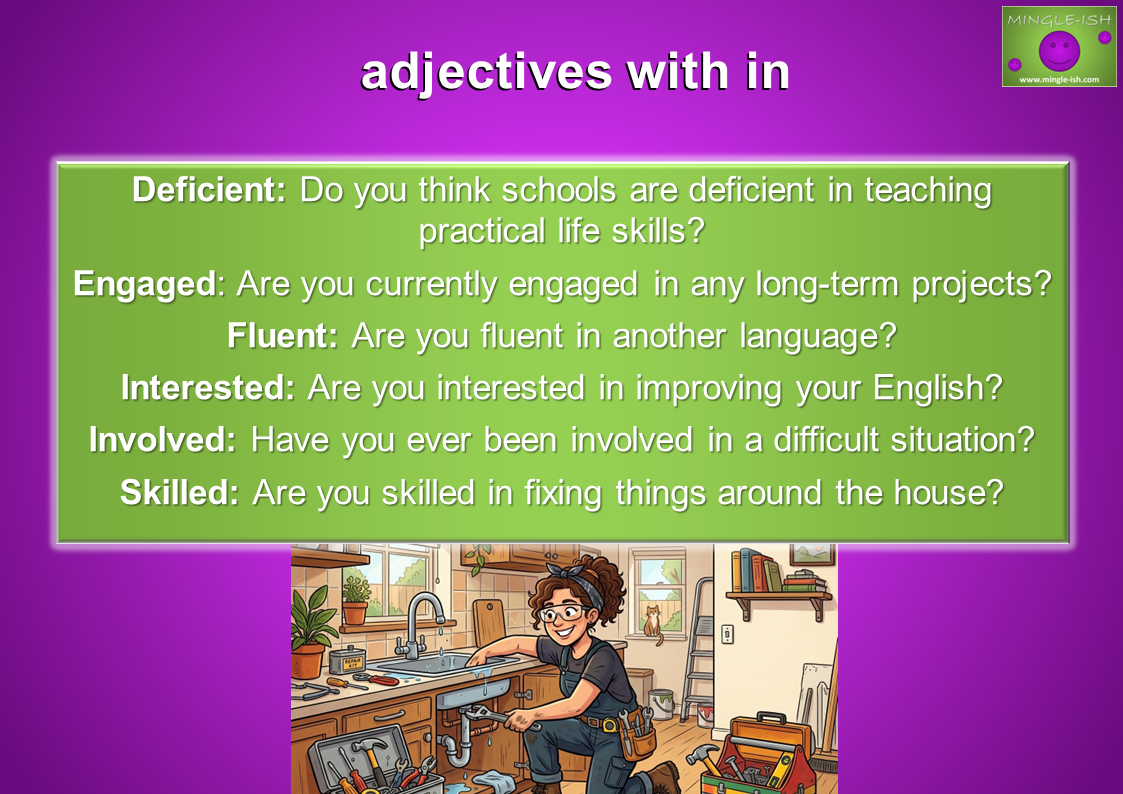
  • Deficient: Do you think schools are deficient in teaching practical life skills?
  • Engaged: Are you currently engaged in any long-term projects?
  • Fluent: Are you fluent in another language?
  • Interested: Are you interested in improving your English?
  • Involved: Have you ever been involved in a difficult situation?
  • Skilled: Are you skilled in fixing things around the house?
Cartoon illustration of a woman repair technician in a kitchen fixing a leaky sink with various tools.

Adjectives with Of

Of is the clingy little preposition. It hates standing alone. It’s always attaching one thing to another. The colour of the sky, a slice of cake, a friend of mine, the sound of rain. If something belongs to something, comes from something, is made of something, or is part of something, of is there, quietly glueing it together. It’s not flashy. It doesn’t shout. It just links everything to everything else like grammatical superglue.

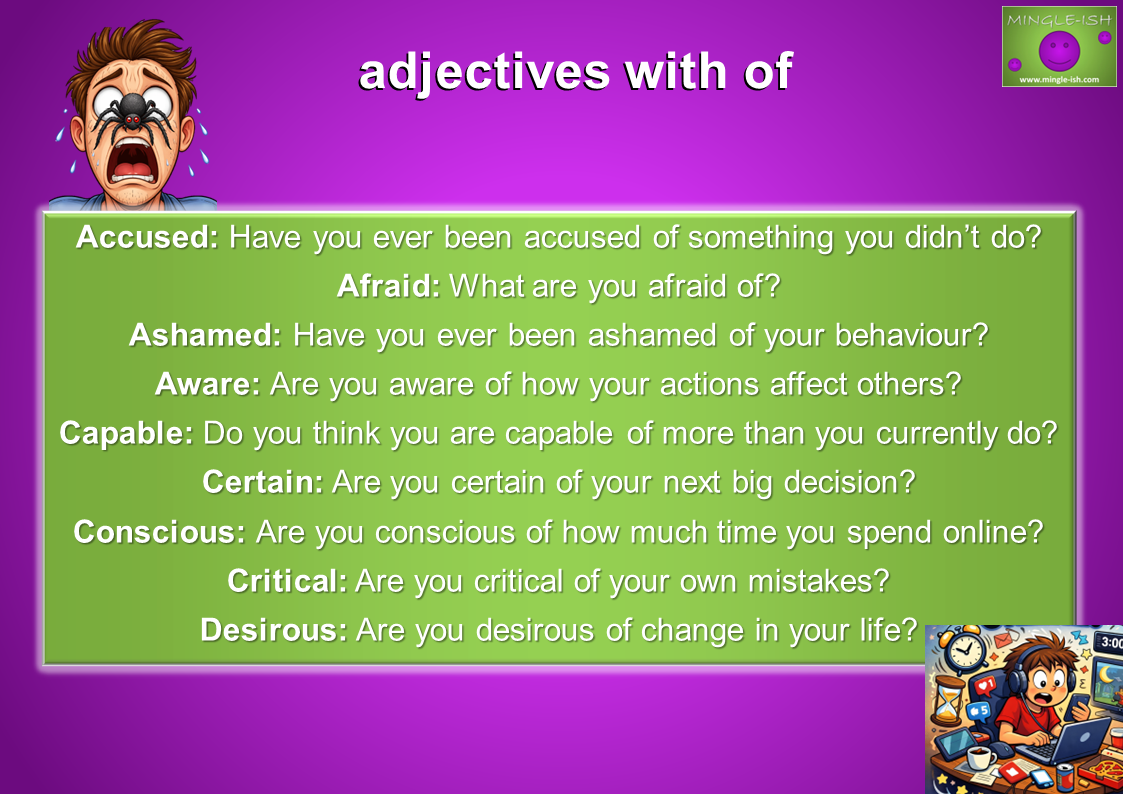
  • Accused: Have you ever been accused of something you didn’t do?
  • Afraid: What are you afraid of?
  • Ashamed: Have you ever been ashamed of your behaviour?
  • Aware: Are you aware of how your actions affect others?
  • Capable: Do you think you are capable of more than you currently do?
  • Certain: Are you certain of your next big decision?
  • Conscious: Are you conscious of how much time you spend online?
  • Critical: Are you critical of your own mistakes?
  • Desirous: Are you desirous of change in your life?
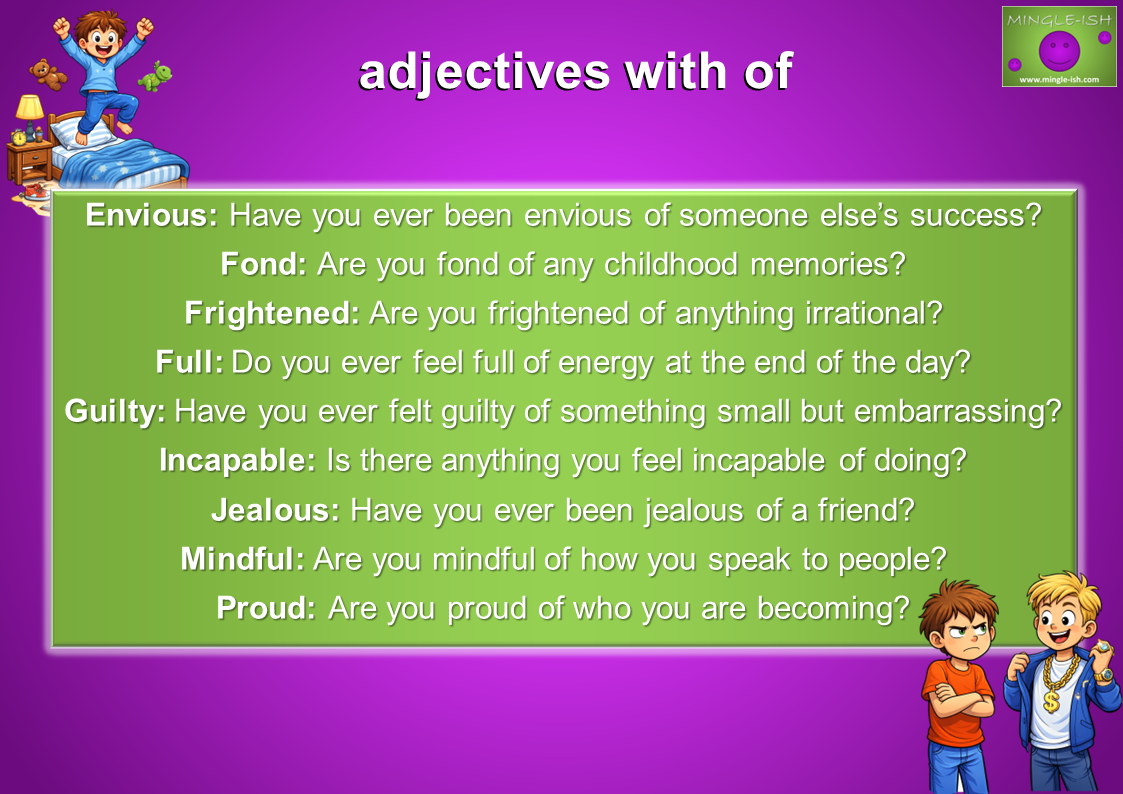
  • Envious: Have you ever been envious of someone else’s success?
  • Fond: Are you fond of any childhood memories?
  • Frightened: Are you frightened of anything irrational?
  • Full: Do you ever feel full of energy at the end of the day?
  • Guilty: Have you ever felt guilty of something small but embarrassing?
  • Incapable: Is there anything you feel incapable of doing?
  • Jealous: Have you ever been jealous of a friend?
  • Mindful: Are you mindful of how you speak to people?
  • Proud: Are you proud of who you are becoming?
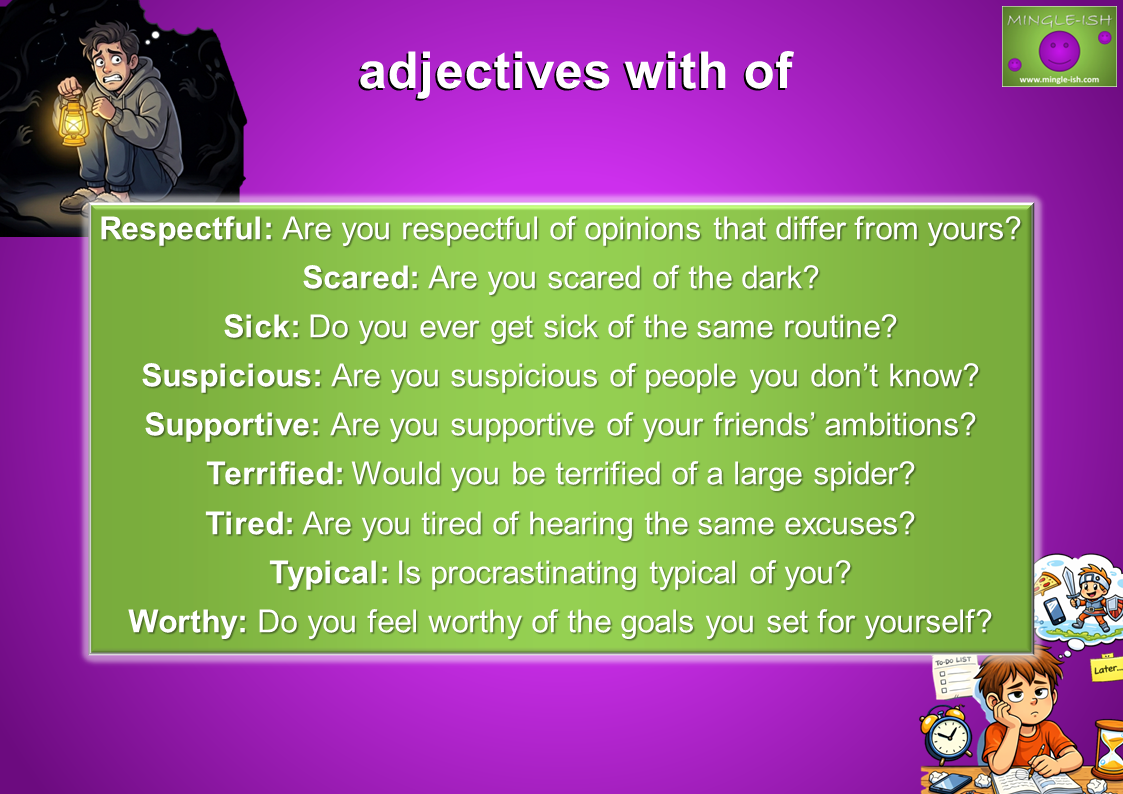
  • Respectful: Are you respectful of opinions that differ from yours?
  • Scared: Are you scared of the dark?
  • Sick: Do you ever get sick of the same routine?
  • Suspicious: Are you suspicious of people you don’t know?
  • Supportive: Are you supportive of your friends’ ambitions?
  • Terrified: Would you be terrified of a large spider?
  • Tired: Are you tired of hearing the same excuses?
  • Typical: Is procrastinating typical of you?
  • Worthy: Do you feel worthy of the goals you set for yourself?
Infographic of English adjectives paired with the preposition "of," featuring conversational examples and Mingle-ish style illustrations.
Educational infographic displaying English adjectives paired with the preposition "of," featuring conversational practice questions and Mingle-ish style illustrations.
Grammar infographic showcasing a third list of English adjectives paired with the preposition "of," including conversational questions and colorful Mingle-ish illustrations.

Adjectives with On

On is the “surface” preposition. It likes things sitting on top of something. Your coffee on the table, your hat on your head, your cat on your laptop the moment you need it. It’s all about contact with a surface. But it also appears in time and tech, like a meeting on Monday or a show on TV. Basically, if something is resting or happening on something, on is doing the work.

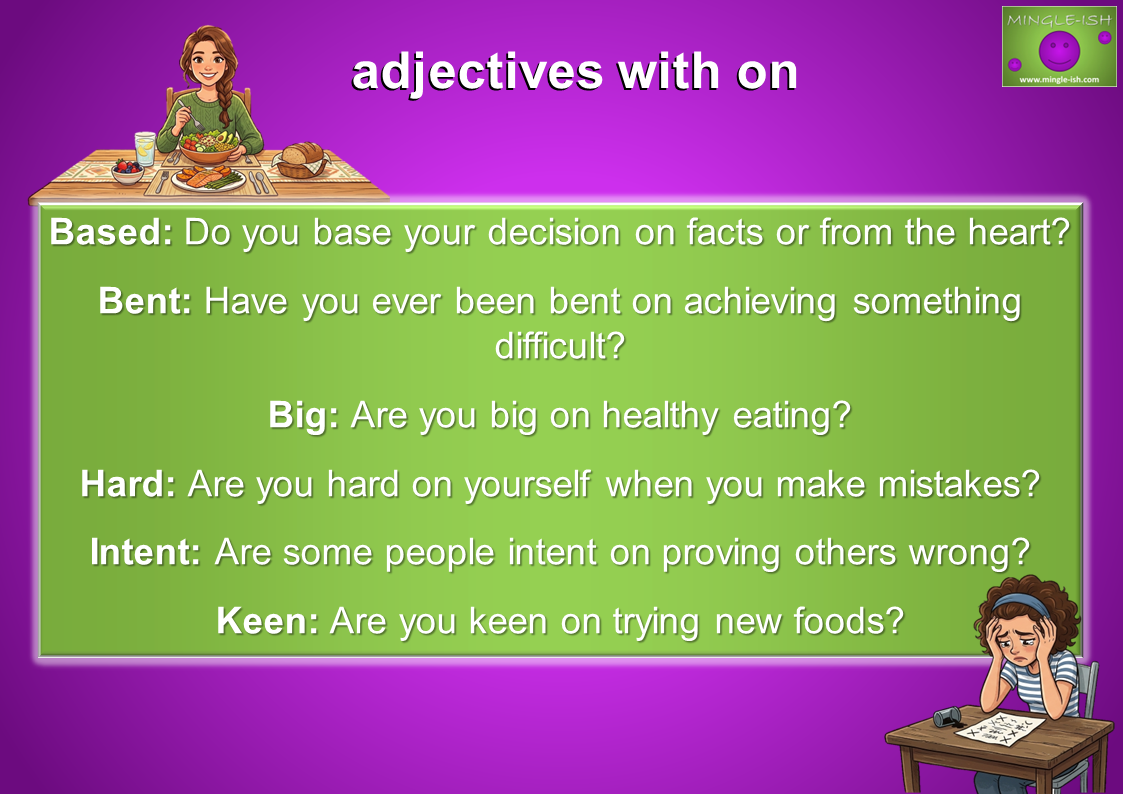
  • Based: Do you base your decision on facts or from the heart?
  • Bent: Have you ever been bent on achieving something difficult?
  • Big: Are you big on healthy eating?
  • Hard: Are you hard on yourself when you make mistakes?
  • Intent: Are some people intent on proving others wrong?
  • Keen: Are you keen on trying new foods?
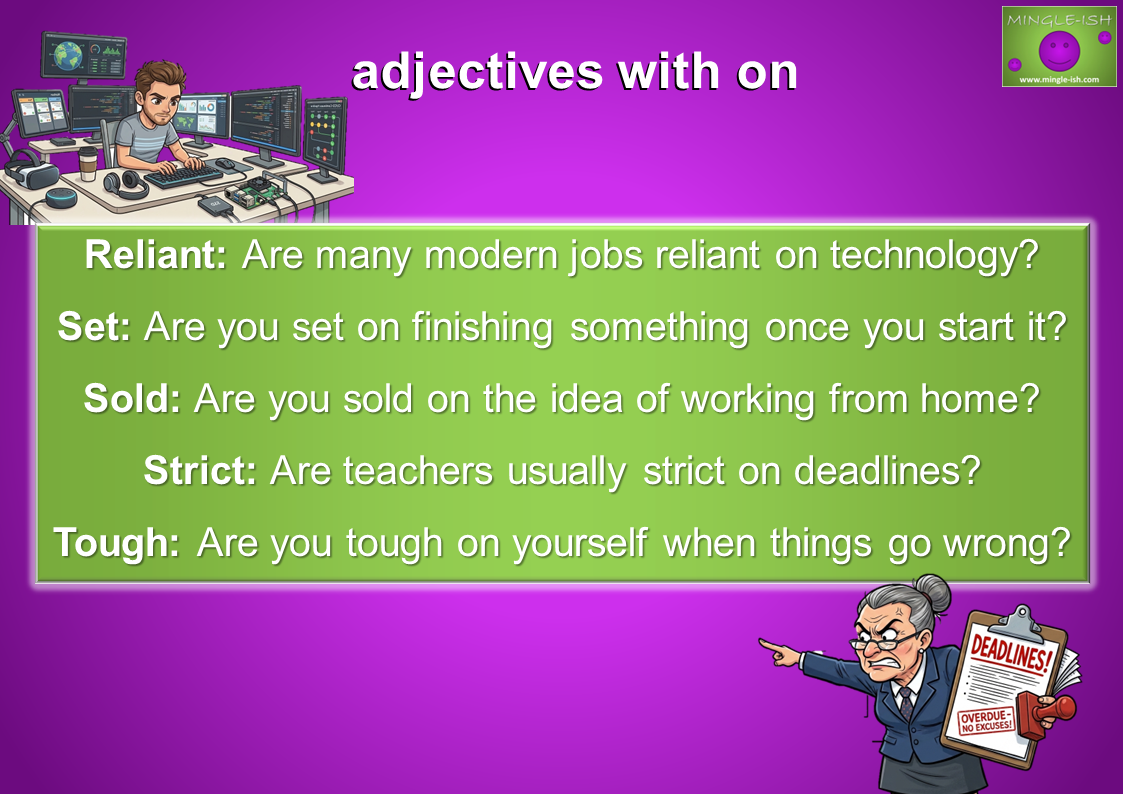
  • Reliant: Are many modern jobs reliant on technology?
  • Set: Are you set on finishing something once you start it?
  • Sold: Are you sold on the idea of working from home?
  • Strict: Are teachers usually strict on deadlines?
  • Tough: Are you tough on yourself when things go wrong?
Examples of adjectives with the preposition on including based on, bent on, big on, hard on, intent on, and keen on with question examples for ESL and EFL learners.
Examples of adjectives with the preposition on including reliant on, set on, sold on, strict on, and tough on with question examples for ESL and EFL learners.

Adjectives with To

To is the “direction” preposition. It loves pointing things somewhere. Go to the park, send a message to your friend, or hand your coffee to your cat (don’t ask me why they always get it first). It’s all about movement, targets, or destinations—physical, mental, or emotional. Basically, if something is heading somewhere or being aimed at someone, to is quietly doing the job.

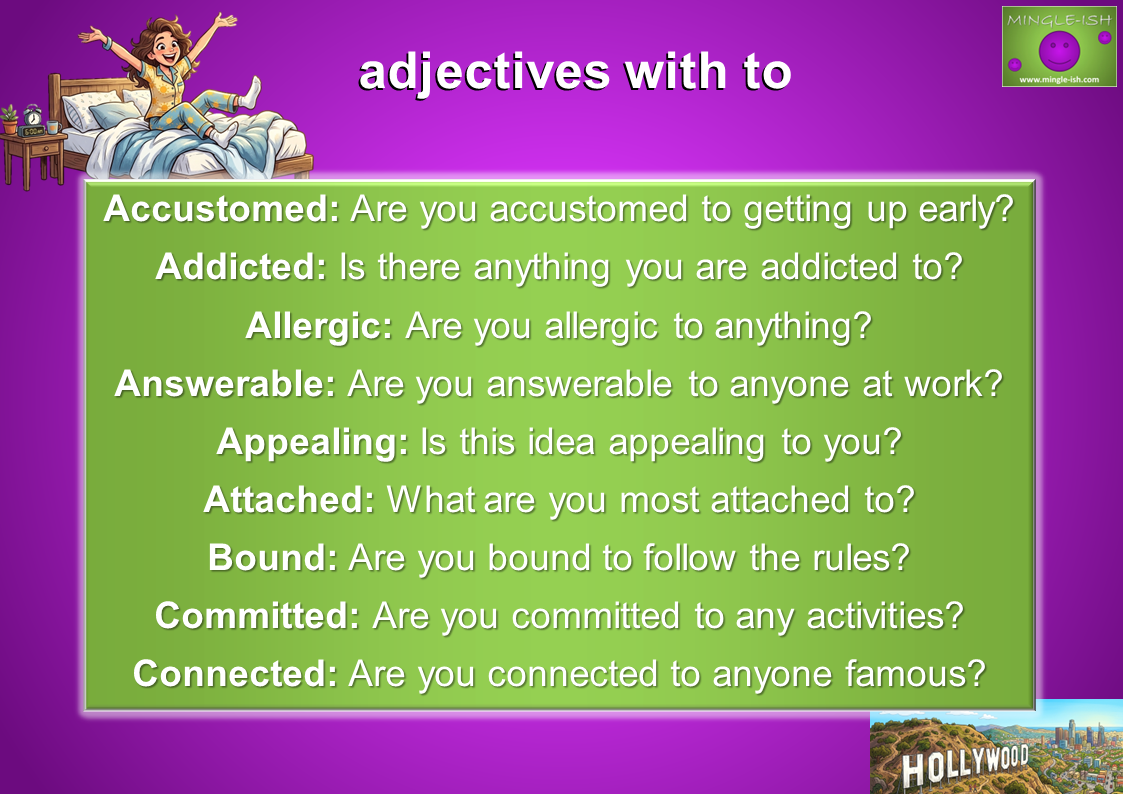
  • Accustomed: Are you accustomed to getting up early?
  • Addicted: Is there anything you are addicted to?
  • Allergic: Are you allergic to anything?
  • Answerable: Are you answerable to anyone at work?
  • Appealing: Is this idea appealing to you?
  • Attached: What are you most attached to?
  • Bound: Are you bound to follow the rules?
  • Committed: Are you committed to any activities?
  • Connected: Are you connected to anyone famous?
  • Dedicated: Are you dedicated to your job or is it just a means to an end?
  • Devoted: Have you ever been devoted to anyone?
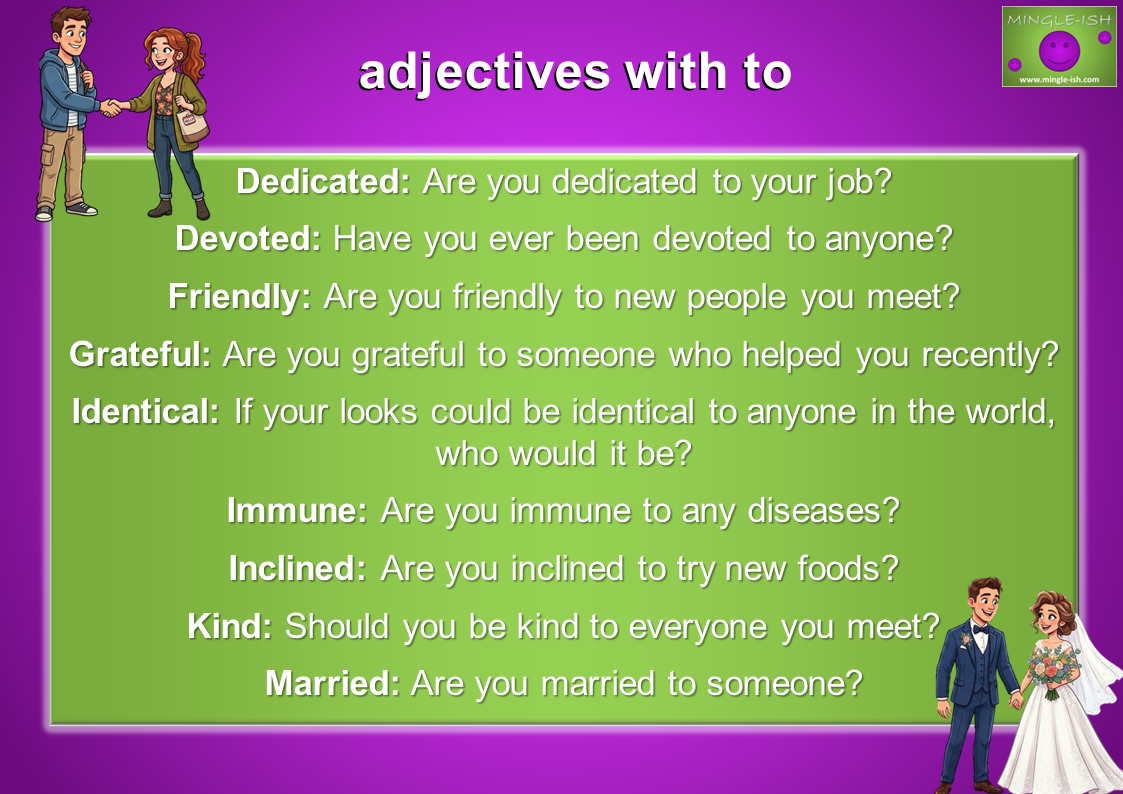
  • Friendly: Are you friendly to new people you meet?
  • Grateful: Are you grateful to someone who helped you recently?
  • Identical: If your looks could be identical to anyone in the world, who would it be?
  • Immune: Are you immune to any diseases?
  • Inclined: Are you inclined to try new foods?
  • Kind: Should you be kind to everyone you meet?
  • Married: Are you married to someone?
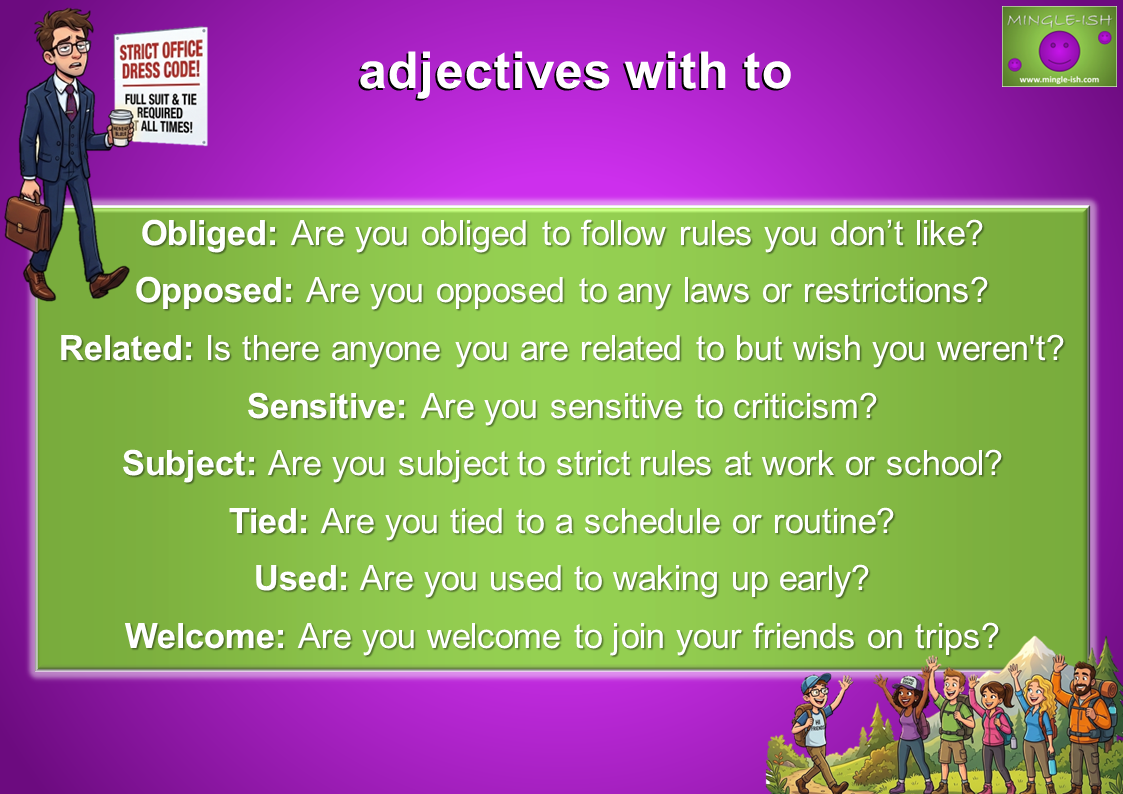
  • Obliged: Are you obliged to follow rules you don’t like?
  • Opposed: Are you opposed to any laws or restrictions?
  • Related: Is there anyone you are related to but wish you weren’t?
  • Sensitive: Are you sensitive to criticism?
  • Subject: Are you subject to strict rules at work or school?
  • Tied: Are you tied to a schedule or routine?
  • Used: Are you used to waking up early?
  • Welcome: Are you welcome to join your friends on trips?
Adjectives with “to” examples in English grammar including accustomed to, addicted to, allergic to, answerable to, appealing to, attached to, bound to, committed to, and connected to.
Educational infographic titled "adjectives with to" listing adjectives like Dedicated, Devoted, and Friendly with example questions and cartoon characters.
Educational infographic titled "adjectives with to" featuring a list of eight adjectives like Obliged, Sensitive, and Welcome with example questions and cartoon illustrations of a businessman and hikers.

Adjectives with With

With is the “together” preposition. It loves company. Drink your coffee with sugar, go to the park with a friend, or tackle a project with enthusiasm. It’s all about having something along for the ride, being involved, or showing a connection. Basically, if two things are hanging out, linked, or acting together, with is quietly doing the magic.

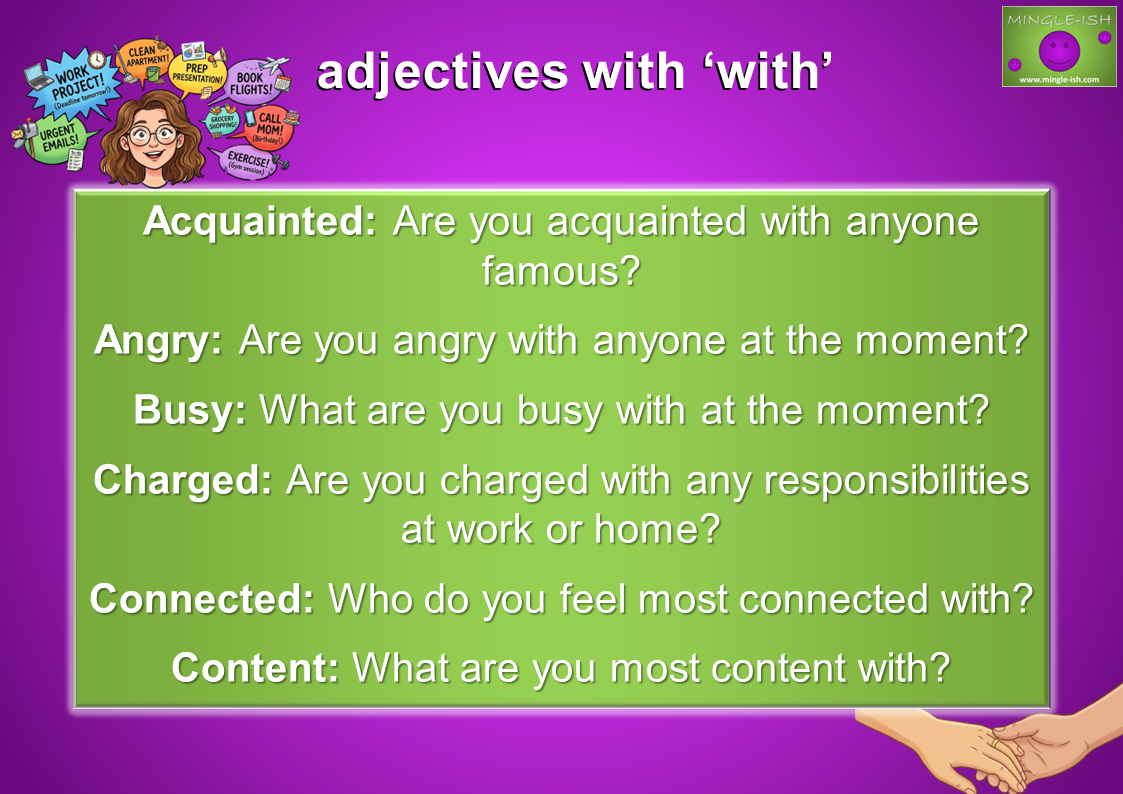
  • Acquainted: Are you acquainted with anyone famous?
  • Angry: Are you angry with anyone at the moment?
  • Busy: What are you busy with at the moment?
  • Charged: Are you charged with any responsibilities at work or home?
  • Connected: Who do you feel most connected with?
  • Content: What are you most content with?
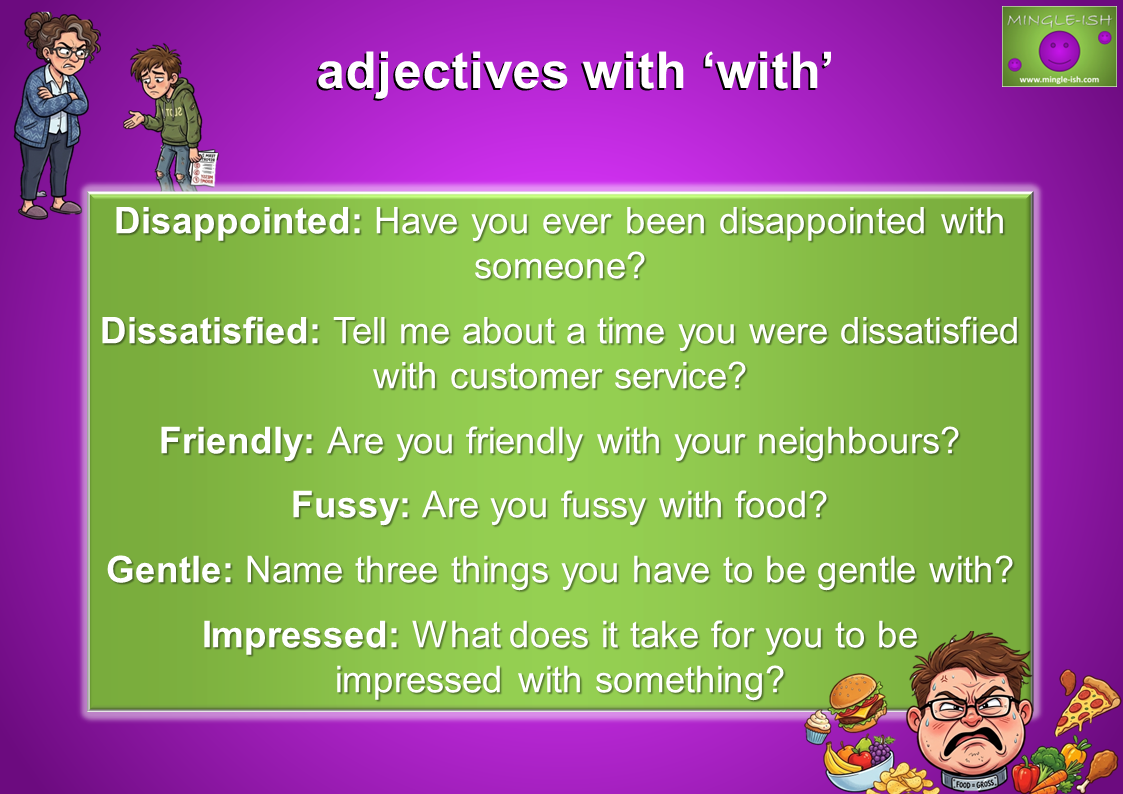
  • Disappointed: Have you ever been disappointed with someone?
  • Dissatisfied: Tell me about a time you were dissatisfied with customer service?
  • Friendly: Are you friendly with your neighbours?
  • Fussy: Are you fussy with food?
  • Gentle: Name three things you have to be gentle with?
  • Impressed: What does it take for you to be impressed with something?
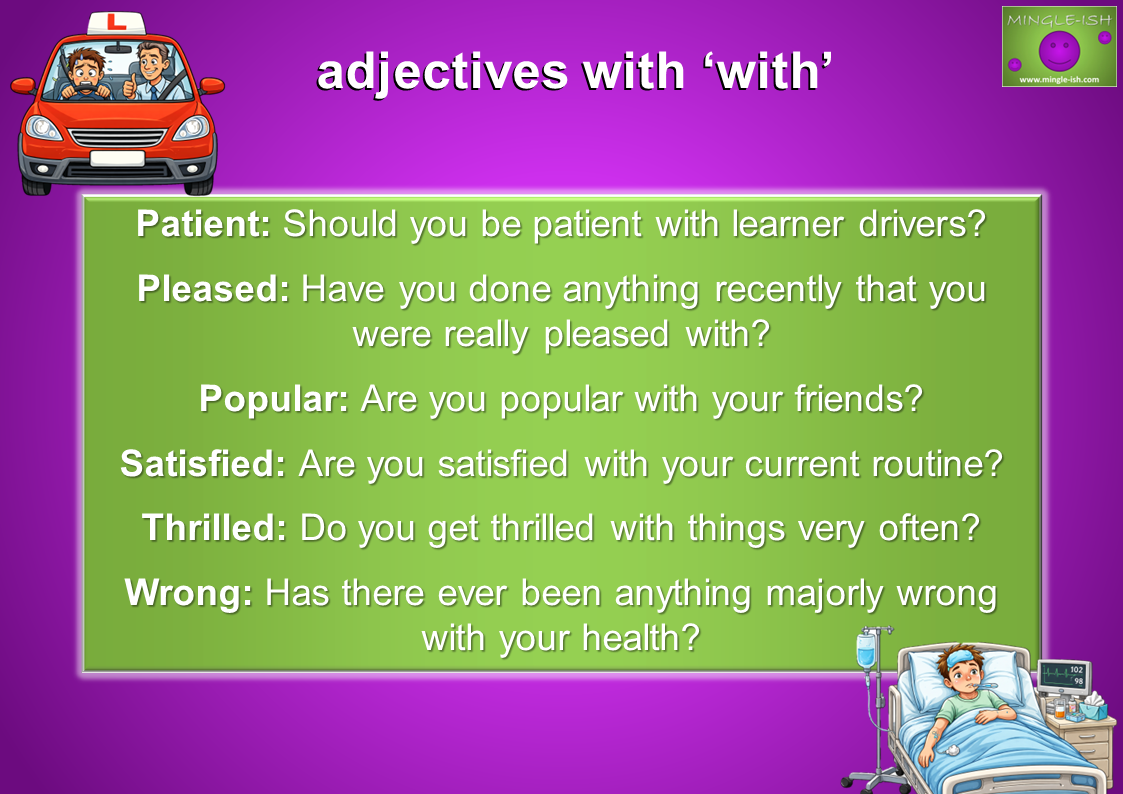
  • Patient: Should you be patient with learner drivers?
  • Pleased: Have you done anything recently that you were really pleased with?
  • Popular: Are you popular with your friends?
  • Satisfied: Are you satisfied with your current routine?
  • Thrilled: Do you get thrilled with things very often?
  • Wrong: Has there ever been anything majorly wrong with your health?
Educational infographic titled "adjectives with 'with'" listing seven adjectives such as Acquainted, Busy, and Content with example questions and cartoon illustrations of a busy woman and holding hands.
Educational infographic titled "adjectives with 'with'" listing six adjectives including Disappointed, Dissatisfied, and Fussy with example questions and cartoon illustrations of a disappointed mother and a man disgusted by food.
Educational infographic titled "adjectives with 'with'" listing six adjectives including Patient, Pleased, and Popular with example questions and cartoon illustrations of a driving lesson and a person in a hospital bed.

You can download a table of adjectives with prepositions below and study it in your own time.

Adjectives with Prepositions for Exams (B1, B2, C1)

If you are preparing for English exams like IELTS, FCE, or other Cambridge tests, adjective and preposition combinations are everywhere. These little partnerships love appearing in grammar questions, sentence transformations, and multiple-choice tasks. One tiny preposition in the wrong place and suddenly the sentence looks completely wrong.

That is because many adjectives naturally stick to a specific preposition. Think of them like grammar best friends. Accustomed to, interested in, afraid of, good at. Swap the preposition and the sentence stops sounding natural.

Exams such as B1, B2, and C1 Cambridge English tests, as well as IELTS grammar sections, often check whether you recognise these combinations. They may ask you to complete a sentence, correct a mistake, or choose the right preposition from a list. It looks simple, but it is an easy place to lose marks if you are guessing.

The good news is that once you start noticing these adjective + preposition pairs, they become much easier to remember. Treat them as fixed phrases rather than trying to figure them out logically every time. Learn the pattern once, and suddenly a whole group of exam questions becomes much less scary.

Common Mistakes with Adjectives and Prepositions

Adjective and preposition combinations can trip people up because English loves fixed partnerships. Change the preposition, and suddenly the sentence sounds odd. Here are some of the most common mistakes learners make.

  • Using the wrong preposition: Some adjectives only work with a specific preposition. For example, learners might say interested on or good in maths, but the correct forms are interested in and good at maths.
  • Copying patterns from another language: Many languages use different prepositions, which can lead to sentences like married with someone or afraid from spiders. English prefers married to someone and afraid of spiders.
  • Leaving the preposition out completely: Sometimes the adjective is correct, but the preposition disappears. For example, I’m interested this topic or She’s good maths. These should be interested in this topic and good at maths.
  • Using the wrong adjective + preposition pair: Some combinations simply don’t exist in English. For example, learners may say responsible of instead of responsible for, or capable to instead of capable of.
  • Mixing up similar adjectives: Certain adjectives look similar but use different prepositions. For example, angry with someone but angry about something, or good at something but good for something.
  • Forgetting that some adjectives change meaning with different prepositions: The preposition can change the meaning of the adjective. For example, good at maths (skilled) vs good for your health (beneficial).
  • Overusing one preposition: Some learners rely too heavily on common prepositions like of, to, or for, even when they are incorrect. For example, different than instead of different from (especially in formal contexts).
  • Guessing the preposition instead of learning the pair: Because these combinations often don’t follow clear rules, guessing can easily lead to mistakes. It is usually better to learn them as fixed phrases, such as afraid of, interested in, keen on, or responsible for.


Once you start thinking of them as little grammar teams, rather than separate words, they become much easier to remember.

FAQ: Adjectives with Prepositions

Adjective and preposition combinations raise a lot of questions because English doesn’t always follow neat little rules. Sometimes it feels like the language just picked a preposition and said, “Right, that’s the one. No arguments.” Below are some of the most common questions learners search for.

What preposition comes after interested?

The correct combination is interested in.
Example: She is interested in learning Spanish.

English does not normally use interested on or interested about in this structure. The adjective interested almost always pairs with in.

Is it good at or good in?

In most situations, the correct phrase is good at.

Example:

  • He is good at maths.
  • She is good at cooking.

Sometimes you may see good in when talking about performance in a specific situation, such as good in interviews, but good at is the most common structure learners need to remember.

What preposition comes after afraid?

The adjective afraid is normally followed by of.

Example:
Are you afraid of spiders?

This is one of the most common adjective + preposition combinations in English.

What preposition comes after keen?

The correct form is keen on.

Example:
Are you keen on trying new foods?

This structure is especially common in everyday conversation.

Do adjective prepositions have rules?

Not really. Unfortunately, English did not design a tidy rulebook for these combinations. Most adjective + preposition pairs developed naturally over time, which means they often have to be learned as fixed phrases.

Are adjective and preposition combinations fixed?

Many of them are. For example:

  • interested in
  • good at
  • afraid of
  • keen on
  • responsible for

Changing the preposition usually makes the sentence sound unnatural.

Why are adjective prepositions difficult for ESL learners?

They can be tricky because different languages use different prepositions. A phrase that works perfectly in one language might use a completely different preposition in English.

How can I learn adjective and preposition combinations faster?

A good strategy is to learn them as pairs, rather than learning the adjective and preposition separately. Treat them like small grammar teams that always travel together.

Examples include:

  • addicted to
  • interested in
  • proud of
  • responsible for
  • good at

Once you start noticing these patterns, they become much easier to remember.

Keep Learning: Explore More English Grammar

Loved learning about adjectives with prepositions? There’s plenty more to explore. English grammar is full of patterns like this, and the more you see them in context, the easier they stick.

Next, try phrasal verbs—they rely on small words like prepositions to completely change a verb’s meaning. Or dive into a full guide to English prepositions, which quietly connect ideas, show direction, time, place, and relationships.

You can also explore a bigger list of English adjectives with examples, tackle essential B1 grammar topics, or test yourself with fun vocabulary and grammar quizzes.

Keep practising, and soon these little grammar partnerships will feel completely natural.